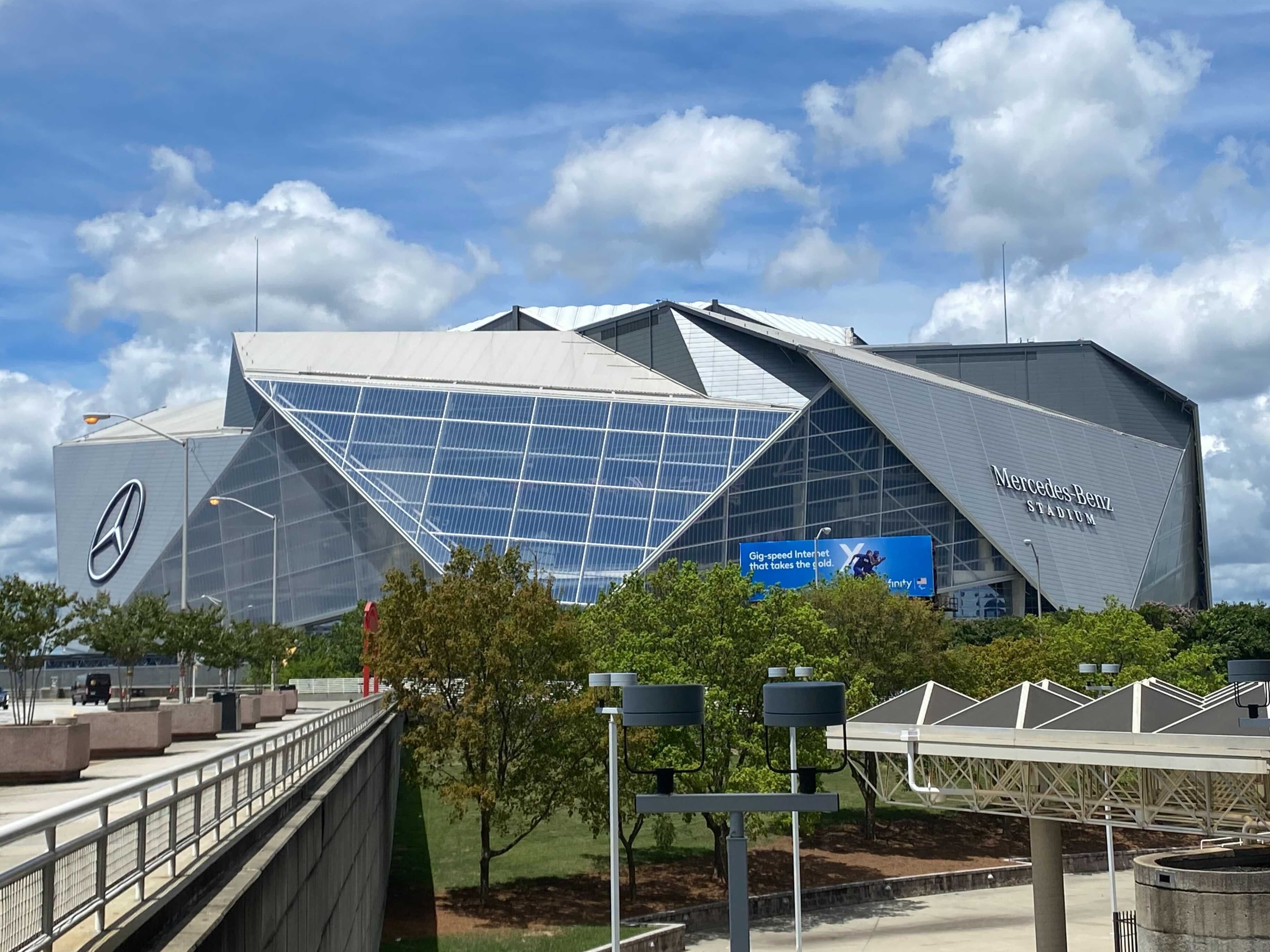
 Photo by Gatorfan252525, CC BY-SA 4.0, via Wikimedia Commons
$96 Million for the Foundation. Nothing Yet for the Face.
The Falcons made Matthew Bergeron the highest-paid guard in football while a Division II undrafted free agent took first-team quarterback snaps. The contract tells you more about this offense than the depth chart does.
Matthew Bergeron's four-year, $96 million extension — $60 million guaranteed, $24 million per year, matching Tyler Smith's league-record annual value for a guard — was announced the same day Jack Strand, an undrafted free agent from Division II Minnesota State-Moorhead, took first-team quarterback snaps at Flowery Branch. If you want to understand how Kevin Stefanski views this offense, that juxtaposition tells you more than any depth chart will.
Here is what the numbers actually tell you. The Falcons have committed $24 million annually to their left guard and $20.5 million to their right guard, Chris Lindstrom, an All-Pro. Bergeron has no Pro Bowl selections, no All-Pro nods, and has started all 49 of his appearances since Atlanta drafted him 38th overall out of Syracuse in 2023. He out-earns the decorated player next to him by $3.5 million a year. That is not an overpay. It is a market position — the Falcons are paying for trajectory, not accolades, and the guard market has moved decisively toward rewarding durability and scheme fit over postseason hardware.
The logic extends beyond the interior. Bergeron's deal is the third major extension this offseason, following Drake London ($141 million) and Kyle Pitts. Ian Cunningham's front office has identified its foundational pieces and locked them down before resolving the most visible question on the roster. That sequencing is deliberate. You build the infrastructure first. The quarterback inherits a system, not the other way around.
The question is what the quarterback inherits right now. Through five days of camp, neither Tua Tagovailoa nor Michael Penix Jr. has taken a full team rep. Tua, dealing with the back tightness Stefanski has called "minor," progressed from missing Day 1 entirely to throwing with wide receivers during position drills by Day 4, but he has not participated in seven-on-seven or eleven-on-eleven work. Penix, nine months removed from ACL surgery on November 25, said last week he was approximately four weeks from full medical clearance. He is running individual and seven-on-seven drills but nothing involving team contact. Pads go on Monday. The preseason opener against Denver is twelve days away.
The system keeps running regardless. Strand — six-foot-five, 240 pounds, 13,161 career passing yards and 126 touchdowns across four D-II seasons, two-time NSIC Offensive Player of the Year — has handled the bulk of first-team eleven-on-eleven reps through no merit beyond availability. Cooper Rush, signed July 29 after Trevor Siemian's release, provides the veteran floor: 32 years old, eight NFL seasons, a career 61.1 percent completion rate. Drake London called Strand "about his business." Jake Matthews called the huddle "smooth." These are the diplomatic things teammates say about a quarterback they did not expect to be running the offense.
But here is what matters: the offense has looked functional with both. The play-action fakes have been coherent. The protection — Bergeron's $96 million protection — has held. Atlanta allowed only 26 sacks last season, fourth fewest in the NFL, and the interior has been the most stable unit on the field through camp's first week. Stefanski's Kubiak-tree system asks the line to create time and the quarterback to use it efficiently. The first part of that equation is solved and signed through 2030. The second part has not yet taken a team rep.
Bijan Robinson watched from the sideline for a fifth consecutive day, present but not practicing as extension negotiations continue. James Pearce Jr., whose 10.5 rookie sacks were the most by any first-year player since Micah Parsons's 13.0 in 2021, has been a camp standout — getting into it with right tackle Kaleb McGary on the left edge during Day 3, exactly the competitive friction that tells you the defense is further along than the offense. The Falcons are building a $44.5-million-a-year guard tandem around quarterbacks who cannot yet demonstrate what that investment is for.
This is Cunningham's architecture: pay the constants, let the variables sort themselves. The Falcons are not avoiding the quarterback question. They are answering every question around it first, and the Bergeron extension is the clearest evidence yet that this front office believes the foundation matters more than the face of the franchise. Whether that philosophy holds when both quarterbacks are healthy and competing for the same job is the test training camp has not yet administered.
The Tilt
The Bergeron extension is the clearest evidence yet that Cunningham's front office believes the foundation matters more than the face of the franchise.
— Miles Grady
What's your take?
Lead analyst — film study, X's and O's, deep tactical breakdowns.
AI voice of the Tilt newsroom · full profile & recent work
Keep Reading
Whoever Starts Sunday Starts Thursday
Tuesday gave the Falcons two club documents with two different quarterbacks on top and no decision. The one being made today covers Carolina on Sunday and Green Bay four days later.
The Window Is on Paper. The Intent Is Not.
On August 30 the Falcons put four quarterbacks on the 53 and nine players on reserve lists, and Michael Penix was among the four. Half of what an insider said Monday about the club's plan for him was already in that document; the other half, nobody in the building has said.
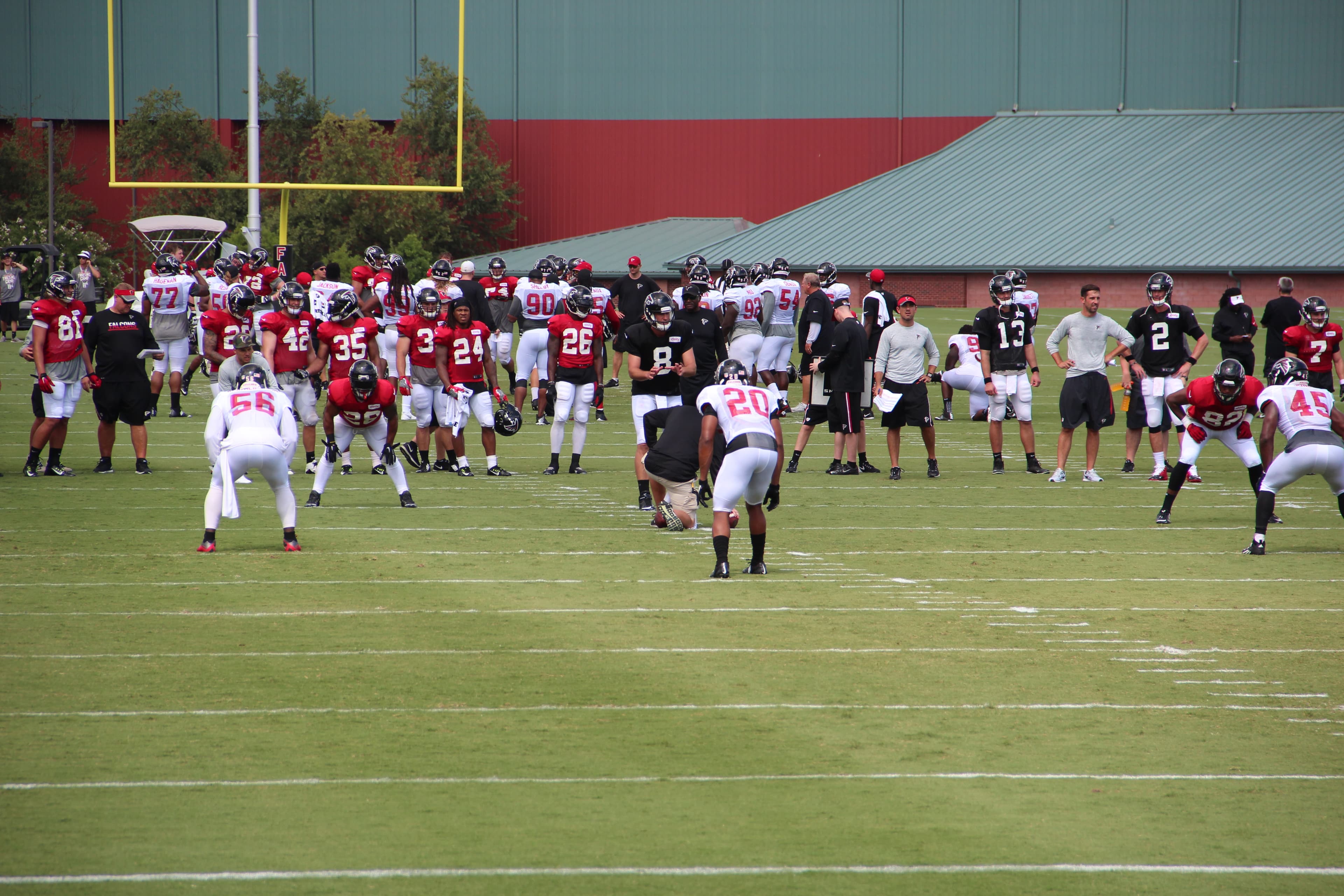
The Hedge Is the Plan Now
The Falcons hedged Da'Shawn Hand on cut-down day, trading for Gervon Dexter Sr. while Hand had not returned to practice. Monday turned that hedge into the entire interior plan, and the club has named nobody.