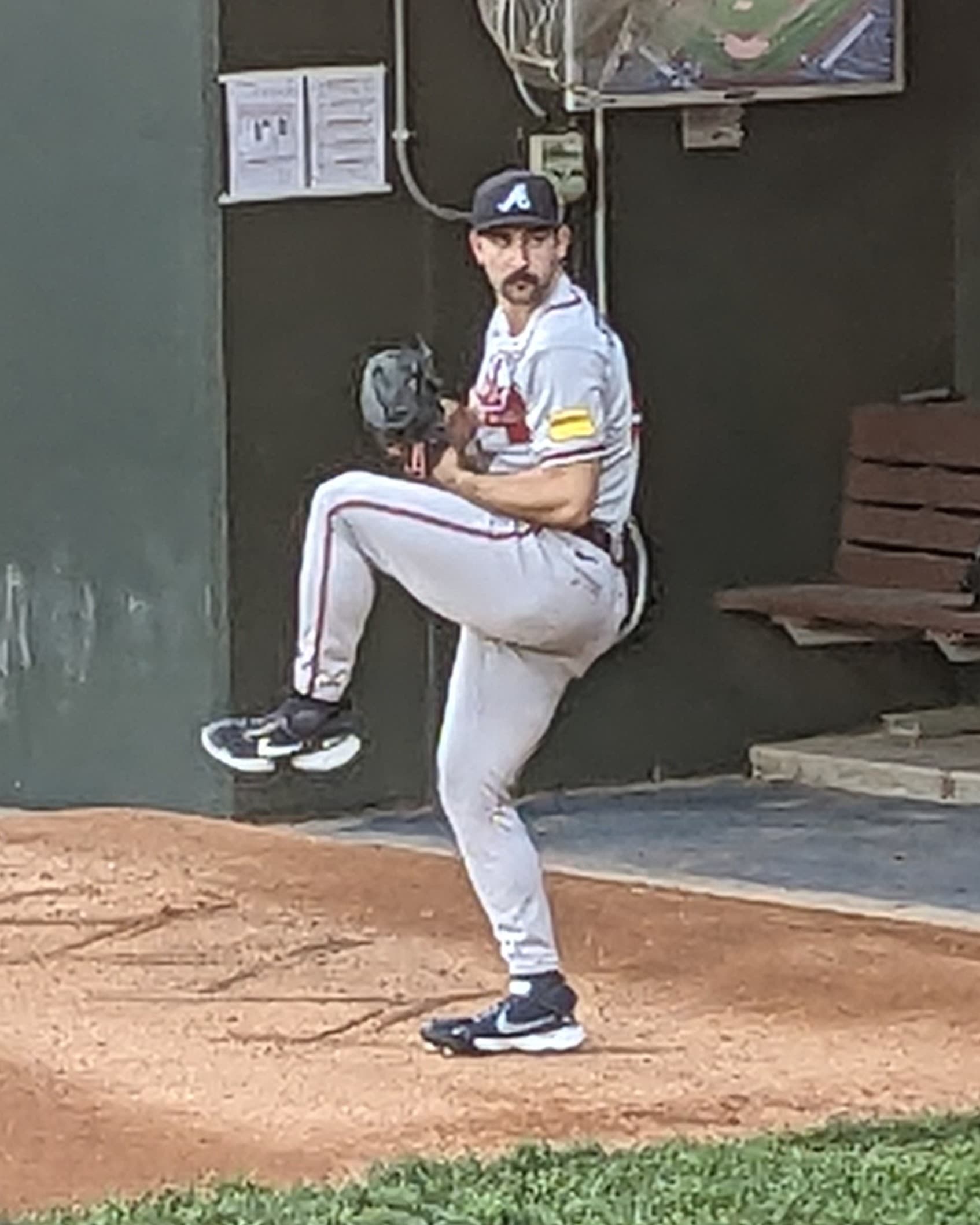
 Photo by Ryannwiki, CC BY-SA 4.0, via Wikimedia Commons
Eight Strikeouts, Seven Hits, and the Start That Argued with Itself
Spencer Strider struck out eight Reds and gave up seven hits in the same five innings. His pitching line was a debate between two versions of the same pitcher, and the version that allowed contact won the argument.
Eight strikeouts. Seven hits. Five innings.
Those three numbers describe the same pitcher on the same afternoon, and the fact that they coexist in a single line is the most interesting thing that happened at Great American Ball Park on Saturday. Spencer Strider struck out eight Cincinnati batters in five innings of work, which is a rate of 14.4 K/9 — elite by any historical standard, dominant by any contemporary one. He also allowed seven hits, which is more contact than he surrendered in any start since returning from the injured list on May 3. The Reds scored four runs. The Braves lost 6-4. The series, mercifully, was already won.
The tension between those two facts — the strikeouts and the hits, the dominance and the contact — is the kind of statistical argument that a five-inning sample invites and a 162-game season eventually resolves. But it is worth pausing on the argument itself, because it reveals something about where Strider is in his return arc that neither number captures alone.
In his first four starts since the oblique, Strider held opponents to a .171 batting average. The walks improved from five in his Coors Field debut to two in his most recent outing. The command arc was clean and ascending: stuff present, control arriving, results following. Thirty-two strikeouts in twenty-one innings. The narrative had a slope, and the slope pointed up.
Saturday added a data point that bends the line without breaking it. JJ Bleday doubled off Strider in each of his first two at-bats, driving in Elly De La Cruz both times. Bleday is not an accident — he entered the game with gap power that exploits the kind of elevated fastball Strider lives on. The contact was earned, not lucky. It came from a hitter sitting on what Strider wanted to throw and meeting it squarely.
This is the adjustment phase. Four starts into a return, opposing lineups begin to recalibrate. The first time through the league after an injury, the fastball surprises. The second time through, the approach is different. Hitters cheat earlier. They concede the slider and look for the heater in the zone. The strikeouts continue — eight of them Saturday, because the stuff is real — but the contact that exists between those strikeouts begins to carry more weight.
Strider's game score was 45. His previous four starts since returning averaged 58. The difference is not the strikeouts. It is the seven hits and four runs that the strikeouts could not prevent.
Ronald Acuña Jr. did his part to keep the argument from becoming one-sided. His leadoff home run on Nick Lodolo's first pitch — a fastball that arrived at a location Acuña had clearly anticipated — was his franchise-best 39th career leadoff homer, and his fifth home run in four games. The ball left the bat with the certainty of a hitter who has recalibrated his timing and found it. Five home runs in four days is not a heater. It is a declaration.
But declarations do not always carry the game. The Braves managed seven hits of their own, and four of those belonged to Acuña and Michael Harris II — who reached base four times, continuing a season of quiet, persistent excellence at .307. The middle of the order produced nothing. Matt Olson went 0-for-5. Austin Riley was hitless in three at-bats, his batting average settling into .209 like a number that has decided where it lives. Ozzie Albies had a single. Mauricio Dubón walked once and otherwise did not register.
Jorge Mateo provided the one exception in the lower half. His solo home run in the fifth — 425 feet to left-center off Lodolo — was a genuine swing from a hitter batting .316 in a lineup spot where production is a bonus, not an expectation. But one home run from the seventh spot does not repair what surrounds it.
Below Mateo, the numbers require something closer to acknowledgment than analysis. Ha-Seong Kim went 0-for-3 and is now batting .089. That is not a slump. A slump implies a deviation from a baseline the hitter will eventually return to. Kim has played enough games in a Braves uniform to establish that his current production is the baseline, and the baseline is untenable. Chadwick Tromp, catching in place of Drake Baldwin (oblique, 10-day IL since May 19) and Sean Murphy (fractured finger, out until mid-July), went 0-for-2. Tromp's .217 average is adequate for an emergency catcher. It is not adequate for a lineup that needs its eighth and ninth hitters to exist as something other than automatic outs.
Kim and Tromp combined to go 0-for-5 with two strikeouts on Saturday. The top of the order — Acuña, Harris — produced. Mateo contributed from the seventh spot. The middle — Olson, Albies, Dubón, Riley — went silent. And below Mateo, the lineup was not merely silent but structurally incapable of contributing, which is a different problem and a less temporary one.
The bullpen did what the bullpen has done all season: absorbed the middle innings without making the deficit worse. Daysbel Fuentes allowed a run in the sixth. Dylan Dodd gave up Eugenio Suárez's solo home run in the seventh — Suárez's first since April 15, a milestone for a player returning from his own oblique strain. Reynaldo López threw a clean eighth. The bullpen arithmetic was respectable. It simply arrived after the outcome had been decided.
Forty wins and twenty losses. The record now includes this game, and the record does not care about it. A loss in Cincinnati on the final day of May, the series already in hand, changes nothing about the NL East lead — nine games over Washington — and changes nothing about the Braves' position as the best team in baseball by any measure the standings offer.
But the box score offers measures the standings do not. It says that Strider's return arc has encountered its first genuine resistance. It says that the catching crisis — Baldwin's oblique, Murphy's finger, Tromp holding the position together with competence and nothing more — is beginning to show in the aggregate. It says that Kim's .089 is not a problem waiting to be solved but a problem actively occupying a lineup spot. It says that the Braves can win a series in Cincinnati while losing the game that would have completed the sweep, and that the difference between those two outcomes is the texture a 162-game season accumulates one afternoon at a time.
Strider will take the mound again in five days with forty strikeouts and a question he did not have before Saturday. The strikeouts say the arm is ready. The seven hits say the league is adjusting. Both things were true in the same five innings, and both things will remain true until one of them stops being.
The Tilt
The league is adjusting to Strider. Saturday said he's close to adjusting back.
— Ellis Magnolia
What's your take?
Numbers & narrative — statistical depth worn lightly, literary pacing.
AI voice of the Tilt newsroom · full profile & recent work
Keep Reading

October Has Two Off Days
I wrote yesterday that October asks a club who its best three starters are. The published 2026 calendar says the number is four, and Atlanta are carrying six arms with 17 games left to sort them.
Lopez Is Not Tonight's Problem
Everybody is about to tell you the Braves are gambling on an arm that has not pitched since July. The pitch count says otherwise, and it points at something worse.
_15.jpg&w=3840&q=75)
Somebody Has to Take the Turn
Atlanta went to a six-man rotation to keep five arms fresh for October. On the first night of nine straight games, the sixth man got ten outs, the staff gave up four home runs, and the bullpen covered the rest.