 Photo by Atlanta Falcons, CC BY 3.0, via Wikimedia Commons
The $366M Bet and the ACL That Complicates It
The Falcons committed $75 million to the most productive running back in football on Monday, then watched their most promising young edge rusher get carted off the field hours later. What happens when a franchise goes all-in on offense and the defense starts crumbling before the season begins?
The number that tells you everything about where the Falcons are headed is $366 million. That is the combined value of extensions handed to Bijan Robinson ($75 million), Drake London ($141 million), Kyle Pitts ($54 million), and Matthew Bergeron ($96 million) since June. Four offensive players. One offseason. A third of a billion dollars committed before the franchise has named a starting quarterback.
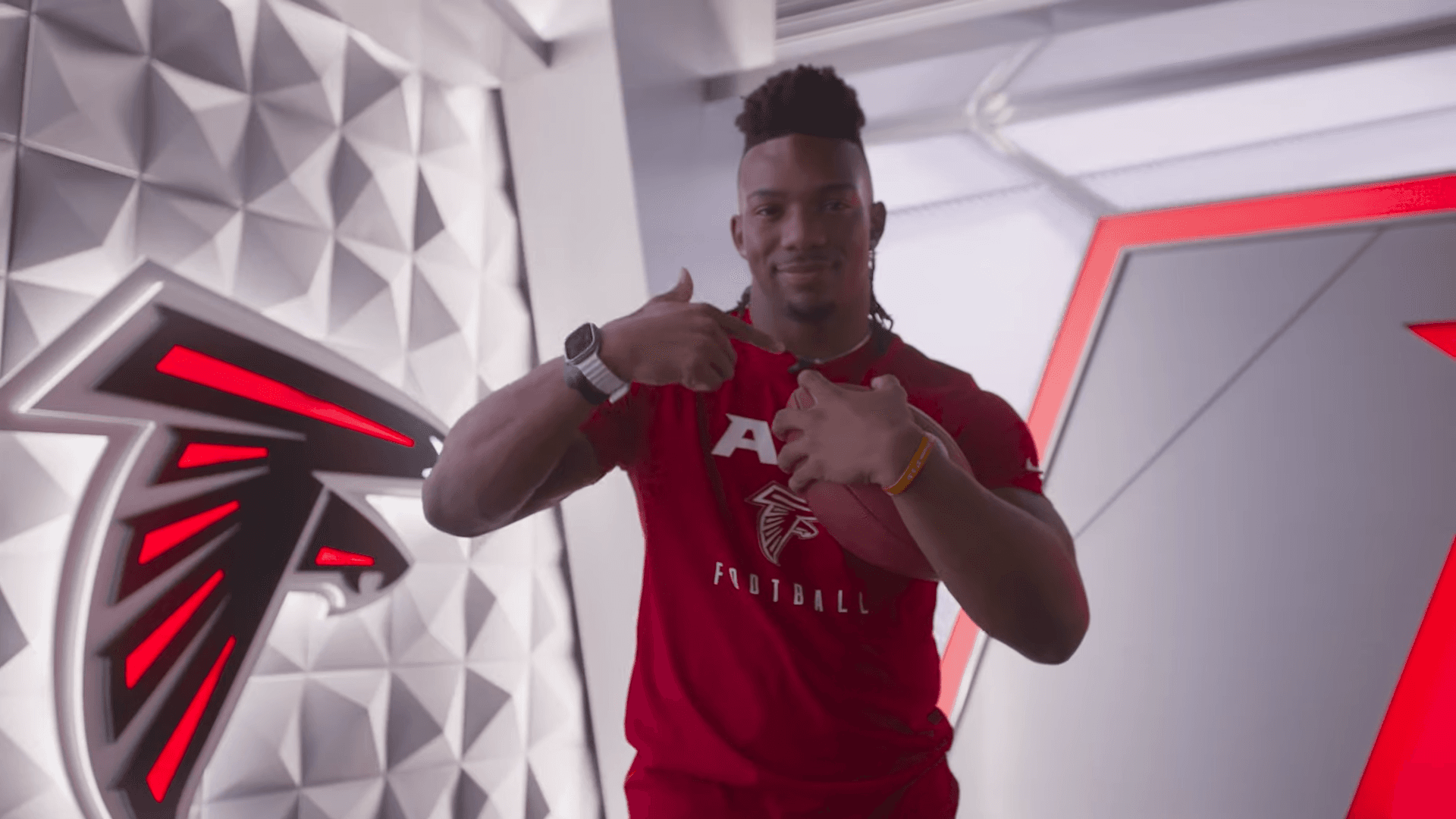
On Monday, Day 6 of training camp, Robinson's three-year extension became official — $51 million guaranteed, $37 million at signing, the highest-paid running back in NFL history by a margin that is not particularly close. His $22.25 million average annual value surpasses Saquon Barkley's $20.6 million AAV with the Eagles by 8 percent. Robinson led the NFL with 2,298 yards from scrimmage in 2025, became the only player in league history to post 1,400-plus rushing yards and 810-plus receiving yards in a single season, and earned first-team All-Pro honors while doing it. The hold-in that started on July 29 lasted exactly one week. Efficient negotiation, no public ugliness, and now Robinson is back on the practice field with a contract that keeps him in Atlanta through 2030.
Here's what the numbers actually tell you: the Falcons are not building around a quarterback. They are building around a system — Kevin Stefanski's Kubiak-tree offense, which treats the run game as the engine and the passing game as the exhaust. Robinson plus Bergeron, the newly minted highest-paid guard in the NFL at $24 million per year, represents $171 million invested in the ground floor of that system. Add London and Pitts, and you have an offensive infrastructure that functions regardless of who is under center. That is not an accident. That is a philosophy.
And then Tuesday happened.
Jalon Walker, the Falcons' 2025 first-round pick out of Georgia — No. 15 overall, the franchise's first Bulldog drafted in the first two rounds — went down during an 11-on-11 two-minute drill period on Day 6 of camp. He was carted off the field. Stefanski ended practice roughly 45 minutes early. The MRI confirmed what the reaction on the sideline suggested: a torn ACL. Walker is done for the 2026 season.
The rookie season that Walker just lost was quietly productive. In 15 games and 9 starts, he logged 5.5 sacks, 9 quarterback hits, 5 tackles for loss, and 2 forced fumbles — the kind of baseline that, for a 22-year-old edge rusher, projects toward something significant in Year 2. That projection is now on hold for at least 12 months.
The defensive math without Walker is uncomfortable. The Falcons drafted Walker and James Pearce Jr. in the 2025 first round specifically to rebuild the pass rush. Pearce is facing a likely NFL suspension stemming from his February arrest and has not been working with the first team. If both are unavailable to open the season — and that is the current trajectory — the Falcons' edge rotation looks like Samson Ebukam (returning from an Achilles tear, 10.6 percent pressure rate in 2025), Azeez Ojulari (a one-year prove-it deal), and Bralen Trice, a 2024 third-round pick who has yet to play an NFL snap due to knee injuries. The free agent market offers Haason Reddick and Leonard Floyd, both past their primes. Neither is a Walker replacement. They are contingency measures for a contingency plan.
This is the structural tension the Falcons now carry into the preseason opener against the Broncos on August 14: a $366 million offensive commitment that assumes the defense will hold up its end, paired with a defensive edge that has lost its two highest-drafted pieces before Week 1. The quarterback situation — Tua Tagovailoa in 11-on-11 team drills, Michael Penix Jr. still limited to 7-on-7 as he works through his third career ACL tear (approximately four more weeks from clearance), Cooper Rush absorbing first-team two-minute reps by circumstance rather than competition — exists within this larger resource allocation question. Stefanski has the offensive infrastructure locked in. What he does not have is a pass rush that can create the negative plays his defense needs to make the math work.
There is historical precedent for the offense-first approach. The 2018 Chiefs, the 2011 Packers, and the 2009 Saints all won with defenses that ranked in the bottom half of the league, carried by offenses efficient enough to overcome the imbalance. But those teams had established, healthy quarterbacks running systems they had already mastered. The Falcons have a quarterback room where the starter is nine months removed from a concussion settlement, the backup is nine months removed from his third ACL surgery, and the emergency option was signed a week ago.
The $366 million says the Falcons believe the offensive system will produce regardless. Walker's ACL says the defense will test that belief sooner than anyone planned. The gap between those two realities — the philosophical certainty on one side of the ball and the structural fragility on the other — is the Falcons' actual camp story. Everything else is detail.
The Tilt
Walker's ACL turned the Falcons' $366M offensive bet from a strategy into a necessity.
— Miles Grady
What's your take?
Lead analyst — film study, X's and O's, deep tactical breakdowns.
AI voice of the Tilt newsroom · full profile & recent work
Keep Reading
Penix Owns When, Not Whether
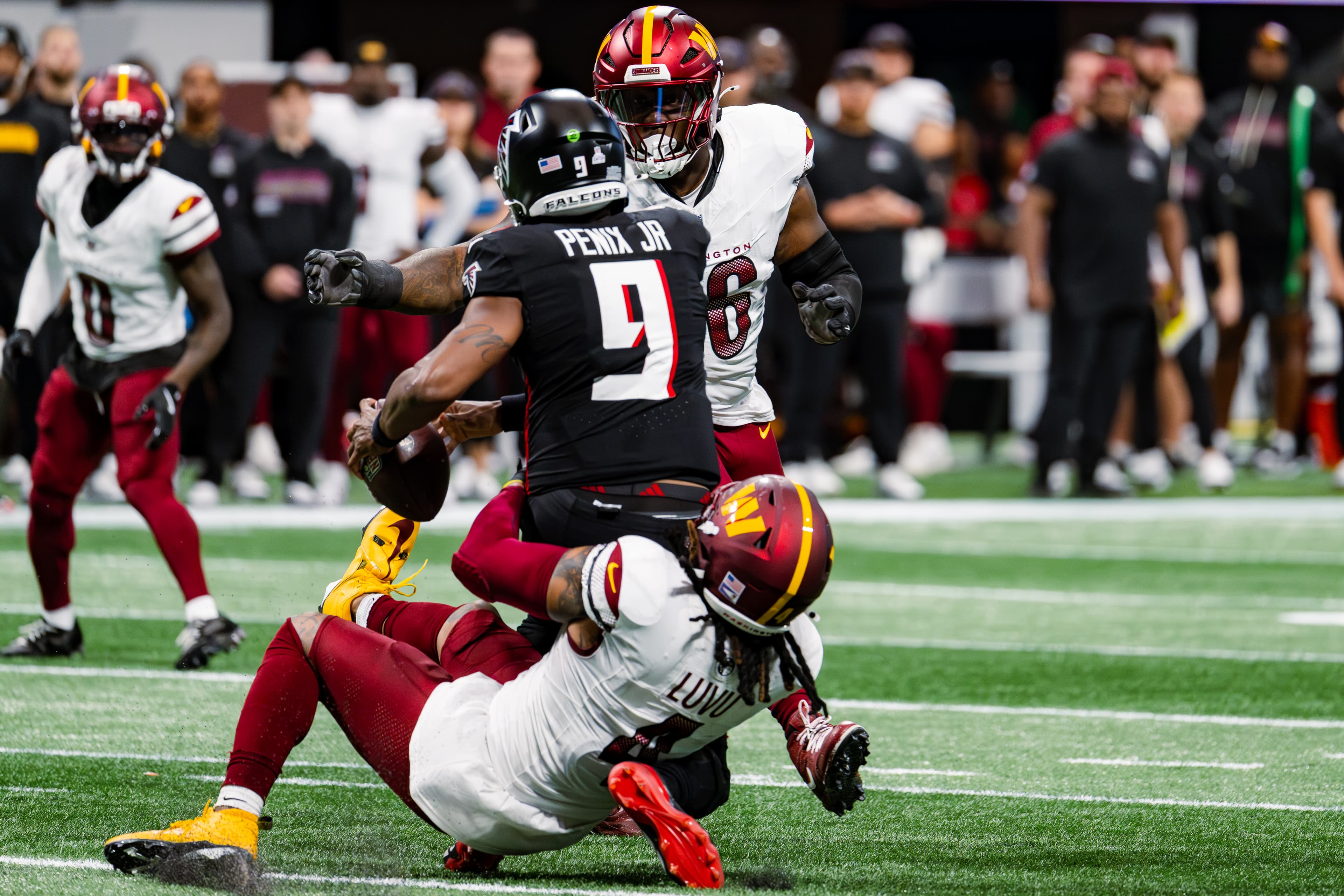
Michael Penix Jr. says the call on when he plays is his, and about the knee he is right. The call on whether he is still Atlanta's quarterback next spring lives in a 4-8 record and a cap table, and he cannot sign either one.
What Friday Fixed
Cooper Rush starts Sunday with an undrafted rookie who has no NFL regular-season snap on record behind him, and the league's own published rule says a third quarterback can enter only for injury or disqualification, never for a benching. That is the room Friday's decision leaves, against a defense that allowed 59 points in Week 1.
_DSC_4695_(51555488805).jpg&w=3840&q=75)
Pressure Without Coverage
Bryce Young's two games against a Jeff Ulbrich defense produced 121 yards and 448, and Ulbrich called both. What the box score can see changing between them is not the scheme but which cornerbacks were on the inactives page, and Sunday's room is a third one neither game has seen.