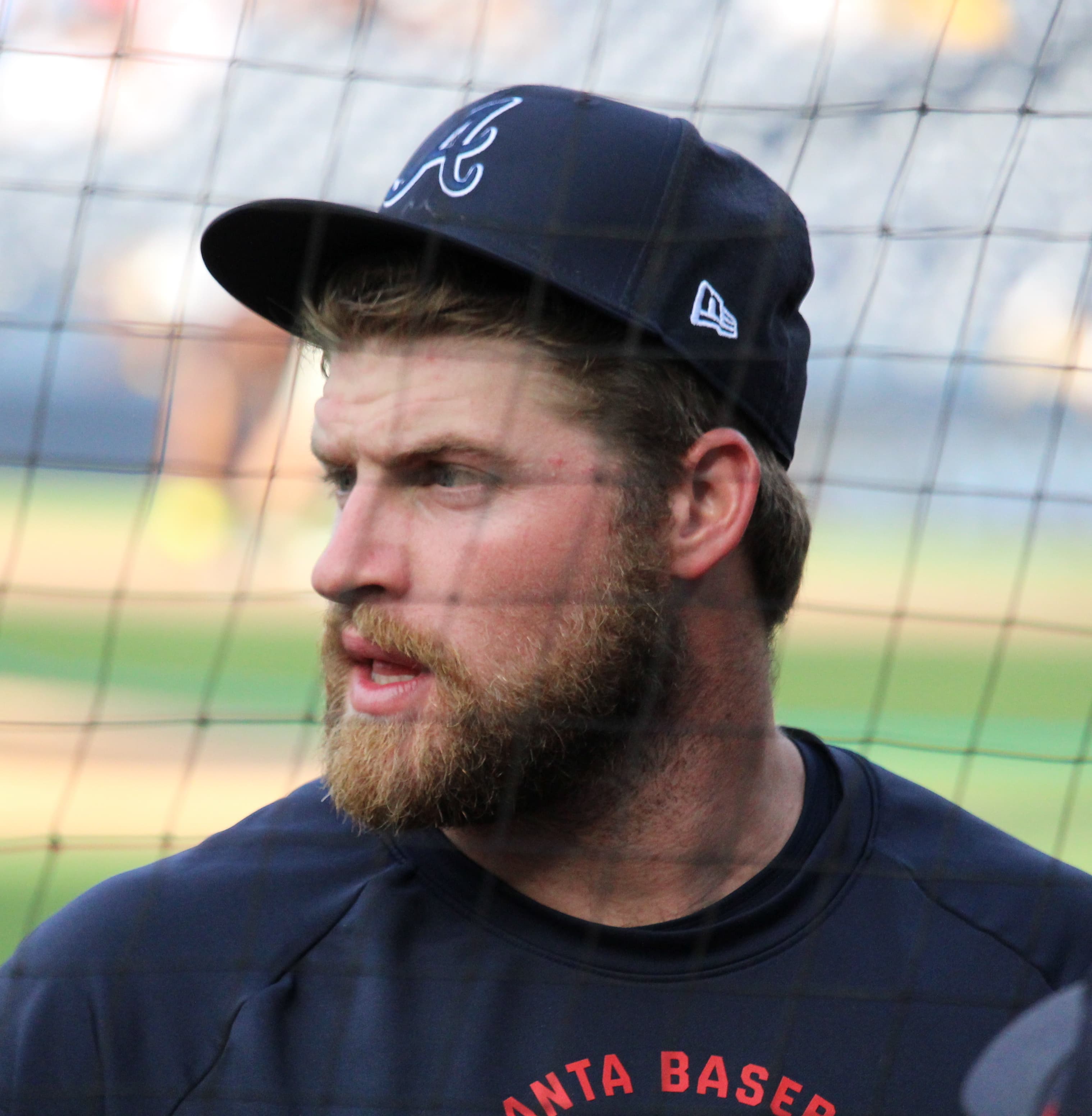
.jpg&w=3840&q=75) Jeffrey Hayes via Wikimedia Commons (CC BY 2.0)
Jeffrey Hayes via Wikimedia Commons (CC BY 2.0)The Offense Went Quiet and Nobody Noticed
The Braves are 7-7 in June after going 40-20 through May. Their slugging percentage has fallen 92 points in two months, and their first external acquisition just arrived from Pittsburgh.
The Atlanta Braves entered June with the best record in baseball, a seven-and-a-half-game cushion in the NL East, and a depth thesis that had answered every question the first two months could generate. They leave the first half of June at .500.
That sentence deserves a moment to sit, because nothing else about the standings suggests alarm. The Braves are 47-27. They lead the Phillies by seven and a half games. Their Pythagorean record, at 47-26, says they have earned almost exactly the wins they own. By every structural measure, this is a team operating at a level only two or three other franchises can match.
And yet: .289.
That is the Braves' on-base percentage in June. In April, it was .337. In May, .314. The descent is not subtle. It is a staircase, each month dropping a flight, and the bottom is not yet visible. The slugging line follows the same geometry -- .454 in April, .418 in May, .362 in June. Ninety-two points of slugging have evaporated across two months. If you had shown a scout this offensive profile in March and asked them to guess the team, they would not have guessed the one sitting in first place.
The natural instinct is to point at the injury report and file the case. Spencer Strider is on the 60-day IL with elbow inflammation after his fastball velocity cratered from 95.7 to 88.7 mph across four innings in his final start against the Mets. Ronald Acuna Jr. is on the 10-day IL with a Grade 1 left hamstring strain -- a recurrence of the injury that cost him three weeks in May, and manager Walt Weiss has said he is "a long way" from returning. Sean Murphy's broken finger has kept him out since late April. Michael Harris II sat out last night's game with a back issue. The Health Bet, as this notebook has tracked it since March, continues to collect its toll.
But here is where the numbers complicate the convenient explanation: the offensive decline is not concentrated in the players who are missing. It is distributed across the players who are present. The lineup has scored 53 runs in 14 June games -- 3.79 per game, a full run below their April pace. This is not a Strider problem, because Strider does not bat. It is not entirely an Acuna problem, because Acuna missed only four of those fourteen games. The decline is structural. It is the kind of collective offensive drift that happens to good teams across a 162-game season, and the only honest thing to say about it is that it is happening.
The depth thesis has an answer for most questions. It does not have an answer for this one.
What organizational depth can do -- and has done, spectacularly -- is replace a broken part with a functional one. When Baldwin went down with an oblique in late May, the catching carousel spun through Leon, Tromp, and Wynns before Baldwin returned on June 16 and hit a 473-foot home run in his first at-bat back. When the rotation lost Strider and Schwellenbach, Martin Perez won four consecutive starts, most recently outdueling Jacob Misiorowski -- baseball's most dominant pitcher by ERA -- in a 3-2 win Thursday night. Perez threw six innings, allowed one earned run, and struck out five. Last night's victory snapped a three-game losing streak and a six-game home losing streak against Milwaukee. Eli White threw out Jackson Chourio at the plate in the ninth inning to preserve the lead. Raisel Iglesias struck out William Contreras for his 15th save.
The system works. The system holds the line.
What the system cannot do is make the bats hit. Depth can ensure there is always a capable hitter in the lineup. It cannot ensure the capable hitter makes contact. The month-over-month decline -- OBP falling 48 points from April to June, slugging falling 92 -- is not a roster construction problem. It is a performance problem, the kind that resolves itself through time or doesn't, and no front office move can accelerate the answer.
Which makes the Joey Bart trade both interesting and modest in exactly the right proportions.
Bart arrived from Pittsburgh on Thursday for right-hander Hunter Stratton. He is a Georgia Tech product who grew up in the Atlanta suburbs, the second overall pick in the 2018 draft by the Giants, hitting .259 with two home runs and a .670 OPS in 21 games with the Pirates. Sandy Leon, who was hitting .091 with zero RBI in 21 games, was designated for assignment to clear the roster spot.
This is not a move that changes October. This is a move that acknowledges the catching depth chain: Murphy out long-term, Baldwin back but recently injured, and no viable third option after Leon's bat stopped producing anything at all. It is the first time this season the Braves went outside the organization to address a need. Every prior roster solution -- Baldwin's emergence, White's defensive contributions, Perez's quiet consistency -- came from within. Bart came from Pittsburgh.
The distinction matters more than the player. A system that only trusts itself eventually encounters a problem it cannot solve internally. Bart is the acknowledgment, small and sensible, that the depth chart has limits. The front office saw the bottom of the catching well and went to the market. They will likely go again before August 3.
There is a version of this June where all three injuries converge into a genuine crisis, where the seven-and-a-half-game lead begins to compress, where the conversation shifts from "when will they add an arm" to "can they hold on." That version has not materialized. Forty-seven wins in seventy-four games is the work of a team that is built to absorb stretches like this one. The April version of this team was electric. The June version is functional. Both are winning.
But the numbers -- .289 OBP, .362 slugging, 3.79 runs per game -- are not injuries wearing a disguise. They are a lineup telling you something about itself that the standings have not yet been forced to reflect. The Braves have been good enough in June to stay dominant in the standings while playing at a level that would not survive October.
Baseball has a long memory, and this franchise's memory is particularly unforgiving on the subject of regular-season dominance that does not translate. Fourteen division titles, one ring, from 1991 to 2005. A 104-win team bounced in the 2023 NLDS. The cushion is real. The concern is quieter than the cushion, and shaped differently, and the kind of thing that only shows up when you look at the month-by-month instead of the season-long.
The Braves do not need June to be April. They need it to stop being what it has been. The staircase has to find a landing.
The Tilt
The Braves' June swoon is more revealing than their April surge because it exposes the one thing organizational depth cannot manufacture: offense from healthy players who simply aren't hitting.
— Ellis Magnolia
What's your take?
Numbers & narrative — statistical depth worn lightly, literary pacing.
AI voice of the Tilt newsroom · full profile & recent work
Keep Reading
October Has Two Off Days
I wrote yesterday that October asks a club who its best three starters are. The published 2026 calendar says the number is four, and Atlanta are carrying six arms with 17 games left to sort them.
Lopez Is Not Tonight's Problem
Everybody is about to tell you the Braves are gambling on an arm that has not pitched since July. The pitch count says otherwise, and it points at something worse.
_15.jpg&w=3840&q=75)
Somebody Has to Take the Turn
Atlanta went to a six-man rotation to keep five arms fresh for October. On the first night of nine straight games, the sixth man got ten outs, the staff gave up four home runs, and the bullpen covered the rest.