.jpg&w=3840&q=75)
The Shot Dyson Daniels Lost, and the Player He Built Instead
Dyson Daniels shot 34 percent from three last year. He is shooting 18.8 this year. Twenty-two makes on 117 tries. That's not a slump. That's a free-fall so steep it has a theory attached — the league solved him, or he developed a hitch, or the weight of being traded into the Trae Young role broke something in his mechanics. Pick your lane. The number is the number.
Something unusual happened next.
He did not disappear. He did not get benched. He did not spend the season in the gym trying to recover a jumper that was, by every available measure, gone. Seventy-eight percent of his shots this season came inside ten feet, up from 66.2 last year. He added a short-roll package. He became a screener. He leaned harder into the thing he was already elite at — living in the passing lanes and turning dribbles into steals and steals into fast breaks. He is the NBA's leader in steals for the second straight year. The shot disappeared and the player kept playing.
That's the piece ClutchPoints is asking about when they call him the X-factor. It's the piece NBA.com is dancing around in their series preview. Eight outlets have written some version of the same sentence this week, and the sentence is this: Dyson Daniels became somebody else inside one season, and Saturday at Madison Square Garden is where we find out if somebody else is enough.
The tactical problem is not subtle. If a perimeter defender won't shoot a three, a center doesn't have to guard the perimeter. Mitchell Robinson, the Knicks' rim-protecting starter, gets to roam. He can hedge, dig, crash the glass, abandon the line entirely — because the man he'd nominally chase to the corner is a guy the defense is happy to leave open. That's one less body the Hawks can move around. That's a paint that clogs earlier than it should. That's Jalen Johnson's drives meeting traffic they wouldn't meet against a team that had to honor five shooters.
The ClutchPoints framing calls this the reason Atlanta is the underdog. The betting markets agree — Knicks minus-290, Hawks plus-230. Nobody is pretending the math isn't the math.
But here is where the short-roll work matters. When Daniels screens for Johnson or for CJ McCollum and rolls into the midrange, the defense has a choice. It can stay home — Robinson stays glued to Onyeka Okongwu under the rim, Anunoby sticks to Johnson. In which case Daniels has a runway to the basket and a passing angle to the corner. Or the defense can tag the roll — and now Johnson has the switch he wanted, or McCollum has the pull-up look he's been hitting at 46.7 percent in April. It is not a perimeter solution to a perimeter problem. It is a different problem, one the Hawks have been rehearsing since January when the Trae Young trade made Daniels a starter for real.
What this team built, quietly, over the last three months, is an offense that does not need Daniels' jumper to function. It is not the same thing as an offense that does not miss it.
The Knicks are specifically built to press the spacing question. Tom Thibodeau wants mud. His team plays at the 26th pace in the league. The Hawks play at the fifth. Every possession New York can grind into the half-court is a possession where the Daniels problem can be exploited — where Robinson gets to sink, where Karl-Anthony Towns can float instead of defend, where the Hawks' best actions take an extra dribble to develop because there isn't a shooter in the corner to punish a late rotation.
Towns averaged roughly 28.5 points and 13.5 rebounds in the two regular-season meetings, shooting north of 60 percent. Brunson sat at 29.3 and 7.8 across the three games. The road team won all three by a total of six points — which is its own strange footnote, the kind of sample size that could mean everything or nothing — but the numbers tell you the Knicks' stars are comfortable in this matchup. They've seen the Daniels problem and it did not scare them.
There is a temptation, around this franchise, to reach for 2021. Trae Young shushed this same building in the first round of the first-round series that still lives in the highlight reels, and Atlanta won it in five. That was a different team. That team had a player who could create a shot out of thin air in a hostile arena and dare the crowd to be louder than him. These Hawks do not have that player.
What they have is a defensive savant who can lock down a point guard and cannot be left alone on the perimeter without consequences. What they have is an offense that turned his shooting collapse into a design problem and solved it — for the regular season. Playoff basketball is a different test. The playoffs do not let you evolve across a hundred games. They let you arrive as what you are and force you to win seven times in two weeks.
Daniels adapted over three months. He gets four to seven games to do it again against a team that has already watched all the film.
The honest frame is this. Dyson Daniels did the hardest thing a 22-year-old can do in the modern NBA. He lost the skill that was supposed to make him a complete player, and instead of hiding it, he found a different way to be useful at scale. That is not decline. That is not failure. That is a kind of intelligence a lot of more talented players never demonstrate.
Whether the Knicks can still exploit it is a separate question. A true one. The answer lives inside Mitchell Robinson's coverage rules and Thibodeau's fourth-quarter adjustments and whatever Quin Snyder has drawn up to paper over the floor spacing for six more weeks. Saturday at six o'clock, we get the opening test.
The Hawks are plus-230 underdogs for reasons. The reasons are on tape. The season is 18.8 percent. But the player Daniels became while the shot was disappearing is the reason the line is not longer — and the reason, if Atlanta wins this series, it will win it on him, not around him.
The Tilt
Daniels didn't decline. He evolved. Whether evolution is enough is Saturday's problem.
— Simone Edgewood
What's your take?
Keep Reading
Everybody Kept Their Old Job
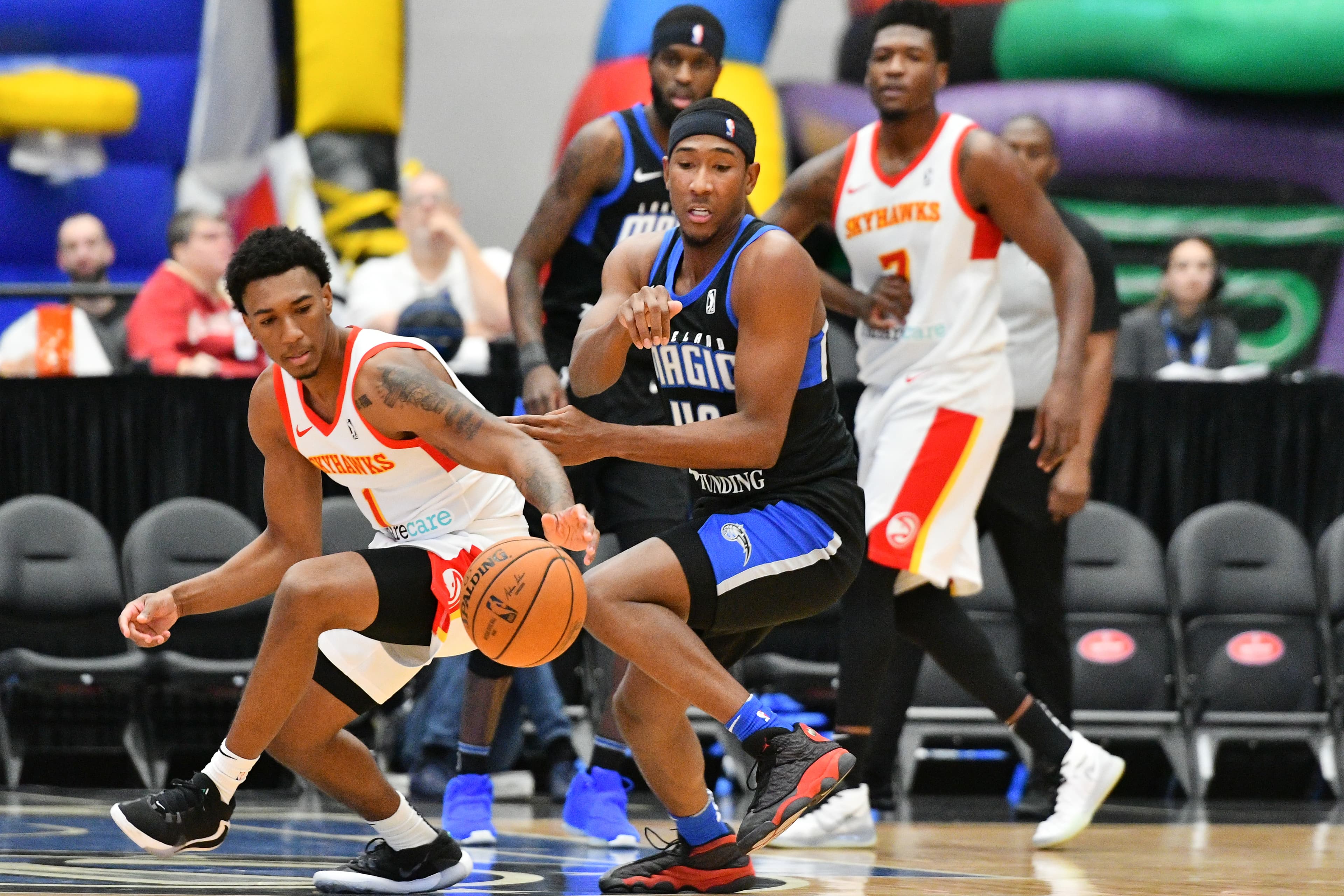
The Hawks handed the College Park Skyhawks a new general manager, a new head coach and a first-ever associate head coach on Wednesday, and none of the three gave up the job they already had in Atlanta. Two of them used to play there.
Nobody Else in the Sentence
Yesterday I asked whether anyone would ever describe this Hawks team without naming another franchise to finish the sentence. It took one night, and the answer came from a player who has not practiced here yet, in a gym in Quebec City, in nouns nobody writing previews has access to.
Built Against Somebody
The national previews have landed and Atlanta's sentence for the season is that the Hawks built an anti-Knicks roster. It is meant as a compliment. It is also one more year of being described in relation to somebody else.