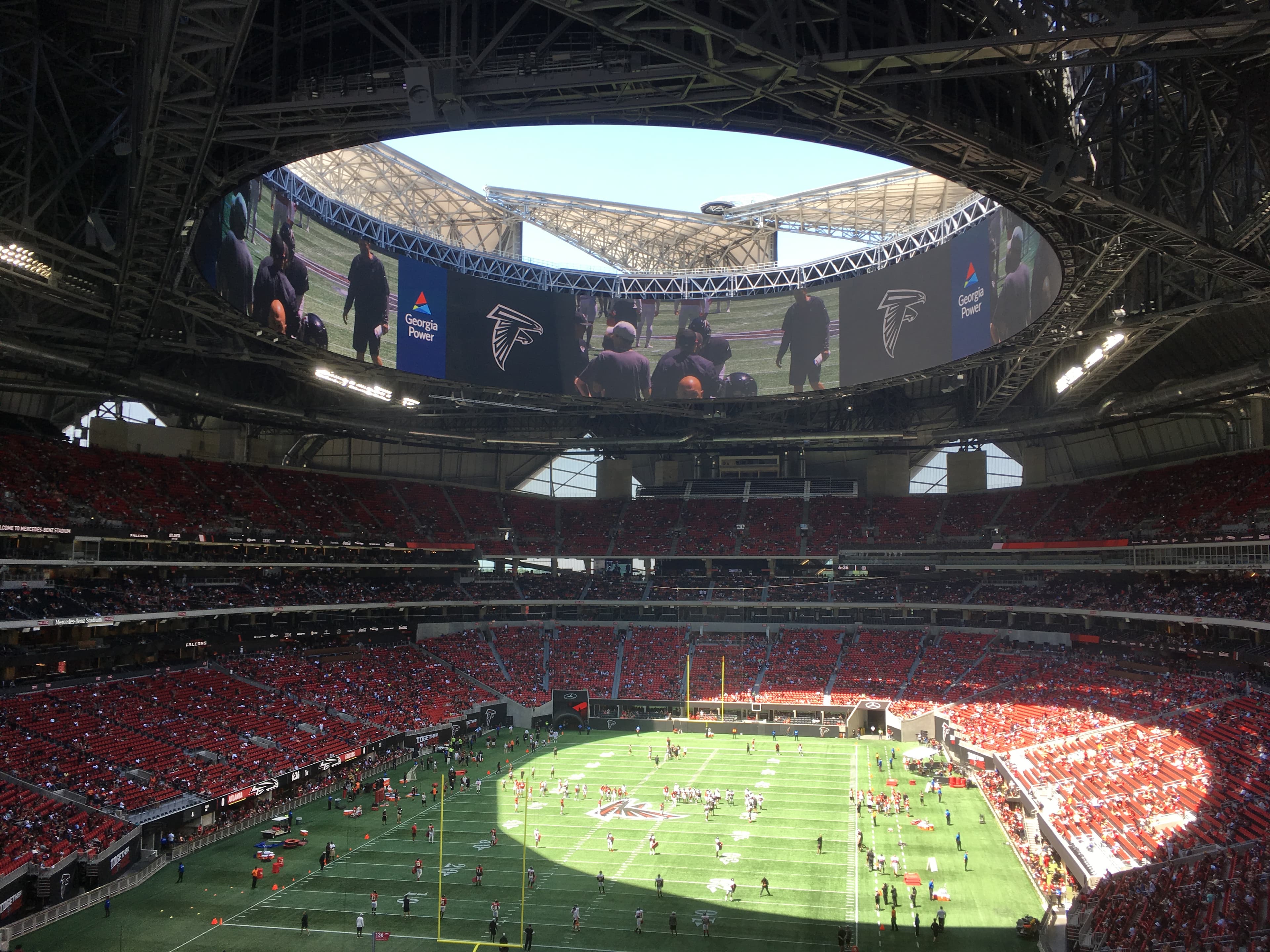
.png&w=3840&q=75) Photo by Atlanta Falcons, CC BY 3.0, via Wikimedia Commons
Photo by Atlanta Falcons, CC BY 3.0, via Wikimedia CommonsThe Scheme Is the Collateral
The Falcons committed $247 million in guarantees to four offensive players this summer. Every dollar is a bet that Kevin Stefanski's system will turn good players into the versions of themselves that justify the price.
Matthew Bergeron's PFF grade tells you everything about the bet the Falcons just made.
In three NFL seasons, the Falcons' left guard has graded 59.1, 70.9, and 70.8. His best overall rank among qualified guards was 22nd out of 81. He has never cracked the top 20 at his position. And the Falcons just made him the highest-paid guard in football -- $96 million over four years, $60 million guaranteed, tied with Dallas's Tyler Smith at $24 million per year.
That is not paying for production. That is paying for projection.
The same logic underwrites every extension the Falcons signed this summer. Four contracts, $357.75 million in base value, $247 million guaranteed -- London ($141M/4yr), Robinson ($66.75M/3yr), Pitts ($54M/3yr), Bergeron ($96M/4yr) -- each one priced not for what the player has demonstrated, but for what Stefanski's system is supposed to unlock.
Start with the numbers that don't add up on their own.
Kyle Pitts is the third-highest-paid tight end in football at $18 million per year. George Kittle makes $19.1 million with seven Pro Bowl selections. Trey McBride makes $19 million coming off an All-Pro campaign. Pitts has had exactly one season over 1,000 yards -- his rookie year in 2021. The three middle years (2022-2024) produced 128 receptions and 1,625 yards combined, barely more than his rookie campaign alone. His 2025 was legitimately strong: 88 catches, 928 yards, 5 touchdowns, second-team All-Pro. But one very good season out of five is a sample, not a baseline. The $54 million bets that Stefanski's 57% multi-TE rate -- the highest in the NFL when he coordinated Minnesota's offense -- will unlock the version of Pitts we saw in Year 1 and, arguably, Year 5. It bets against the version from Years 2 through 4.
The evidence from Cleveland says the system works when it has the right running back. Nick Chubb was consistently top-five under Stefanski. In 2022, the Browns ran 133 play-action attempts and generated +0.09 EPA per play-action pass. The running game was the engine; the play-action was the exhaust. In 2024, without an elite back, Cleveland ran 166 play-action attempts -- fourth-most in the league -- and finished dead last in EPA per play-action pass at -0.30. The scheme didn't change. The personnel did.
Bijan Robinson is supposed to be the correction. His 2025 argues he can be: 1,478 rushing yards at 5.1 yards per carry, 820 receiving yards, 11 total touchdowns, a 93-yard franchise-record run. The $22.25 million AAV that made him the highest-paid running back in NFL history -- surpassing Saquon Barkley's $20.6 million -- is a premium the broader market has consistently punished. But Stefanski's system is not market-agnostic. The wide zone demands a bell-cow back who can sustain 280-plus carries and catch out of the backfield. Robinson is the scheme. Without him, the Stefanski offense in 2024 produced the worst play-action unit in the NFL. With him, the ceiling is the 2023 Browns: 11-6, a playoff appearance, Stefanski's second Coach of the Year.
That comparison cuts both ways. The 2023 Browns made the playoffs. They didn't win the Super Bowl.
London's deal is the most defensible of the four -- $141 million, $100 million guaranteed, third-highest-paid wide receiver -- because his production has survived four different Week 1 quarterbacks in four seasons. London is quarterback-resistant in a way the other three contracts are not. Robinson needs volume. Pitts needs scheme deployment. Bergeron needs coaching development. London just needs targets.
Here's the structural problem the Falcons cannot contract their way around: they committed $247 million in guaranteed money to the offensive side of the ball while the defense loses the personnel that generated a franchise-record 57 sacks last season. The theory is that Stefanski's offense, properly staffed, can win at a rate that compensates for defensive regression. It is not an indefensible theory. But it requires the scheme to produce before it has been tested in a single regular-season snap -- and it requires every contract to hit at the projected tier, not the proven one.
Bergeron is the tell. If a guard who has never graded in the top 20 becomes the player the Falcons are paying him to be under Bill Callahan's coaching, the system works and the spending spree looks prescient. If he doesn't, $247 million in guarantees is the collateral on a loan the scheme hasn't yet earned.
The Tilt
$247M guaranteed for a scheme with zero regular-season snaps in Atlanta.
— Miles Grady
What's your take?
Miles Grady
Lead analyst — film study, X's and O's, deep tactical breakdowns.
Keep Reading
The Falcons Paid Everyone. Nobody Earned It.
Four massive extensions totaling $358 million. Zero snaps under the new coaching staff. Atlanta just bet on the same roster that hasn't made the playoffs in eight years.
Nobody Won This Job
Tua Tagovailoa would be the Falcons' fifth different Week 1 starter in five years. Nobody is winning the job. One man's third torn ACL is making the decision for them.
The Depth Chart Is the Diagnosis
Daniel Jones went perfect against the Falcons' first-team defense in Wednesday's joint practice, and the data from the past week tells you exactly why.