.jpg&w=3840&q=75)
Simone Edgewood: The Ugliest Beautiful Thing in Basketball
There's a gym off Memorial Drive, tucked behind a laundromat nobody uses anymore, where pickup games start at 6 a.m. on Saturdays. No refs. No scoreboard. Just whoever shows up. And the teams that win there — every single time — are the ones who chase rebounds. Not the ones with the prettiest jumper or the flashiest crossover. The ones who want the ball more.
I keep thinking about that gym when I look at what the Hawks have become.
I've written four pieces in five days about this team. "The Hawks Don't Need Your Permission to Be Good" was about the audacity of believing when nobody else does. "Eight Players, One Answer" was about the system being bigger than the star. "Detroit Told Us Everything" was about grit. And last night, "Certainty Has an Expiration Date" was about the moment certainty met something bigger than itself in Boston.
Each piece was about feeling. About energy. About what you could sense in the building.
Today I want to talk about the receipts.
The Hawks are 15-3 since the All-Star break. You already know that number. Here's the one you probably don't: before the break, Atlanta ranked 27th in the NBA in offensive rebounding percentage at 27.3%. Twenty-seventh. Out of thirty teams. That's not mediocre — that's deliberate neglect of the glass. That's a team that shoots and retreats, that treats missed shots as someone else's problem.
Since the break? Fourth. At 34.2%.
Say that transition out loud. Twenty-seventh to fourth. That's not an adjustment. That's a conversion. That's a team that looked at itself in the mirror sometime around mid-February and decided to become something different.
The defensive rebounding tells the same story — 21st in the league before the break at 68.9%, fourth since at 74.0%. Per Peachtree Hoops' Hassan Ladiwala, the Hawks now hold the 3rd-widest rebounding margin and the 2nd-widest second-chance points margin in the league over that stretch. They're outscoring opponents by 5.9 points per game just on second chances.
These aren't glamour numbers. Nobody's putting offensive rebounding percentage on a billboard. But they're the difference between 26-30 and 41-33.
Here's the thing about these numbers that nobody's talking about: they describe effort, not talent.
The Trae-era Hawks were built on brilliance. One man with the ball, everybody else spacing the floor, and if the shot didn't fall, you ran back on defense and tried again. That system produced highlights. It produced All-Star appearances. It produced one magical playoff run in 2021 and then four years of diminishing returns and growing frustration.
What it never produced was this — a team that wins the possession battle. The Hawks rank 3rd in the NBA in defensive turnover rate since the break at 16.6%, up from 15.4% and 8th before it. They're first in points off turnovers at 23.9 per game, up from 19.8. First. In the entire league. They're creating nearly four extra points per game just from ripping the ball away from people and running.
That's not a system that depends on genius. That's a system that depends on hands, feet, and the willingness to be in the right place even when the cameras are pointed somewhere else. Dyson Daniels — 2nd in the league in steals — is the embodiment. Zaccharie Risacher, the 20-year-old No. 1 pick, has seen his rebounding surge to 11.4 per 100 possessions since the break. Daniels is at 11.2. These are wing players crashing the glass like their rent depends on it.
The point differential over the post-break stretch is +230 — a number matched only by Oklahoma City and Charlotte this season, per Ladiwala's breakdown. That's not a hot streak. That's a structural transformation.
I want to be careful here, because I wrote last night about the limits of what this team is, and I meant every word. Boston outrebounded the Hawks 49-29. The same rebounding identity that drove the surge got exposed by a team with more size, more depth, and more institutional comfort with playoff physicality.
Both things are true at the same time. The engine is real. The ceiling is real.
The rebounding transformation works against most of the league because it's driven by effort and scheme — Quin Snyder's system asks wings to crash, asks guards to contest, asks everybody to treat the glass as a collective responsibility. But effort has a physical limit. When you're giving up three or four inches at every position against a team like Boston, want-to runs into can't. That 49-29 number from Thursday night is the exact point where identity meets insufficiency.
So what do the numbers actually tell us? They tell us the Hawks have built something genuine. A 15-3 record with the league's best points-off-turnovers rate, a top-four rebounding transformation on both ends, and an 87.1% playoff probability per ESPN's BPI — that's not an accident and it's not a mirage. It's a team that changed how it plays at the most fundamental level.
But the numbers also tell us that the Hawks' bench got outscored 55-18 in Boston. That the shooting depth — McCollum, Hield, Kennard, Kispert, NAW — goes quiet when the other team's physicality takes away the catch-and-shoot looks that fuel the machine. That there's a difference between winning the possession battle against Orlando and winning it against the teams you'd face in a seven-game series.
Back-to-back Most Improved Player winners on the same team has never happened in NBA history. If Nickeil Alexander-Walker wins — and 20.4 points per game after never cracking 11 in six prior seasons makes a compelling case — the Hawks would be the first, following Daniels's MIP last season. That fact alone tells you the story of what Snyder has built. The system is the constant. The players it elevates keep changing.
But I'll let the MIP debate live where it belongs — in the individual conversation. What matters for this piece is what NAW's transformation represents collectively. He's shooting 41.6% on catch-and-shoot threes at 5.9 attempts per game. That efficiency exists because Daniels is creating turnovers that become transition opportunities. Because Johnson is drawing doubles in the high post. Because Okongwu is setting screens and rolling. NAW isn't a star who makes the system work. He's a player the system made into a star. There's a difference, and it's the difference between the Hawks of 2022 and the Hawks of right now.
I grew up watching teams win at that gym on Memorial because they wanted the ball more. Not because they were more talented. Not because they had the best player. Because they decided, collectively, that every loose ball was theirs.
The Hawks have eight games left. Two games separate 5th from 10th in the Eastern Conference. The schedule is the 6th-toughest remaining in the league. Nothing is settled, and last night in Boston proved that the teams at the top of the bracket have tools this roster doesn't.
But the numbers — the rebounding numbers, the turnover numbers, the possession numbers — say something the vibes alone couldn't prove. This isn't just energy. This isn't just the post-Trae honeymoon. This is a team that structurally changed how it plays basketball, and the results are the best stretch Atlanta has had since 2015.
The identity is built on effort. On wanting the ball more. On treating every possession like it belongs to you.
That might not be enough to survive a playoff series against Boston. But it's enough to be real. And in a city that's spent four years in play-in purgatory wondering when the basketball would feel like it mattered again, real is not nothing.
Soundtrack: "Work" by Rihanna. Not the pretty parts. The beat underneath.
The Tilt
This Hawks team is built on effort, not talent. That's scarier for the East.
— Simone Edgewood
What's your take?
Keep Reading
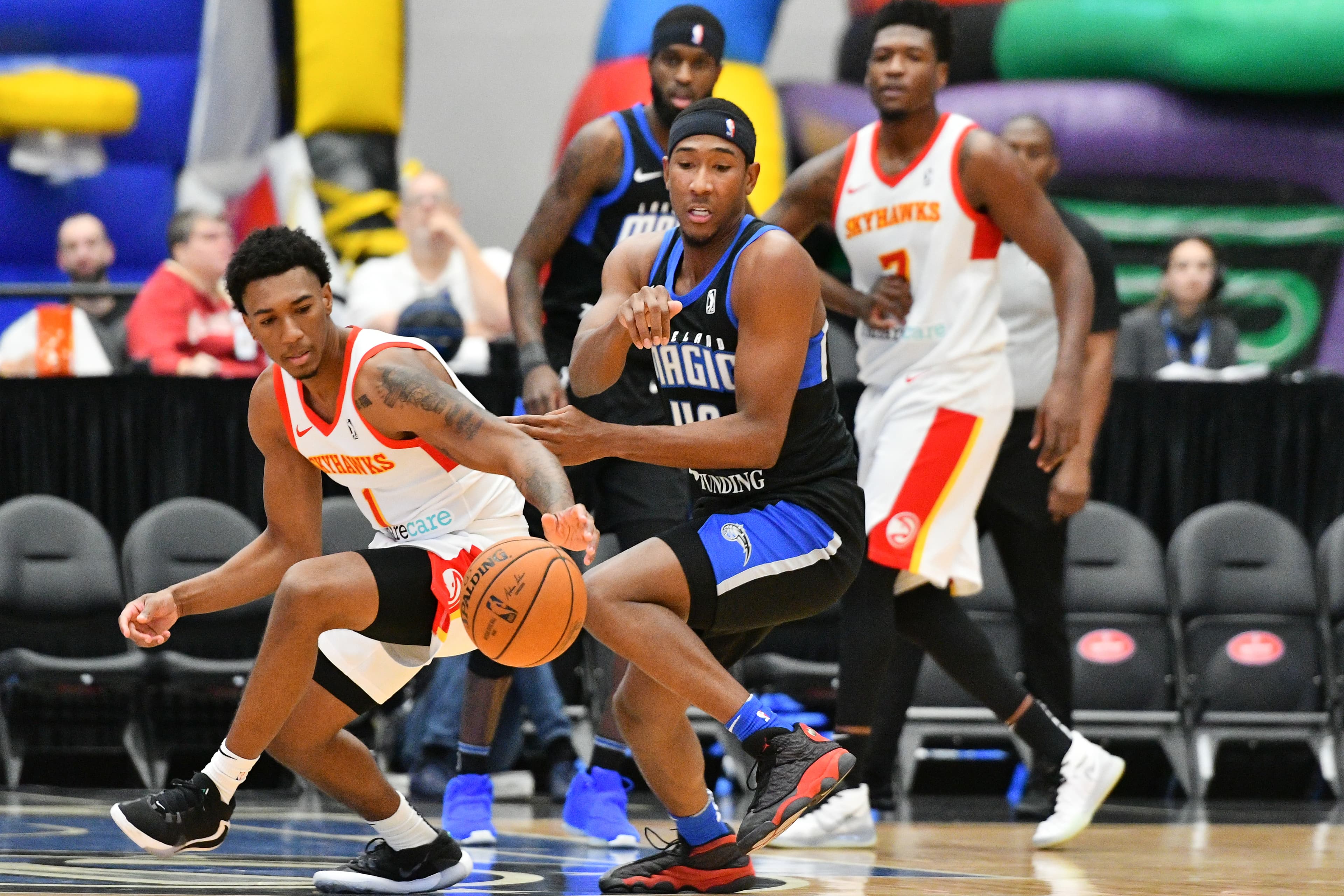
Everybody Kept Their Old Job
The Hawks handed the College Park Skyhawks a new general manager, a new head coach and a first-ever associate head coach on Wednesday, and none of the three gave up the job they already had in Atlanta. Two of them used to play there.
Nobody Else in the Sentence
Yesterday I asked whether anyone would ever describe this Hawks team without naming another franchise to finish the sentence. It took one night, and the answer came from a player who has not practiced here yet, in a gym in Quebec City, in nouns nobody writing previews has access to.
Built Against Somebody
The national previews have landed and Atlanta's sentence for the season is that the Hawks built an anti-Knicks roster. It is meant as a compliment. It is also one more year of being described in relation to somebody else.