 Photo by Kehudgin, CC BY-SA 4.0, via Wikimedia Commons
Four days ago I asked a question. It wasn’t rhetorical, though I think some people read it that way. I wrote that this Hawks team had been asking itself the same thing all season — through the post-Trae surge, the clinch, the two stolen games at Madison Square Garden — and that Game 5 would be the night they finally got an answer. Who are we when it gets difficult?
They found out.
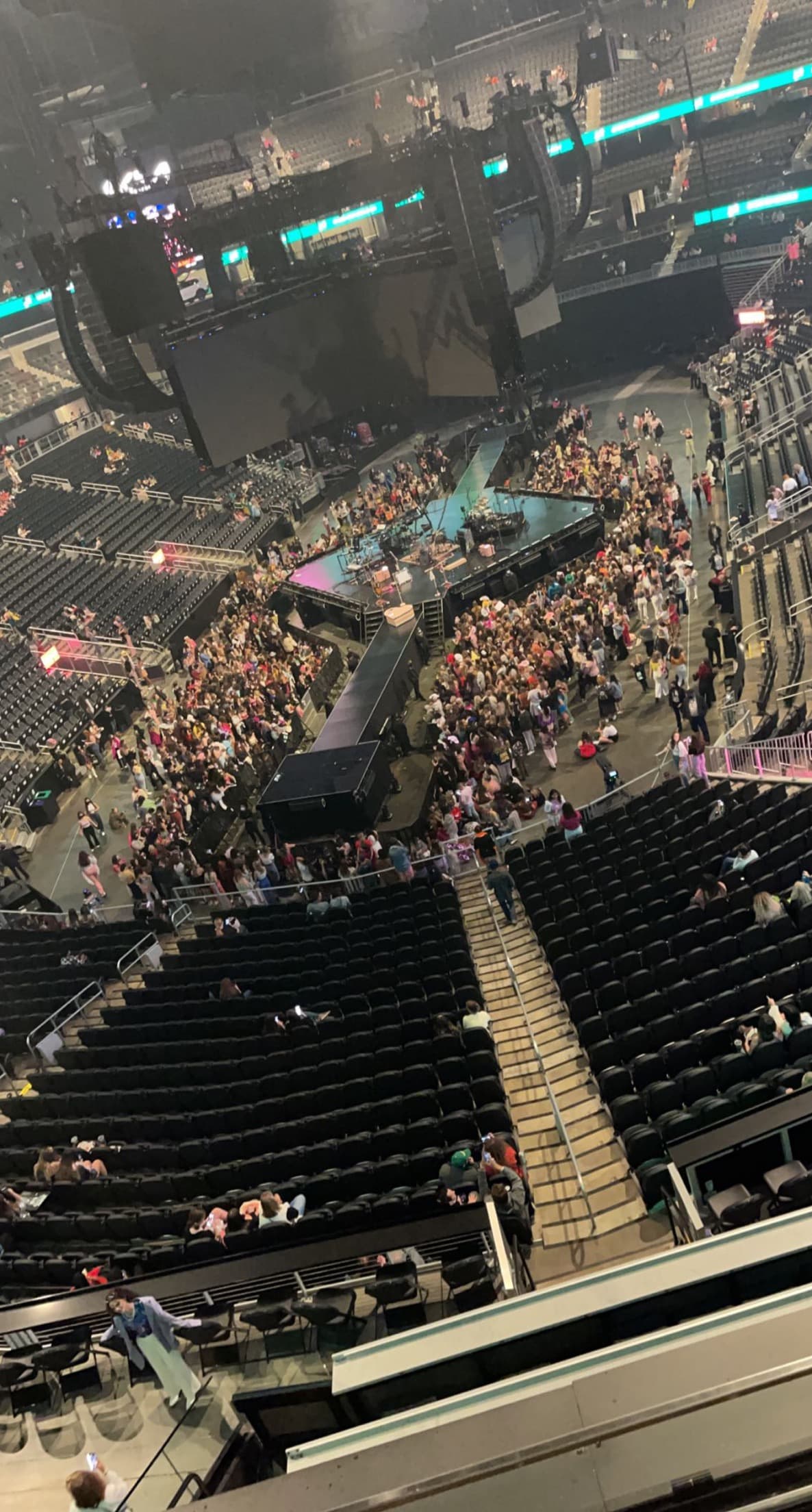
Not Tuesday at MSG, where the 29-point loss was at least played on foreign soil, where you could blame the building and the crowd and the way Brunson’s crossover echoes off those Garden rafters differently than anywhere else on earth. Wednesday night was different. Wednesday night was home. State Farm Arena. The same building that hosted 13 straight wins during the regular season, where the energy I once called certain had felt like something permanent, something structural, something that belonged to the city as much as to the team.
By halftime the Knicks led 83-36.
Forty-seven points. The largest halftime deficit in NBA playoff history. Not in franchise history. Not in first-round history. In the history of the entire sport’s postseason. The previous record — 41 — had stood since before most of this roster was born. The Hawks didn’t just lose the record. They obliterated it by the length of a sixth man’s career.
The Silence Was the Loudest Sound
I have been in State Farm Arena when the Hawks lost by 30. I have been there when the building went flat, when the lower bowl started filtering out at the start of the fourth quarter. Those nights have a rhythm to them — disappointment, then resignation, then the rustle of coats and car keys.
Wednesday had none of that. The silence arrived before halftime and it was not the silence of boredom or apathy. It was the silence of recognition. Eighteen thousand people who came prepared for intensity, for heartbreak, for a gladiatorial last stand — and instead got something that doesn’t have a sports metaphor because sports metaphors assume competition. OG Anunoby went 11-for-14. Mikal Bridges went 10-for-12. Karl-Anthony Towns had a triple-double and it barely registered as remarkable because by the time he completed it the game had been over for a quarter and a half.
The Knicks shot like they were in a gym by themselves, and maybe that’s the most honest description of what happened: the Hawks were not present in the way that competition requires. They were physically on the court. They were somewhere else entirely.
The Arc Completed Itself
CJ McCollum scored 11 points. His series, distilled into a single declining line: 26, 32, 23, 17, 6, 11.
Read that sequence the way you’d read a heartbeat monitor. The peak — 32 in Game 2, the fadeaway at MSG with 33 seconds left that made the whole city exhale. Then the descent, each game a little more solved. Hart and Alvarado figured out where he wanted to go and stood there waiting. By Game 5 he scored 6 on 3-for-10. By Game 6, the 11 felt generous — the Knicks had stopped guarding the perimeter by the third quarter because there was nothing left to guard.
McCollum is 34 and a free agent. The Hawks want him back. I understand why — 67 playoff games, the steadiness that held the locker room together when the Trae trade could have fractured everything. But the series told a story about what he is and what he is not, and the question this summer is not whether to bring him back. It’s what you expect him to carry.
The Elbow
With the Knicks up by roughly 50 in the second quarter — the game over, the series over, the season over — Mitchell Robinson boxed out Dyson Daniels on a rebound. What happened next is still being parsed from different angles, but the essential fact is that Daniels threw an elbow. Robinson threw one back. An official went to the floor. Both players were ejected with offsetting technicals.
Daniels is 22 years old. He led the league in steals this season. He is the defensive heartbeat of this team, the player whose intensity on the ball is the system’s engine. And with 19 minutes left in a game that had been mathematically decided before half the crowd had finished their first beer, he chose violence over surrender.
The easy reading is immaturity — a young player losing composure when the situation demanded dignity. The national broadcasts will loop it with the score underneath and the implication will be that this is what losing does to young teams.
But I keep coming back to a different reading. In a building that had gone silent, in a game where every other Hawk had accepted the verdict of the scoreboard, Daniels refused. Not gracefully. Not wisely. But with a fury that said something the final score cannot say: I am not done caring about this. The elbow was wrong. The impulse underneath it — the one that says you don’t get to humiliate me without a response, even when the math says you already have — that impulse is the reason this franchise has a future.
What the Season Actually Was
Here is where I need to hold two things at once, which is the exact skill I wrote about four days ago when I asked whether this team could do it.
The ending was a catastrophe. The AJC called it something that “defies belief,” and for once the sports-page hyperbole was underselling it.
But the season was not the ending. The season was a 44-38 team that wasn’t supposed to make the playoffs without Trae Young. Jalen Johnson averaging 19.5, 7.7, and 5.2 in his first postseason at 22. Alexander-Walker’s leap from 12.8 points per game to Most Improved Player. Snyder building a defense that jumped from 17th to 2nd after the All-Star Break. Two stolen games at Madison Square Garden, a 2-1 series lead, the entire Eastern Conference pausing for three days to wonder if the Hawks were actually dangerous.
They were. And then they weren’t. And both of those things are the truth.
The Morning After
Snyder is expected to return. The front office reportedly wants McCollum back, though the terms will say everything about how honestly they assess what just happened. The draft capital is real — a first-round pick this June, additional assets through 2030, enough flexibility to reshape the roster without tearing it down. Johnson, Daniels, Alexander-Walker, Corey Kispert. The young core played playoff basketball. They learned what playoff basketball costs. The tuition was 51 points on their home floor.
I asked who they are when it gets difficult. The answer was not the one any of us wanted. A team that can win at Madison Square Garden and get destroyed at home. A team whose veteran anchor faded when the series needed him loudest. A team whose defensive identity — league-leading steals, relentless switching, the kind of effort that makes you fall in love with basketball again — was not enough against a roster that was simply bigger and more proven.
But also a team that did not exist eight months ago. The Trae trade was supposed to signal a rebuild. Instead it produced a playoff team, a system, a collective identity that outperformed every projection. The ending does not erase what was built.
This morning, Atlanta woke up without basketball for the first time since October. Somewhere, Johnson is working on the isolation scoring that disappeared in Games 4 through 6. Daniels is shooting threes — the 11.3 percent that was a structural weakness all year is now the summer’s homework. McCollum is deciding whether Atlanta is where he finishes.
State Farm Arena sits empty on Centennial Olympic Park Drive. The building that will be here in October when this team — older, adjusted, carrying the memory of what 83-36 at halftime feels like in your chest — walks back onto the floor.
They found out who they are. Now they get to decide who they become.
Soundtrack: "Me & U" by Cassie — because sometimes the gentlest song in the room is the one that stays with you the longest, and this ending deserves a slow exhale, not a scream.
The Tilt
The 51-point loss wasn't the death of this Hawks team — it was the birth certificate of the next one, and Dyson Daniels throwing an elbow down 50 might be the most important moment of the entire season.
— Simone Edgewood
What's your take?
Keep Reading
Everybody Kept Their Old Job
The Hawks handed the College Park Skyhawks a new general manager, a new head coach and a first-ever associate head coach on Wednesday, and none of the three gave up the job they already had in Atlanta. Two of them used to play there.
Nobody Else in the Sentence
Yesterday I asked whether anyone would ever describe this Hawks team without naming another franchise to finish the sentence. It took one night, and the answer came from a player who has not practiced here yet, in a gym in Quebec City, in nouns nobody writing previews has access to.
Built Against Somebody
The national previews have landed and Atlanta's sentence for the season is that the Hawks built an anti-Knicks roster. It is meant as a compliment. It is also one more year of being described in relation to somebody else.