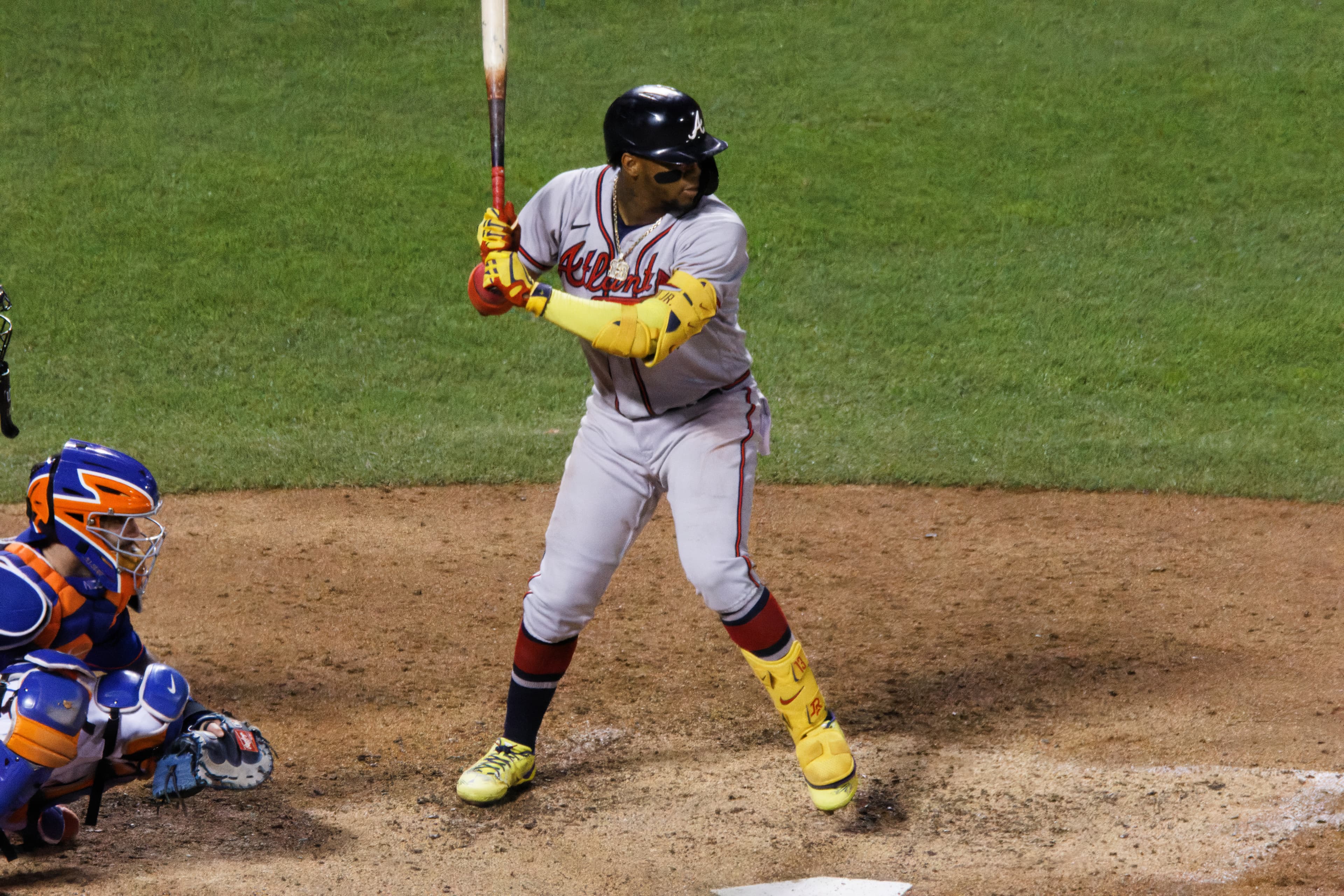
 D. Benjamin Miller via Wikimedia Commons (CC0 1.0)
Thirty-Five Degrees and Eighty Wins
Ronald Acuña Jr. is hitting .121 against fastballs, a 217-point freefall from his MVP season. The Braves are 80-55 and winning anyway, which might be the most troubling detail of all.
In the summer of 2023, Ronald Acuña Jr. hit .338 against four-seam fastballs. He slugged .674 on them. Pitchers threw him the most predictable pitch in baseball and he turned it into something violent and personal. He won the MVP that year by a margin that made the voting feel procedural.
This season, the number is .121.
The gap — 217 points of batting average, 469 points of slugging — is not a slump. A slump is a week of bad contact and two fewer line drives. This is a different hitter standing in the same batter's box.
The Geometry
Start with the stance. Video analysis from MLB.com and Battery Power has documented what the naked eye suspects: Acuña's front side is open 35 degrees, more than double his career norm. The change creates a cascading mechanical problem that begins in his lower half and ends with a barrel arriving late.
An excessively open stance disrupts the timing chain. The hitter's weight transfer — the kinetic sequence from back leg through hip rotation through trunk rotation through the hands — depends on the front side staying closed long enough to generate torque. Open it 35 degrees and the hips fire early. The barrel follows a steeper path. The bat enters the zone at an angle optimized for lift, not for contact on elevated pitches.
This is not abstract. Acuña's bat path is the steepest it has been since 2021. His whiff rate on pitches up in the zone — exactly where pitchers locate four-seam fastballs — is a career high. The barrel arrives in the neighborhood. It does not connect. His average exit velocity is 90 mph. His hard-hit rate sits at 45.1 percent. The talent is still traveling through the body. It is arriving at the wrong coordinates.
The why matters. Acuña tore his ACL in 2023. He missed most of 2024. This season he has suffered two left hamstring strains — the second, a Grade 1 strain on June 9 against the White Sox, sent him to the injured list for five weeks. He completed a rehab assignment with Triple-A Gwinnett, declared himself ready after four plate appearances, and was activated on July 27.
I wrote that day that his .217 batting average in rehab was meaningless — that nine of fourteen batted balls left his bat at 95 mph or higher, that exit velocity was the diagnostic to trust. The data was correct. The conclusion was not. What I underestimated was the possibility that the hamstring had altered his lower-half mechanics in ways exit velocity alone would not detect. You can still hit the ball hard if your hands are quick. You cannot hit a fastball consistently if your stance is 35 degrees open and your hips fire before the pitch arrives.
The Numbers Since
Since returning on July 27, Acuña has hit .188 — 21-for-112 — with a .614 OPS across 28 games. In his last 10 games, the line has worsened: 6-for-40 (.150) with 16 strikeouts. For the full August sample of 20 games, his walk rate has dropped to 4.7 percent and his strikeout rate has risen to 27.9 percent. His wRC+ for the month is 77 — a number that, for context, would make him the worst everyday hitter on most American League rosters.
His full-season slash line sits at .228 with a .731 OPS, 13 home runs, and 35 RBI in 81 games. His OPS+ is 101. League average. For a player with a career .288 batting average and a $100 million contract extension, this is, by every available metric, the worst extended stretch of his professional life.
On August 27, during the finale of the Dodgers series at Truist Park, manager Walt Weiss benched him. Hyun-Jin Kim started in right field. Weiss framed it as a reset, a chance to slow the game down. The subtext was mechanical, not motivational. "He's been pressing at the plate," Weiss said, "and there's more chase without the walks he normally draws."
The Paradox
The Braves are 80-55. They lead the NL East by five games over Philadelphia. They have won five straight. Their franchise player is producing at replacement level, and the standings have barely registered the absence.
In early August, I documented the two records: the Braves were 45-18 with Acuña in the lineup, 25-27 without him — a gap in win pace so severe it constituted a structural vulnerability. A month later, that thesis requires updating. Acuña has been in the lineup for most of the 28 games since his return, producing at the lowest level of his career, and the team has continued climbing. The pitching — Sale's historic season, the bullpen depth Anthopoulos assembled — has carried the weight that Acuña's bat no longer can.
The paradox is not that the franchise player is struggling. Slumps end. Mechanics can be corrected. Hamstrings heal. The paradox is that the team has discovered it can win without his production. The roster was constructed for precisely this scenario: depth over star dependency, distributed scoring over hero concentration. The design is working. Whether it works in October is a question the regular season cannot answer.
The Counterweight
There is a counterweight to the decline, and it lives in the Statcast data. Acuña's expected weighted on-base average — xwOBA, which strips out luck and defensive positioning — sits at .357. His actual wOBA is .323. The 34-point gap suggests batted-ball quality that has not been rewarded by outcomes. He is hitting into outs that, over a larger sample, should become hits.
The barrel rate remains 12.1 percent, respectable if not elite. The exit velocity has not cratered. The Statcast profile describes a hitter experiencing mechanical interference, not physical erosion. Fix the stance, fix the bat path, and the results follow. In theory.
The problem is timing. The Rockies arrive at Truist Park on Friday for a two-game series — the kind of soft matchup designed to let struggling hitters recalibrate against lesser pitching. After Colorado come the Giants. Then September. Then, if the Braves hold their lead, October.
The Long Arc
The Braves have been here before, though the face changes. Fourteen division titles between 1991 and 2005 produced one championship. The 2023 team won 104 games, sent eight All-Stars to the Midsummer Classic, and lost in the Division Series — with Acuña going 2-for-14.
The 80-win Braves of late August 2026 are winning on architecture: pitching depth, lineup balance, organizational redundancy. Acuña's slump has tested the structure and the structure has held. That is a credit to the design.
But the design was never meant to function without its centerpiece indefinitely. It was meant to survive a two-week absence, not absorb a sustained diminishment. If Acuña's .121 on fastballs is a mechanical problem — the stance, the bat path, the timing chain — it is fixable. If it is a physical one, the consequence of an ACL reconstruction and two hamstring strains teaching the body a new and worse set of habits, then the correction extends beyond the geometry of a stance.
The Braves will enter October with the best record in the National League regardless of what Acuña does in September. The question is whether they enter it with Ronald Acuña Jr. or with the version of him who has been standing in the box since July 27 — same uniform, same number, different coordinates.
The Tilt
Acuña's .121 on fastballs is a body problem, not a slump — and October won't wait.
— Ellis Magnolia
What's your take?
Ellis Magnolia
Numbers & narrative — statistical depth worn lightly, literary pacing.
Keep Reading
The Grades Are Still Up
Every major outlet graded the Braves' trade deadline an F. Three weeks and a Dodgers sweep later, Tyler Mahle has a 1.52 ERA and the team is 80-55.
The Arithmetic of Restraint
Three weeks ago, the consensus graded Atlanta's trade deadline an F. The numbers have filed a rebuttal.
Nobody Wants to Say It
The Braves are 80-55 with their franchise player hitting .188 since his return. The question nobody at the tailgate wants to ask out loud.