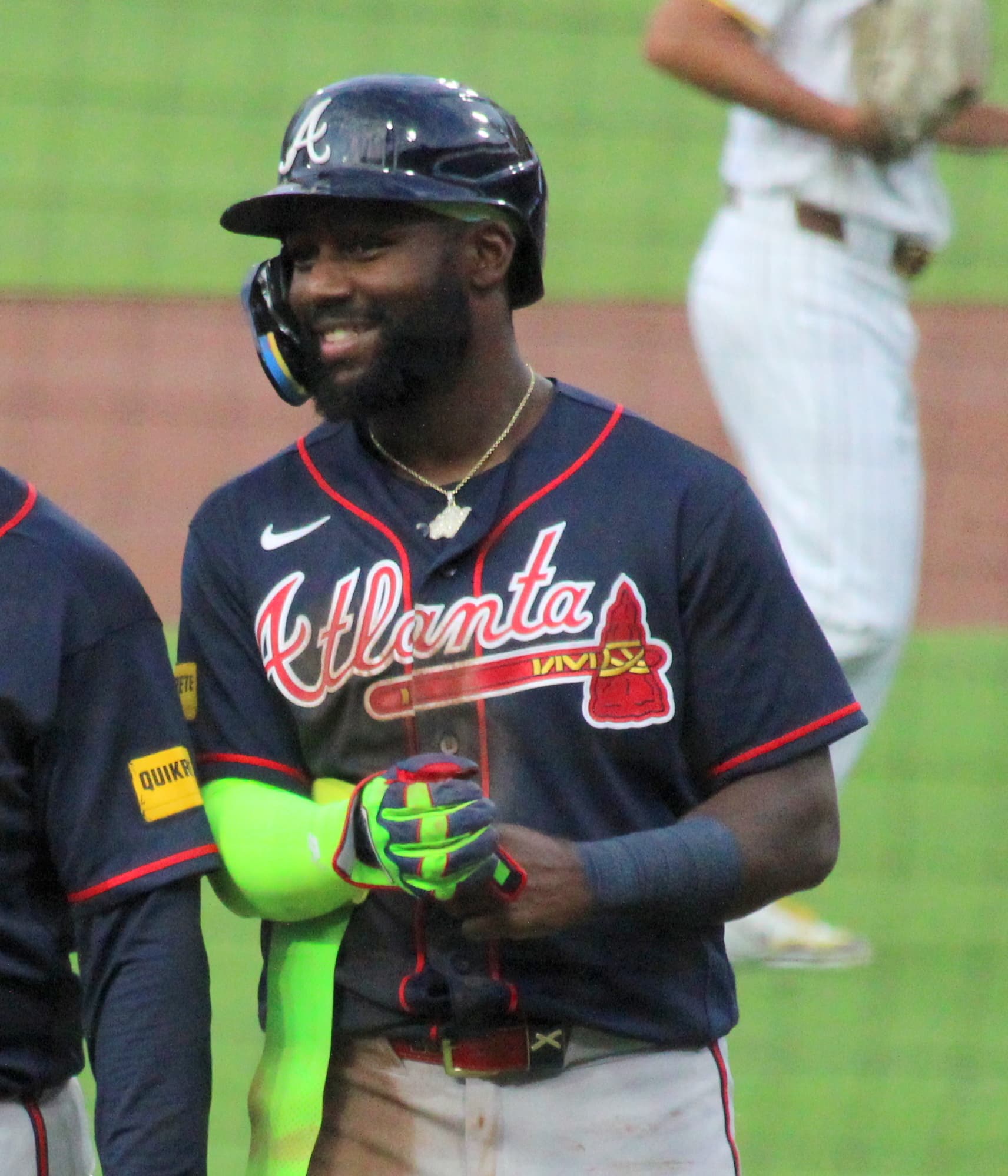
 Photo by Reunion via Wikimedia Commons, CC BY 4.0
Three Games and Eighty-Three Runs
The Phillies have closed a 9.5-game deficit to three in a month. The Braves' 83-run advantage in run differential suggests the math hasn't moved nearly as far as the scoreboard.
The number that matters most in the National League East right now is not three — though three is the gap in games between the Braves and Phillies, reduced from 9.5 over the past month in a compression that has generated the breathless coverage you'd expect. The number that matters is eighty-three.
That's the difference in run differential between Atlanta (+110) and Philadelphia (+27). In the language of Pythagorean expectation — baseball's most reliable translator of performance into projected wins — a +27 team is an 84-win team. A +110 team wins 94. Philadelphia has spent three weeks playing like the latter while being, structurally, the former.
On Sunday, the structure reasserted itself. Zack Wheeler allowed eight runs in a 9-2 loss at Seattle, ending Philadelphia's nine-game winning streak. One loss proves nothing — the same way one streak proves nothing. The Phillies' August was spectacular and almost certainly unsustainable, and their run differential says so.
My colleague Dex Ponce cataloged the Braves' offensive emergency yesterday with characteristic urgency. He's right about the diagnosis: a 3-7 stretch in the last ten, an August wRC+ of 85 that ranks 24th in baseball, Ha-Seong Kim hitting .066 in a number so small it barely registers as a batting average. But diagnosis and prognosis are different disciplines, and the prognosis requires looking at what comes next.
SportsLine's simulations — thousands of them, accounting for remaining schedule strength, roster depth, and that eighty-three-run differential — give the Braves a 78.1 percent chance of winning the division, with a projected final record of 92 wins. The Phillies sit at 21.7 percent. Those models don't know about momentum. They know about math.
The math has a specific September geography. Seven games remain between these two teams: four at Citizens Bank Park from September 4th through 7th, three at Truist Park from the 11th through the 13th. Atlanta leads the season series 5-1. If you want to know where this division gets decided, circle those dates. Everything else is preamble.
Before the preamble resolves, though, there is the matter of the Dodgers at Truist Park starting tonight — and with them, a subplot that extends into October.
Tyler Glasnow activates off the 60-day injured list tomorrow. Before a lower back sent him to the shelf in May, he carried a 2.72 ERA with 49 strikeouts in 39.2 innings. His final rehab outing — 5.1 innings, one hit, nine strikeouts, 77 pitches — suggested the back is no longer the variable. The Dodgers, already 80-51, are about to add a front-line arm to a rotation that was winning without one.
Tonight, it's Bryce Elder facing that lineup. Elder's 2026 reads as two chapters: the 1.97 ERA through his first eleven starts and the 3.92 he carries now after a mid-summer correction. The more relevant data point: on May 10th, he faced the Dodgers in Los Angeles and delivered 5.2 innings of one-hit, shutout baseball with eight strikeouts. One game is not a trend. But reference points count when the sample against a particular opponent is small.
The Braves' lineup will need to produce something resembling run support. Matt Olson's 36 home runs remain the load-bearing pillar of an offense that has otherwise gone quiet. Michael Harris II offers the most encouraging counter-data: 13-for-39 over his last ten games, a .333 clip that suggests at least one bat has remembered how to hit in August.
The instinct during a 3-7 stretch is to conclude that the slide is the truth and the preceding months were the lie. A 9.5-game lead that becomes three feels like confirmation of something you suspected all along.
Run differential tells a different story. Eighty-three runs of separation is not a rounding error. It is the accumulated evidence of 131 games suggesting one team is meaningfully better than the other. The Phillies have been extraordinary for three weeks. The Braves have been better for five months.
September will settle the arithmetic. It usually does.
The Tilt
The Phillies' surge will be remembered as the most exciting three weeks of an NL East race that was never actually close.
— Ellis Magnolia
What's your take?
Ellis Magnolia
Numbers & narrative — statistical depth worn lightly, literary pacing.
Keep Reading

The Dodgers Didn't Come to Visit
Los Angeles arrives at Truist Park on a six-game win streak, and the Braves haven't won a series in three weeks. This isn't a measuring stick. It's a mirror.
Number Eight Is Generous
The Braves dropped to number eight in the power rankings. Bleacher Report calls it cooling off. The real diagnosis is worse.

The Right Defense for the Wrong Problem
JustBaseball's case for Anthopoulos's trade deadline restraint holds up on the pitching numbers. The problem is that pitching was never the problem.