 Photo by Thomson200, CC0, via Wikimedia Commons
Three-Tenths of One Percent
ESPN rated Atlanta's trade deadline the best in baseball this morning. In the column directly beside that rating, the same model prices what the deadline did for Atlanta's October at three-tenths of one percent.
Three-tenths of one percent.
That is what the best trade deadline in baseball bought the Atlanta Braves, according to the model ESPN published at seven o'clock this morning. Bradford Doolittle's one-month review of the 2026 deadline sorts all thirty clubs by how their acquisitions have actually played and how their fortunes have actually moved, and Atlanta sits at the top of it. A post-deadline rating of 108.6, the best of any club still playing for something. A deadline pickup impact of 10.9, the highest in baseball. Tyler Mahle described, in plain words, as the best pickup of the deadline.
Printed on the same line as that rating, in the column measuring what the deadline changed about Atlanta's odds of playing in October, is the number that makes the whole thing worth reading twice.
Plus 0.3 percent.
Both figures are Doolittle's. Both are correct. Sitting beside each other, they are the most useful thing published about this team today.
Five days ago I graded this same deadline, against a set of deadline-day graders, one of whom had handed Alex Anthopoulos an F for it. I gave Mahle an A and called him a rental who might be the best deadline pickup in baseball. Doolittle built a rating system and arrived at the same place from a different direction, which is the kind of thing a writer is supposed to enjoy.
There is a version of this column that is a slow lap around the warning track. It would be easy to write, and it would be worth about three-tenths of one percent.
The more interesting row in Doolittle's table belongs to Philadelphia, and it runs the opposite direction on both axes.
The Phillies sit in his second tier, the one reserved for contenders whose pickups have not helped but whose odds improved anyway. Their deadline pickup impact is negative: minus 6.9. Luis Arraez, the acquisition that looked like a perfect fit for that lineup, is hitting .280 with a .678 OPS across twenty-seven games in Philadelphia -- Doolittle had him at .704 when he filed, and the days since have not been kind. Brooks Raley has been, in Doolittle's word, fine.
There is a detail Doolittle does not draw a line under, and it is worth drawing. The seller in both deals was the same club. San Francisco sent Mahle to Atlanta and Arraez to Philadelphia inside the same deadline, and a month later one of those trades is the best pickup in baseball and the other is a negative number.
Philadelphia's change in playoff probability over the same month: plus 34.2 percent.
So the club that ran the best deadline in baseball moved three-tenths of a point, and the club whose deadline the same model scores below zero moved thirty-four. If you want to be irritated by that, there is room. It is also not a flaw in the model, and working out why is most of the point.
A playoff probability does not measure how good a team is. It measures how much doubt that team had left to spend. Atlanta went into deadline day on August 3 leading this division by seven and a half games, and a club that far ahead in early August has almost nothing left to gain in a simulation -- the model had already handed Atlanta October and was quibbling about the margin. Philadelphia went into the same afternoon inside a wild-card scramble, where every game won converts directly into doubt removed. Thirty-four points is not evidence that Philadelphia's deadline was better. It is evidence that Philadelphia's summer was more frightening.
There is a tell further down the page. The highest rating Doolittle prints anywhere does not belong to Atlanta at all. It belongs to Kansas City, at 111.0, filed under a heading that reads Tier 6: Noncontenders. The Mets are next at 108.9, in the same tier. Both clubs sold in August, both have played better baseball since, and the rating rewards them faithfully for it. A scale that places the last-place club in the American League Central above the Braves is not a broken scale. It is a scale answering a question about the month behind us rather than the one ahead.
The rating column and the odds column are measuring two different things, and Doolittle is careful enough to print both. Read together, they say something neither says alone: Atlanta's deadline was excellent and almost entirely beside the point of the question the odds model asks.
Which brings up the sentence in his Atlanta paragraph that deserves more attention than the rating does. "As a club, Atlanta has been status quo," Doolittle writes, "which in most instances would be sufficient, but in the Braves' case, they're dealing with a white-hot Phillies team running them down in the division race."
That reads like a phrase written for rhythm. I checked it, because phrases written for rhythm usually do not survive being checked.
It survives. Since the deadline, Atlanta is 16-12. Philadelphia is 19-8. Atlanta led this division by seven and a half games on the morning of August 4 and leads it by four tonight, with seven meetings still to play between them -- four at Citizens Bank Park beginning tomorrow evening, three at Truist Park the following weekend.
Three and a half games of a division lead crossed from one column to the other during the month in which Atlanta was, by ESPN's own rating, having the best deadline in baseball.
That is the sentence worth sitting with. The deadline worked. The lead shrank. Both are true, and any version of this argument that requires you to discard one of them is a version worth distrusting.
So what did Anthopoulos actually buy, if not probability?
The ERA is the part everyone quotes. Mahle has made five starts in an Atlanta uniform and allowed five earned runs across all of them -- a 1.48 ERA, 1.4 wins above replacement inside a single month, the same five runs he gave up in his final start as a Giant. Doolittle lays that coincidence out, and it is a good one.
But the ERA is the least durable number in the group. Five starts is thirty and a third innings, and I am not going to pretend that settles what eighteen starts in San Francisco could not. The figure underneath it is steadier. Mahle walked 37 men in 94.2 innings for the Giants, a strikeout-to-walk ratio of 2.4. He has walked five in 30.1 innings for Atlanta, a ratio of 6.4. Command settles down faster than run prevention does, because it describes what a pitcher is doing rather than what has been happening to him.
This morning I argued that Philadelphia's rotation is priced at the name rather than at the 2026 results. Mahle is that same trade run backwards. San Francisco sold a 3-9 pitcher with a 5.13 ERA, which is what the record said. Atlanta bought a pitcher throwing strikes, which is what the peripherals said, and which is also what he was in Texas a season ago at 2.18 across sixteen starts. Anthopoulos was not buying a breakout. He was buying the gap between a man's record and his stuff, and that gap is the cheapest thing on the market every July because it is the least legible.
The rest of the haul is smaller, and Doolittle is honest about it, so I will be. Lane Thomas, the addition to the lineup, is hitting .194 with a .636 OPS across nineteen games in Atlanta, down from the .719 he posted in Kansas City, and he is not what anyone drew up. Brent Suter has a 2.20 ERA in sixteen and a third innings out of the bullpen with six walks inside them, which is useful and rather less tidy than the ERA by itself suggests. Doolittle's word for Suter is strong. Mine would be cheap and fine, and the distance between those two is not worth an argument.
Mahle is listed for one-ten Sunday afternoon at Citizens Bank Park opposite Aaron Nola, the third of the four games that open this stretch. By the model that just named him the best pickup of the deadline, that start is a rounding error -- three-tenths of a percent of an October that Atlanta was going to reach with him or without him.
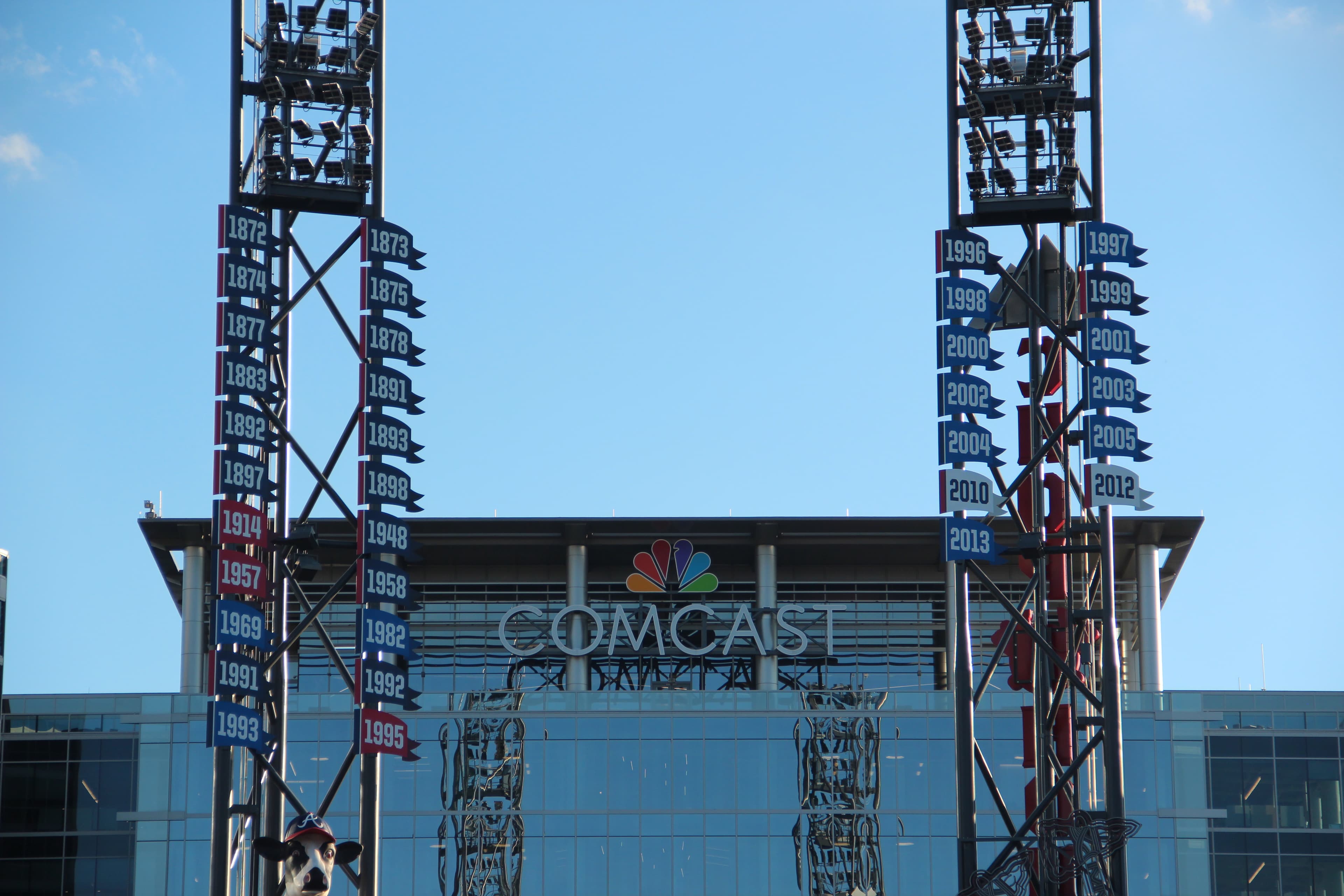
The light towers at Truist Park carry a small flag for every season this franchise finished something, a column of years running back to the 1870s. None of them commemorate a playoff probability. Anthopoulos did not spend August 3 buying three-tenths of a point; he bought a starting pitcher who might take the ball in the middle of October, and the entire value of that purchase is deferred into a month this model does not price.
Whether it was the right thing to buy gets answered in about six weeks. It does not get answered Sunday, and it certainly was not answered this morning.
The Tilt
Winning the trade deadline bought Atlanta almost nothing this season, and that is not an argument against having won it.
— Ellis Magnolia
What's your take?
Ellis Magnolia
Numbers & narrative — statistical depth worn lightly, literary pacing.
Keep Reading
Fifty Pitches to Nothing
Kyle Schwarber and Bryce Harper batted eight times at Citizens Bank Park tonight, made eight outs, and needed fifty pitches to do it. Atlanta won 5-2 in the least interesting way available, which is exactly why it counts for something.
.jpg&w=3840&q=75)
What the Worry Is Worth
On Tuesday I told you Atlanta's road record was the part of this race that should hold your attention. I spent this morning working out what it is actually worth, and the answer is about one-seventh of a game.
.jpg&w=3840&q=75)
Priced at the Name
I sat down to write that Philadelphia holds the pitching edge in this series. Then I pulled the 2026 lines for all eight listed starters and found that the man Philadelphia has listed for Saturday has walked eighteen batters in his last twenty-seven and a third innings.