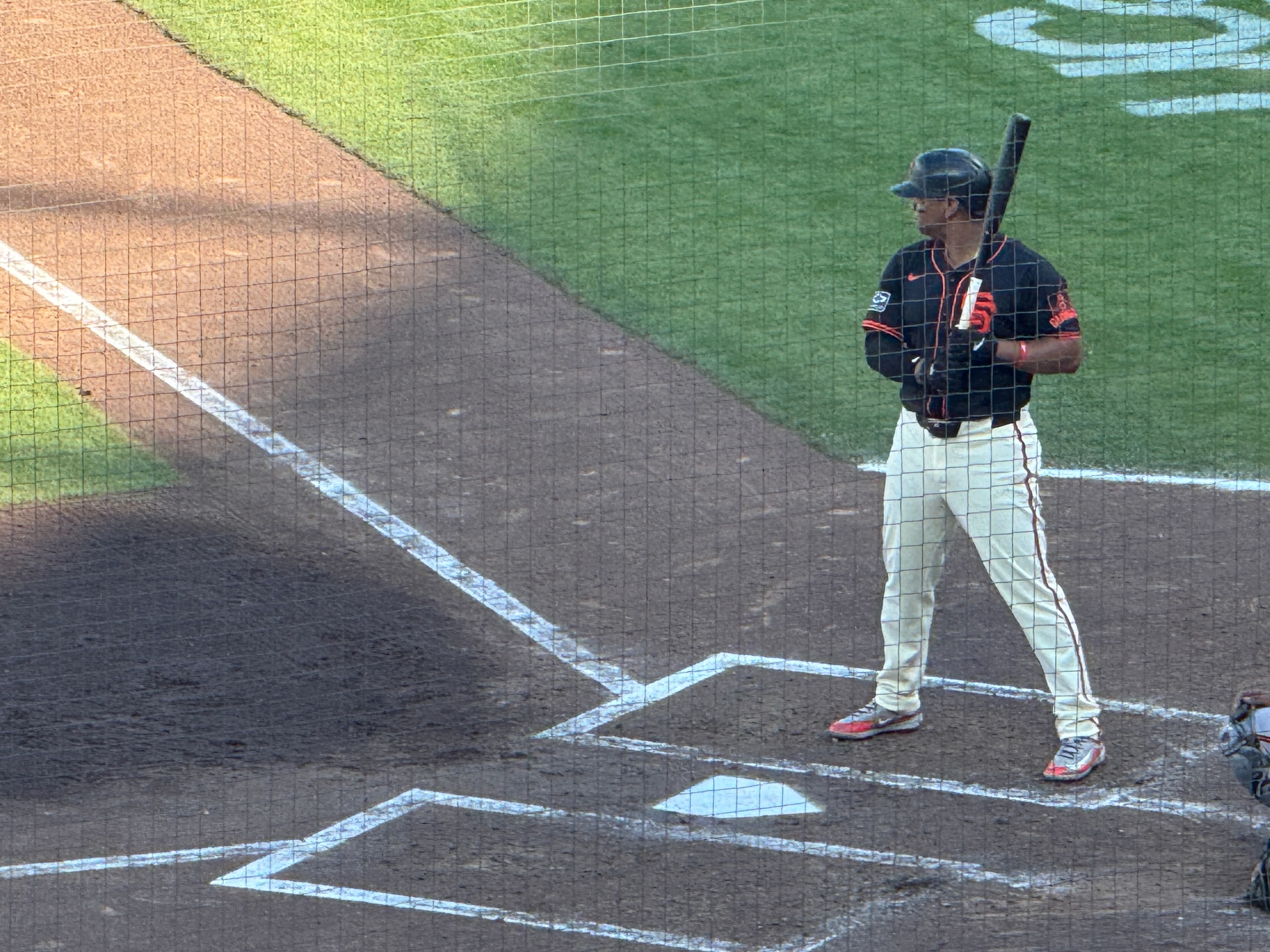
 Photo by Thomson200, CC0, via Wikimedia Commons
Two Outs, Runners On
The Braves traded Anthony Molina to San Francisco a month ago. Monday night he came back and ended their seven-game winning streak, four days before the pitcher they traded him for starts in Philadelphia.
On August 2, the Braves sent a young right-hander named Anthony Molina to San Francisco as part of the deal that brought back Tyler Mahle. On Monday night at Truist Park, Molina beat them.
He got the win in a 7-3 Giants victory that ended Atlanta's seven-game winning streak, in front of 29,349 people who had come to watch the streak become eight. Bryce Elder took the loss and fell to 8-8. Four days from now, in Philadelphia, Tyler Mahle will start the third game of the most important series Atlanta has played this year.
Baseball has a long memory, and it is not always a kind one. It is, however, reliably symmetrical.
The standings this morning say Atlanta is 82-56 and leads the National League East by four games over Philadelphia, who are 78-60. That lead was five on Sunday morning. The Phillies have won five straight and eight of ten; the Braves have won seven of ten and lost the one that mattered most recently. A game of cushion has gone in two days, which is the kind of arithmetic that makes September feel like it is accelerating even when nothing structural has changed.
And here is the thing: structurally, almost nothing has.
Atlanta has scored 639 runs and allowed 526, a run differential of plus-113. Philadelphia has scored 624 and allowed 593, a differential of plus-31. That is a gap of 82 runs between two teams separated by four games in the standings. Run differential is not destiny — it is a description of what has already happened, and the Phillies have banked their wins in tighter games — but a gap that size is not noise. It is the sound of one team having been meaningfully better for five months while the standings quietly declined to reflect it.
Which sets up the only schedule that matters. Atlanta and Philadelphia will play seven times in the next thirteen days: four games at Citizens Bank Park beginning Friday, then three at Truist Park the following weekend. Sale opens against Sanchez. Then Perez against Wheeler, Mahle against Nola, Elder against Luzardo to close it out. Between the two series, Atlanta hosts Tampa Bay for three. There is no soft landing anywhere in it.
The home-road split is the part that should hold your attention. Atlanta is 48-24 at home and 34-32 on the road — a team that has been nearly unbeatable at home and roughly a coin flip on the road. Four of the next seven meetings are in Philadelphia. The Phillies, for their part, have been slightly better on the road than at home, 40-30 to 38-30, which is the sort of detail that means little in June and quite a lot in the second week of September.
So: seven games, mostly on the road, against a team playing its best baseball of the year, with a four-game cushion and an 82-run argument that the cushion should be larger.
Games like that get decided in about six moments. Here are two men likely to be standing in them.
Demetrius Bell at Battery Power spent some time this week with a pair of splits that deserve wider circulation, and both come with a caveat that has to be stated first, because the caveat is not a hedge — it is the whole point.
Mauricio Dubon has hit .270/.315/.390 this season. That is a .311 wOBA and a 95 wRC+, which is to say: a hair below league average, a useful bench piece, nothing you would build a paragraph around. But with runners in scoring position and two outs, Dubon has hit .345/.387/.517 across 62 plate appearances — a .394 wOBA, a 151 wRC+. The 2026 league average in that same situation is .230/.328/.383. Hitters get worse with two outs and traffic on the bases. Dubon has gotten substantially better.
Sixty-two plate appearances. That is the caveat, and it matters enormously. Sixty-two plate appearances is not a skill. It is a description of sixty-two specific things that happened, and if you resampled the season you would very likely get a different number. The honest sentence is not "Dubon is clutch." The honest sentence is "Dubon has hit like this in these spots, and nobody can tell you whether it will continue."
Raisel Iglesias has a similar shape and a more troubling one. With the bases empty, opposing hitters have managed .209/.263/.327 against him across 118 batters faced — a .262 wOBA, which is genuinely excellent. Once a runner reaches, that becomes .263/.337/.413 across 89 batters faced, a .329 wOBA. He goes from a late-inning weapon to roughly an average major league hitter's afternoon. Eighty-nine batters faced is a small sample too. It is also, unfortunately, a sample that speaks directly to what a closer is for.
There is a version of this September where those splits are noise — where Dubon returns to being a 95 wRC+ hitter in every context and Iglesias retires the leadoff man in Philadelphia three nights running and none of this is ever mentioned again. That version is genuinely likely. Small samples regress; that is the most reliable thing about them.
But there is another version, and it is the one that makes the next two weeks worth watching closely rather than anxiously. In that version, a utility infielder who has been unremarkable for five months keeps coming up with two outs and a runner on second at Citizens Bank Park, and a closer who is a different pitcher depending on whether the leadoff man reaches gets asked to prove which pitcher he is, four times in eleven days.
Active rosters expand from 26 to 28 across the league today. Atlanta's additions had not been announced as of this morning, so we will leave that space blank rather than fill it with a guess.
The Braves have been the better team since April by a margin of 82 runs. They now have thirteen days to demonstrate it against the only club still asking. Molina beating them Monday was a coincidence with good timing — baseball producing a small, perfectly shaped joke at Atlanta's expense on the night a streak died.
The next two weeks will not be a joke. They will be the season, compressed into seven games, decided in about six moments, by men whose most relevant statistics currently come with a warning about sample size attached.
The Tilt
Atlanta has been 82 runs better than Philadelphia for five months, and the next thirteen days will be decided instead by two small-sample splits nobody can promise will hold.
— Ellis Magnolia
What's your take?
Ellis Magnolia
Numbers & narrative — statistical depth worn lightly, literary pacing.
Keep Reading
Atlanta Has a Bogey Team
Atlanta swept the Dodgers eight days ago. Tonight it lost to a 57-81 club for the fifth time in six tries.
.jpg&w=3840&q=75)
Four Runs at Once
For eight days, no inning moved this team by more than two runs. San Francisco needed one inning to move it by four, and a seven-game streak was over.
.jpg&w=3840&q=75)
The Width of One Run
Seven straight wins, five of them by exactly one run. The margins tell you more about this team than the streak does.