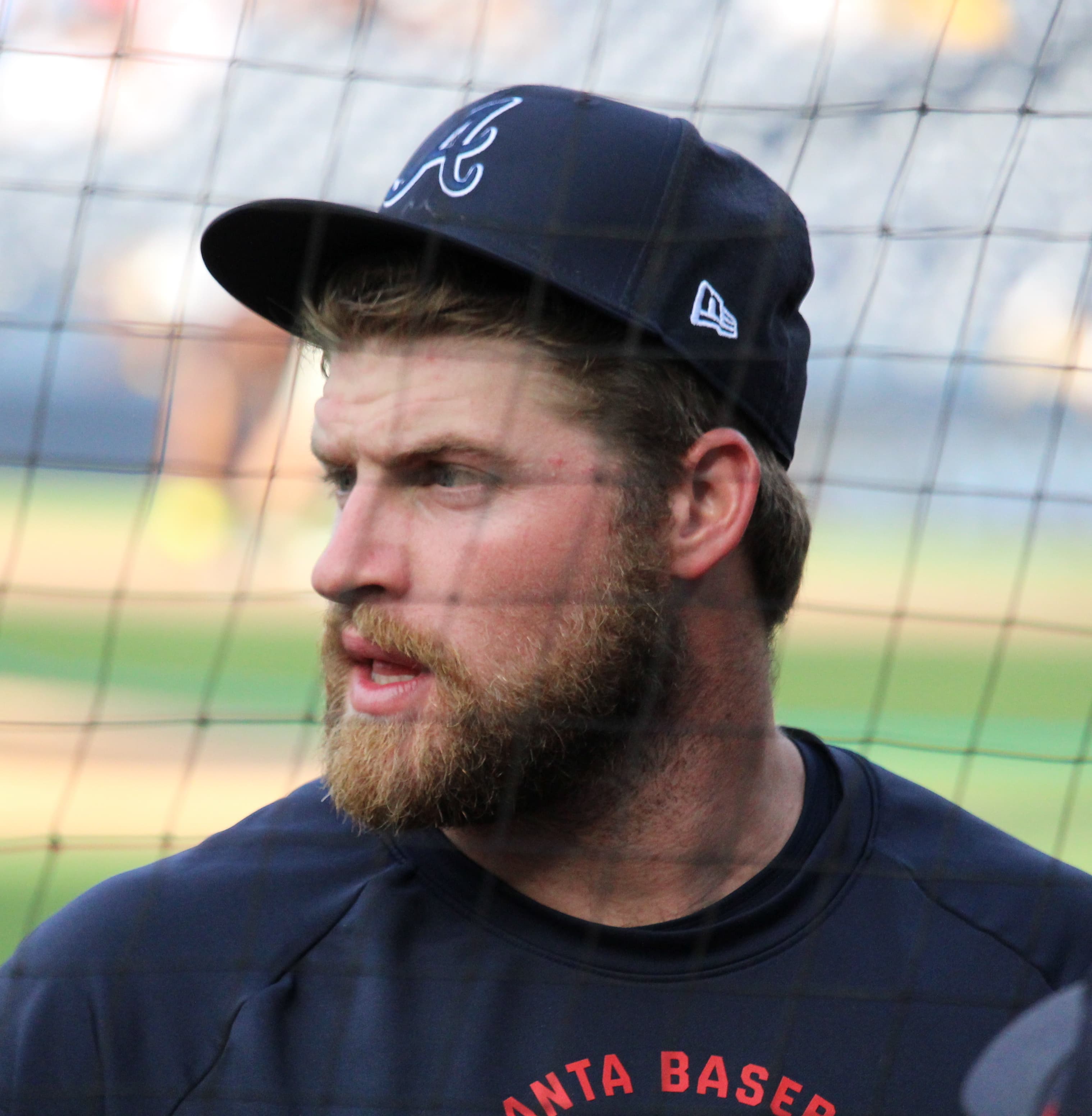
_12_Chris_Sale.jpg&w=3840&q=75) Photo by Thomson200, CC0, via Wikimedia Commons
Photo by Thomson200, CC0, via Wikimedia Commons134 Years and the Same Blueprint
The last franchise team to start this well had Kid Nichols, a four-man rotation, and a 152-game schedule. The 2026 Braves have a depth chart that never stops producing names.
In 1892, the Boston Beaneaters went 52-22 in the first half of the National League’s only split-season experiment, then won the pennant and the World’s Championship Series 5-0 over Cleveland. One hundred and thirty-four years later — through a relocation to Milwaukee, another to Atlanta, through Hank Aaron and Bobby Cox and a World Series that arrived from below .500 — the franchise posted its best 35-game start since those Beaneaters.
The Braves are 25-10. And the parallel goes deeper than the number.
Frank Selee’s 1892 roster was built on a specific premise: you cannot have too many arms who belong. When the American Association dissolved after 1891, Selee’s Beaneaters absorbed its talent — Jack Stivetts, Hugh Duffy, Tommy McCarthy. Stivetts and Kid Nichols both won 35 games that season. Historians call it the first great starting rotation of four. The Beaneaters didn’t win because they had one ace. They won because the next man up was also an ace.
The 2026 Braves haven’t dissolved a rival league, but Alex Anthopoulos has spent three years following Selee’s logic with different currency. Chris Sale arrived via trade. Martín Pérez via a minor-league deal in January. J.R. Ritchie through the draft pipeline. Bryce Elder through internal development. Robert Suarez in free agency. Each acquisition answered a different question at a different time, and across three games in Denver, the cumulative answer was a sweep and a franchise milestone nobody had been tracking until it arrived.
Sale was Saturday’s headline: 7 innings, 1 earned run, 11 strikeouts, his sixth win. At 37, he is pitching with the economy of a man who has learned that the strike zone rewards accuracy, not ambition. His ERA has fallen to 2.14. Since the one bad start in Anaheim on April 7, he has allowed more than 1 earned run exactly once in five starts. That is not a streak. That is a method.
But the game’s other story was Drake Baldwin, the second-year catcher who went 3-for-4 with 4 RBI and a two-run home run. Baldwin’s season OPS has climbed past .900 — on pace for 35 home runs from the catching position. Kid Nichols didn’t have a catcher hitting like that. Baldwin is what happens when a franchise invests in depth at every position, not just the ones on magazine covers.
The Beaneaters’ split-season is a useful cautionary footnote. They went 52-22 in the first half and 50-26 in the second — still excellent, but visibly mortal. The pace that defines April does not always define October.
The 2026 Braves are navigating that truth right now. Ronald Acuña Jr. went to the 10-day IL Friday with a Grade 1 left hamstring strain — the mildest classification, two to three weeks, but any lower-body injury for a player with two prior ACL tears registers at a different frequency. Spencer Strider returned Sunday and walked five batters in 3.1 innings before the bullpen cleaned up behind him. Raisel Iglesias, the closer who hasn’t blown a save all season, has been on the IL since April 21 with shoulder inflammation. His expected activation Tuesday in Seattle will be the latest name to re-enter a roster that keeps compensating for the last name that left it.
This is what the 25-10 record actually measures. Not dominance — configuration. The May 3 lineup that swept Colorado included Jonah Heim catching (5 RBI, a 425-foot home run), Jorge Mateo at shortstop (407-foot solo shot), and José Azócar on the roster for the first time because Acuña’s hamstring required a corresponding move. Three weeks ago, none of those names appeared in the projected starting nine.
Selee’s Beaneaters did the same thing with different mechanisms. Stivetts was a two-way player — a .296-hitting pitcher in an era when that meant he was a legitimate offensive weapon. Duffy and McCarthy, the celebrated “Heavenly Twins” outfield pairing, were absorbed from a rival league’s collapse. The roster churned constantly. The results stayed.
There is a temptation, when a franchise posts its best start in 134 years, to treat the comparison as a destination. It isn’t. A .714 winning percentage extrapolated across 162 games projects to 116-46. The Braves will not win 116 games. The pace is diagnostic, not predictive — it tells you what the structure can produce under favorable conditions, not what it will produce across six months of regression and a late-summer road trip through the AL West.
But the diagnosis is worth reading carefully. The Braves lead baseball in runs scored at 5.65 per game. Their team ERA is 3.05. They are ranked #1 in MLB.com’s power rankings for the first time in three years, and ESPN has them at #2. Ozzie Albies is hitting .316 — a career-best trajectory. Michael Harris II carries a .902 OPS. Matt Olson’s 414-foot home run Saturday was his 11th, and his 85 defensive runs saved since 2018 nearly doubles any other first baseman.
Kid Nichols won 35 games for the Beaneaters in 1892 and is now in the Hall of Fame. Jack Stivetts won 35 games and is largely forgotten. The difference between the two is not talent — it is the length of the sample. Nichols sustained it across a career. Stivetts had one magnificent season and several ordinary ones.
Baseball has a long memory. This franchise’s memory is longer than most — 134 years of it, from Boston to Milwaukee to Atlanta, from Selee’s four-man rotation to Anthopoulos’s depth chart that regenerates a new name every time one disappears into the trainer’s room. The Braves head to Seattle tonight for three games against the 16-19 Mariners, with Iglesias expected back by Tuesday.
The 1892 Beaneaters won it all. Whether the 2026 Braves follow the same arc is a question for October. For now, the blueprint reads the same as it did when Selee drew it up: have more arms than you need, fill every lineup spot with someone who belongs, and let the math compound over 162 games.
The first 35 say the math is working.
The Tilt
The 25-10 start is diagnostic, not predictive — same blueprint the Beaneaters drew in 1892.
— Ellis Magnolia
What's your take?
Keep Reading
October Has Two Off Days
I wrote yesterday that October asks a club who its best three starters are. The published 2026 calendar says the number is four, and Atlanta are carrying six arms with 17 games left to sort them.
Lopez Is Not Tonight's Problem
Everybody is about to tell you the Braves are gambling on an arm that has not pitched since July. The pitch count says otherwise, and it points at something worse.
_15.jpg&w=3840&q=75)
Somebody Has to Take the Turn
Atlanta went to a six-man rotation to keep five arms fresh for October. On the first night of nine straight games, the sixth man got ten outs, the staff gave up four home runs, and the bullpen covered the rest.