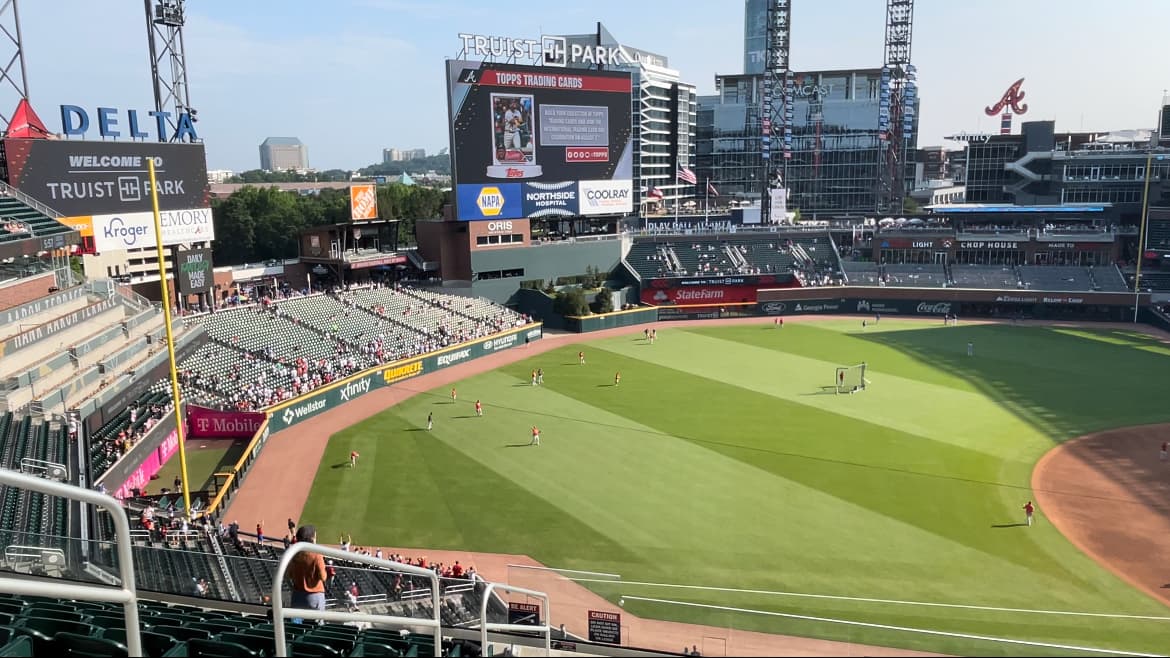
 Photo by BullDawg2021, CC BY-SA 4.0, via Wikimedia Commons
Four Teams Kept That Company. Two of Them Collapsed.
The Braves lost a series for the first time in 2026. The historical company they just left tells you exactly nothing about what happens next.
Since the Wild Card era began in 1995, four teams had opened a season with eleven or more unbeaten series before the Braves joined them. Two made deep October runs. Two never got there. The correlation between the streak and the ending is, precisely, zero.
The 1997 Orioles went fourteen unbeaten series and won 98 games. Lost the ALCS to Cleveland. The 2020 Dodgers went thirteen and won the World Series. The 2018 Diamondbacks went twelve, finished 82-80, and missed the playoffs. The 1995 Phillies went twelve, opened 37-18, then collapsed to 69-75.
The Braves went 10-0-1 through their first eleven completed series of 2026. Then the Braves flew to Seattle.
The series opened Monday at T-Mobile Park with the kind of game that looks fine for six innings and then doesn't. Four Braves hit solo home runs — Baldwin, Albies, Olson, Riley — building a 4-0 lead that felt comfortable in the way baseball leads sometimes do before they aren't. Tyler Kinley entered the sixth and allowed five runs: Luke Raley hit a three-run homer, J.P. Crawford followed with a two-run shot, and a 4-0 game became a 5-4 loss.
The bullpen had been the subject of honest scrutiny since Iglesias went to the IL. The middle innings were the vulnerability this column identified. Kinley's sixth inning was not an outlier. It was the vulnerability arriving on schedule.
Matt Olson's home run in that game was his 300th career homer. He became the 166th player in major league history to reach that number, and one of 65 to do it before turning 33. The milestone deserved a better frame than a loss, but milestones rarely consult the scoreboard.
Game 2 was the correction. Olson hit a 412-foot walk-off homer off Andres Muñoz in the ninth — his second home run in as many nights. Iglesias, activated from the IL that afternoon, earned the save in his first appearance back. Elder gave the Braves six innings of two-run ball.
Ozzie Albies extended his hitting streak to seventeen games, tying the franchise record. He leads the majors with 47 hits. For a player whose April started quietly enough that nobody was writing about him, Albies has become the most consistent bat on a roster full of them.
That was the series at its best: Olson's milestone power, Albies's accumulating presence, Iglesias returning to the back end.
Then Bryan Woo reminded everyone that pitching matchups are not suggestions.
Woo threw six innings on Tuesday, allowing one hit and striking out nine — a season high. Julio Rodriguez hit a 436-foot home run. Cole Young went 3-for-4 with two doubles. Pérez took the loss, giving up two runs over 5.2 innings in a start that was fine in every way that doesn't produce a win.
Albies went 0-for-3. The hitting streak ended at seventeen.
Two bookends, then. Olson's 300th home run opened the series. Albies's streak ending closed it. Between them, the Braves lost a series for the first time in 2026.
The temptation is to read the loss diagnostically — to find the structural flaw it exposes and project it forward. Resist.
The Braves are 26-12 with a plus-81 run differential and 5.73 runs per game, both best in the majors. Iglesias is back. Nothing about a 1-2 series against a competent Seattle team changes the underlying architecture. But the historical company tells you the streak was never the evidence. Baltimore went fourteen unbeaten series in 1997 and lost in October. Arizona went twelve in 2018 and missed the playoffs. Philadelphia went twelve in 1995 and collapsed to 69-75.
The 10-0-1 record was a real accomplishment and a useless predictor. It measured resilience over a small window. It did not measure what happens when the window opens wider.
The Braves fly to Dodger Stadium tomorrow for a three-game series. Sale faces Sheehan. Strider, in his second start since returning from the IL, draws Yoshinobu Sasaki. Elder gets Wrobleski in the finale.
That is the measuring stick. Not the streak that just ended, but the opponent that comes next. Acuña remains on the 10-day IL with a Grade 1 left hamstring strain — estimated return May 13 — which means the Dodgers series will be played without him. The lineup has absorbed his absence without structural damage. Whether it can absorb Sasaki and the Dodgers' pitching depth is a different question.
Baseball has a long memory, but it has a short attention span. The franchise will lose twenty or thirty more games this season. The ones that matter tend to announce themselves against October-caliber opponents, not in the middle of a May road trip.
The streak is over. The season is not. And the next three games will tell you more about this team than the last eleven series combined.
The Tilt
The 10-0-1 series streak was the most meaningless accomplishment on the Braves' resume, and losing it might be the most useful thing that's happened to them since April.
— Ellis Magnolia
What's your take?
Keep Reading
October Has Two Off Days
I wrote yesterday that October asks a club who its best three starters are. The published 2026 calendar says the number is four, and Atlanta are carrying six arms with 17 games left to sort them.
Lopez Is Not Tonight's Problem
Everybody is about to tell you the Braves are gambling on an arm that has not pitched since July. The pitch count says otherwise, and it points at something worse.
_15.jpg&w=3840&q=75)
Somebody Has to Take the Turn
Atlanta went to a six-man rotation to keep five arms fresh for October. On the first night of nine straight games, the sixth man got ten outs, the staff gave up four home runs, and the bullpen covered the rest.