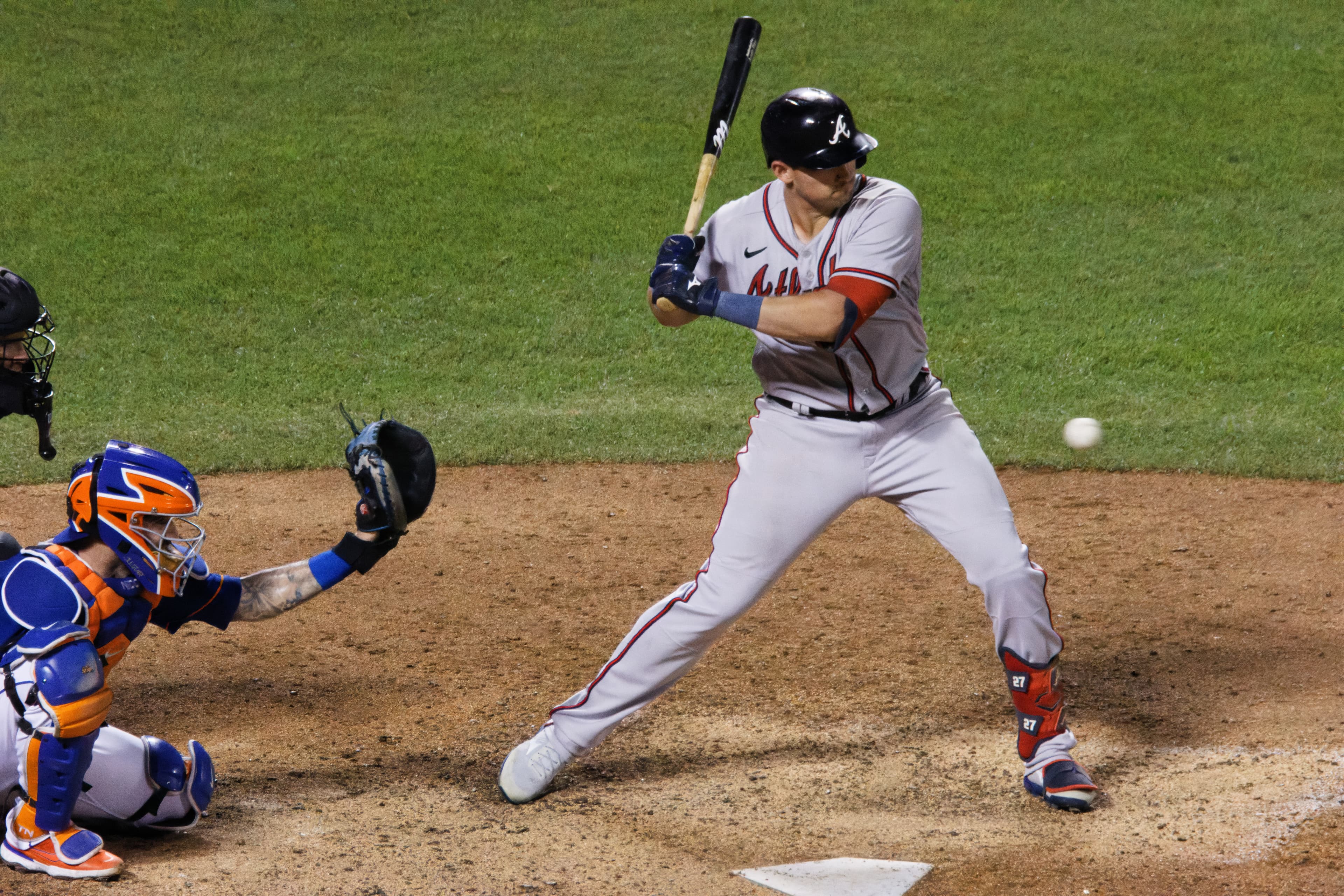
 Photo by Thomson200, CC0, via Wikimedia Commons
Four Walks and One Hit Tell the Same Story
Grant Holmes walked four batters in four innings. His pitchers also allowed one hit. Both numbers tell the same story — the Braves don't need perfection because the infrastructure absorbs everything.
One hit.
That is the number the box score remembers from Monday night at Truist Park, where the Braves beat the Cubs 5-2 before 38,342 people who had just watched a video tribute to Bobby Cox and Ted Turner. One hit allowed by four Atlanta pitchers across nine innings. Alex Bregman's solo home run in the fourth was the only ball a Cub put in play and found grass all evening.
But the number the box score remembers is not the number that tells the full story. For that, you need a different one.
Four.
Grant Holmes walked four batters in four innings on seventy-eight pitches. He walked the leadoff man in the first. He walked two more in the fourth. Bregman drove a ball over the left-field wall for a solo home run — the only hit any Cub would manage all night — and another run scored on a grounder. Both Cubs runs belonged to the fourth inning, both belonged to Holmes. His pitch count was already at seventy-eight through four frames, the kind of economy that suggests a man spending lavishly at a store where he can't quite find what he's looking for.
Holmes's ERA sits at 4.35, the highest among the Braves' four primary starters. His FIP is 4.89. He has walked twenty-one batters in 41.1 innings this season -- a 4.57 BB/9 rate that would be alarming for a middle reliever, let alone a man asked to give a contending team length.
And yet. One hit. Five strikeouts. Holmes's line is a contradiction in miniature: the headline says dominance, the process says survival. Both are true simultaneously. You can walk four and allow one hit on a Monday night in May. You cannot walk four and allow one hit across thirty starts.
The Braves do not need Holmes to be perfect. They need Holmes to be present. And the infrastructure that absorbed his seventy-eight pitches and turned them into a one-hitter is the more revealing story.
Didier Fuentes is twenty-one years old. He ended 2025 with shoulder inflammation, earned an Opening Day roster spot, got optioned briefly to Gwinnett, and returned to a role most pitchers twice his age would find uncomfortable: bridge the gap between a starter who couldn't finish and a closer who doesn't miss.
Monday, Fuentes threw three scoreless innings. Zero hits. One walk. Three strikeouts. His season line now reads 15.2 innings, a 3.45 ERA, a 1.02 WHIP, and a strikeout-to-walk ratio of 19 to 5. I wrote in my notebook on March 29, after watching him pitch four innings of one-run ball against Kansas City, that he looked like he belonged. Six appearances later, the evidence has not argued back.
The relay from Fuentes to Dylan Lee to Raisel Iglesias was seamless. Lee threw a perfect eighth -- his seventh hold, his ERA at 0.92, twenty-one strikeouts against one walk over his last twenty outings. Iglesias retired the side in order for his seventh save. His ERA in 2026 remains 0.00. Twenty consecutive scoreless appearances dating to last season.
The fifteen-year age gap between the man who earned Monday's win and the man who recorded the save is not a coincidence. It is a design document.
Austin Riley opened the third with a solo home run -- 409 feet, 106.1 miles per hour off the bat. His sixth of the season. Over his last ten games, Riley has hit .263 with two home runs and seven RBI, a stretch that reads like a different hitter than the one carrying a .220 average and a 77 wRC+ into early May. His Statcast profile (91.1 mph exit velocity, 9.1% barrel rate, .289 wOBA) says the bat has not fully arrived. The 409-foot answer was the most emphatic sentence he has offered in weeks. Whether this is a trend or a moment, the honest notebook records both possibilities and waits.
The fifth inning provided the cushion. Dominic Smith went 4-for-4, pushing his average to .363 and extending a career renaissance that started with grief and a grand slam. Mike Yastrzemski -- hitting .188 entering the game, the subject of national articles questioning the Braves' $23 million investment -- launched a two-run homer into the Chop House seats. Matt Olson added an RBI single. Four runs, four contributors, a 5-2 lead the bullpen would not negotiate.
Yastrzemski finished 2-for-2 with three RBI and the best game of his Atlanta tenure. At .214, he remains well below the player the Braves signed. One game does not constitute a turning point. It constitutes a data point, and the sample must grow before the conclusion does.
The Braves are 29-13. Best record in baseball. Best forty-two-game start in the franchise's Atlanta era. Nine games clear in the NL East -- a division whose competitive question I declared answered in late April. Their run differential is plus-87, fourteen more than the next-closest team. Monday's opponent was not a team being swept aside: the Cubs entered at 27-15, second-best record in the National League. That they left Truist Park with one hit and a three-game losing streak says something about the distance between good and whatever the Braves are building.
But here is the number that an honest accounting must hold alongside the rest: the rotation FIP is 4.22 against a rotation ERA of 2.84. The gap -- 1.38 runs -- is the largest positive variance in baseball, built partly on a .244 rotation BABIP that tends to migrate toward the mean as summer settles in. This does not mean the pitching is a mirage. It means it has been both excellent and fortunate, and the honest analyst distinguishes between the two.
The franchise knows this rhythm. The 1997 Braves started 22-8 through thirty games and lost the NLCS. The 1998 team went 106-56 and lost the NLCS. The 1995 champions -- the only team in this city's history to finish the job -- started 18-12. They were not the best version of themselves in April. They were the right version of themselves in October. Since expanded playoffs began in 2022, the best regular-season team has won the World Series exactly once. Atlanta won fourteen consecutive division titles with one ring.
Before the first pitch Monday, Truist Park went quiet for Cox and Turner -- two men whose fingerprints remain visible in every organizational reflex this franchise demonstrates. The tribute was a reminder that the architecture the 2026 Braves inhabit was drafted by men who are no longer here to see it occupied.
One hit allowed. Four walks absorbed. Three scoreless bridge innings from a twenty-one-year-old. A closer who has not surrendered an earned run all season. A 409-foot statement from a third baseman searching for his swing. A career night from an outfielder searching for his role.
The Braves are building this season on the depth to survive the nights when the starter cannot locate, the patience to wait for the bats that haven't arrived yet, and the infrastructure to turn four walks and one hit into the same final score. The notebook records both the numbers that matter and the few that will eventually regress.
Keep Reading
October Has Two Off Days
I wrote yesterday that October asks a club who its best three starters are. The published 2026 calendar says the number is four, and Atlanta are carrying six arms with 17 games left to sort them.
Lopez Is Not Tonight's Problem
Everybody is about to tell you the Braves are gambling on an arm that has not pitched since July. The pitch count says otherwise, and it points at something worse.
_15.jpg&w=3840&q=75)
Somebody Has to Take the Turn
Atlanta went to a six-man rotation to keep five arms fresh for October. On the first night of nine straight games, the sixth man got ten outs, the staff gave up four home runs, and the bullpen covered the rest.