_by_Sandro_Halank%E2%80%93082.jpg&w=3840&q=75) Photo by Sandro Halank, CC BY-SA 4.0, via Wikimedia Commons
Photo by Sandro Halank, CC BY-SA 4.0, via Wikimedia CommonsThe Morning After
The exit interviews happened Thursday. Jalen Johnson sat in front of reporters and said what twenty-four-year-olds say when the season ends before they expected it to: "It just sucks. I think that's the best way to sum it up." Then he paused, and said the part that matters more: "I'm going to take a couple days to decompress, and then I'm really going to dive back into the film."
The film. Not the vibes, not the motivation, not the narrative. The film. Johnson has become the kind of player who processes a loss through footage, not feelings. That distinction is worth noting as the Hawks begin an offseason that will test whether the franchise trusts process as much as its best player does.
Because here is the tension the exit interviews surfaced, the one that will define this summer: GM Onsi Saleh stood at the podium and said, plainly, that the Hawks are "not one player away from this. The best iteration of this team is going to be through development and our players currently getting better." He praised Quin Snyder as "an unbelievable partner." He talked about draft flexibility, financial room, the patience to let a young roster grow.
And then you look at the roster, and you see a No. 1 overall pick who played 7.7 minutes per game in the playoffs.
The Risacher Question
Zaccharie Risacher averaged 9.6 points this season. Down from 12.6 as a rookie. His perimeter isolation defense fell to the 23rd percentile. He lost his starting job after the All-Star break, his minutes shrank to 16.3 per game over the final 15 games, and he received a DNP-CD on April 8 — a healthy scratch on a team fighting for seeding. In the Knicks series, he appeared in three of six games. Zero starts.
At exit interviews, Risacher said what you say when the ground beneath you has shifted: "I feel like I just kept working, you know. I had to stay ready no matter what. And that was, I feel like, the biggest adjustment for me... fighting through adversity is a part of the job."
John Hollinger of The Athletic has reported that a trade "can't be ruled out." And here is where the franchise pattern surfaces — the one that runs deeper than any single roster decision. The Hawks have always been willing to move on from players before the story is finished. Pettit to Dominique to Mutombo to Horford to Millsap to Trae. Not all trades, but all departures. The franchise does not wait to see how the last chapter reads. It turns the page early and starts writing the next one.
Risacher did not fail in isolation. The roster got better around him. Johnson became a first-time All-Star at 24 — 22.5 points, 10.3 rebounds, 7.9 assists over 72 games. Nickeil Alexander-Walker won Most Improved Player, leaping from a career-high 12.8 to 20.8 points per game on 45.9/39.9/90.2 splits. Jonathan Kuminga arrived at the trade deadline from Golden State and debuted with 27/7/4 on 75 percent shooting. Wings and forwards filled the space Risacher was supposed to grow into, and the team won more games because of it.
This is the paradox Saleh's "development" philosophy has to answer: the system develops players beautifully — the Hawks are the first franchise in NBA history to produce back-to-back Most Improved Players, with Dyson Daniels winning it last year and Alexander-Walker this year — but that same development engine has no room for the player they spent the first overall pick on.
What Twenty-Four Million Dollars Tells You
Kuminga has a $24.3 million team option for next season. Reports say there is mutual interest in declining it to negotiate a longer deal instead. The math makes sense: the Hawks traded Kristaps Porzingis — who had played 17 games — and Buddy Hield to get him. Letting Kuminga walk would reduce that trade to a salary dump with no return.
But Kuminga, by multiple accounts, "noticeably dropped off in form" in the final three games of the Knicks series. The regular season showed flashes. The postseason showed limits. The decision to extend him is a proxy for how the front office weighs playoff performance against potential — and it will tell you more about this regime's actual philosophy than anything Saleh said at the podium.
Saleh's public stance is clear: no star acquisition. Jake Fischer reported the Hawks have "received no indication" that they are pursuing a Giannis Antetokounmpo trade this summer. The front office is choosing the longer road. The question is whether the roster they are building for that road includes a 20-year-old French wing who cannot crack the rotation, a 23-year-old trade-deadline acquisition whose playoff performance trailed off, or both.
May 10
There is a date on the calendar that changes the math. The NBA draft lottery is Sunday, May 10. The Hawks own the more favorable of the Pelicans' and Bucks' first-round picks — and New Orleans finished 26-56, landing in the 7th lottery slot. That gives the pick a 6.8 percent chance of being the No. 1 overall selection and a 29.3 percent chance of landing in the top four.
The Hawks also hold their own pick at No. 23 and the No. 57 in the second round. Combined with $55.9 million below the first luxury-tax apron and $68.9 million under the second, the financial and draft flexibility is real. Saleh's patience has currency.
If the Pelicans pick lands in the top four, the offseason shifts from patient development to a draft night with franchise-altering stakes. A top-four pick, paired with Risacher as a trade asset, gives the Hawks enough ammunition to reshape the roster without mortgaging the young core that produced a 46-36 season — the franchise's best record since 2015-16.
If it doesn't, the offseason becomes a series of smaller, more honest decisions. Re-sign McCollum at terms that acknowledge what the Knicks series exposed about his limitations at 34. Pick up Kuminga's option or negotiate the longer commitment. Find shooting. Address the perimeter creation that vanished when the playoffs demanded it.
The Sentence After the Ending
Daniels, who led the league in steals for the second consecutive season, was asked about his three-point shooting — 11.3 percent this season, a career worst. "I think it's all mental," he said. The answer was honest in the way that only a 22-year-old can be: no deflection, no scheme excuse, just the admission that the limitation is inside his own head.
Snyder has one year left on his contract. The Hawks plan extension discussions. The president of basketball operations search, announced nearly a year ago, has produced no public hire — leaving Saleh as the decision-maker for the biggest offseason the franchise has faced since trading Trae.
As Dex wrote yesterday, the humiliation of the ending leaves no room for self-deception. That is a gift, if the franchise treats it as one. Forty-six wins. A first-round exit. A No. 1 pick who cannot find minutes. A system that develops players better than almost anyone. A lottery ticket that resolves in eight days.
Johnson said he would decompress for a couple days, then go to the film. That is the right instinct. The film does not lie, and it does not console. It just shows you what happened, frame by frame, and waits for you to decide what to do next.
The Hawks have always moved on before the story is finished. This summer, the question is whether they are moving toward something or just moving.
Soundtrack: "Pink + White" by Frank Ocean — because the most honest songs about endings don't sound sad. They sound like the weather changing.
The Tilt
The Hawks have produced back-to-back Most Improved Players and cannot find minutes for the No. 1 overall pick they drafted two years ago. That contradiction is not a roster problem. It is the franchise telling you exactly who it values.
— Simone Edgewood
What's your take?
Keep Reading
Everybody Kept Their Old Job
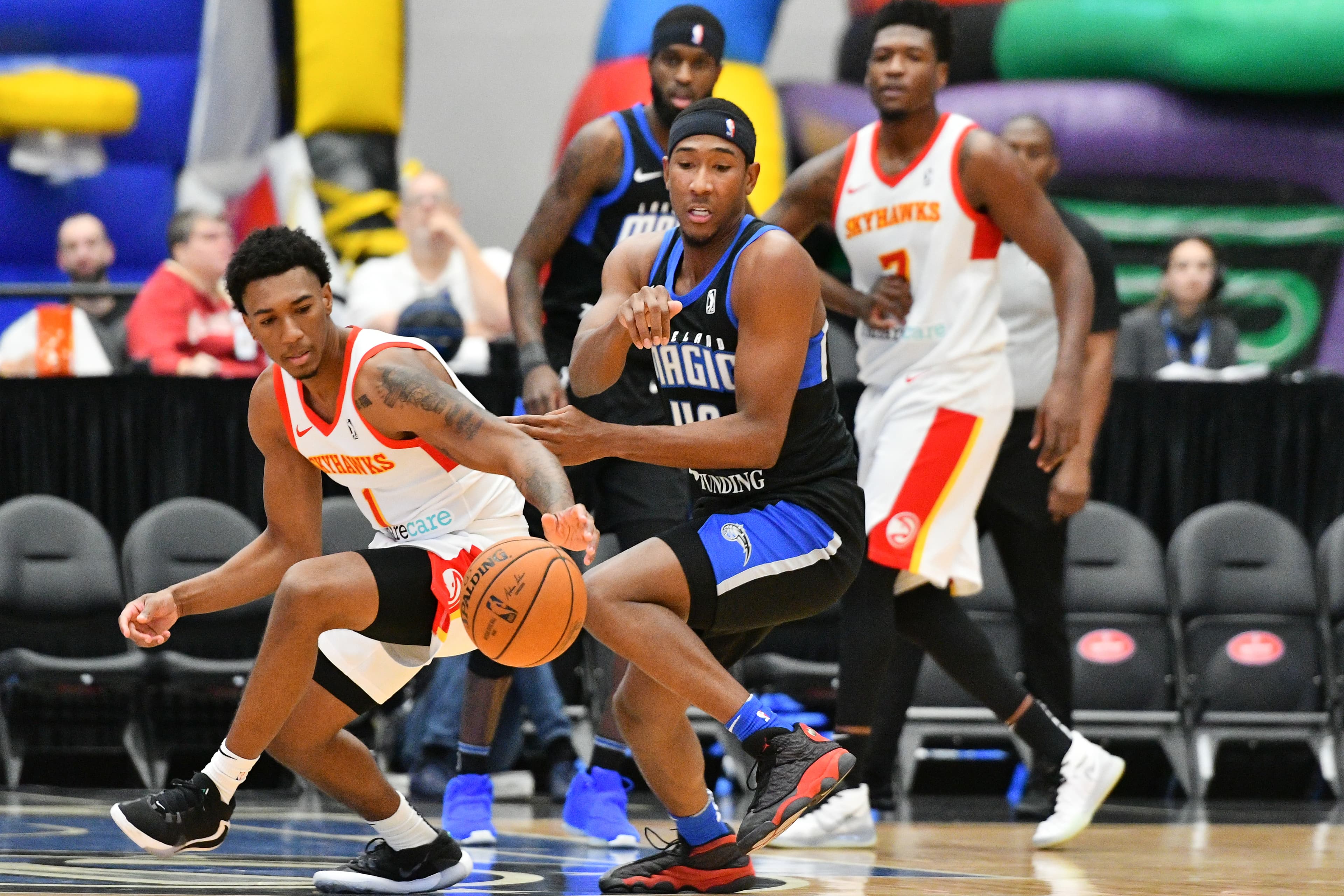
The Hawks handed the College Park Skyhawks a new general manager, a new head coach and a first-ever associate head coach on Wednesday, and none of the three gave up the job they already had in Atlanta. Two of them used to play there.
Nobody Else in the Sentence
Yesterday I asked whether anyone would ever describe this Hawks team without naming another franchise to finish the sentence. It took one night, and the answer came from a player who has not practiced here yet, in a gym in Quebec City, in nouns nobody writing previews has access to.
Built Against Somebody
The national previews have landed and Atlanta's sentence for the season is that the Hawks built an anti-Knicks roster. It is meant as a compliment. It is also one more year of being described in relation to somebody else.