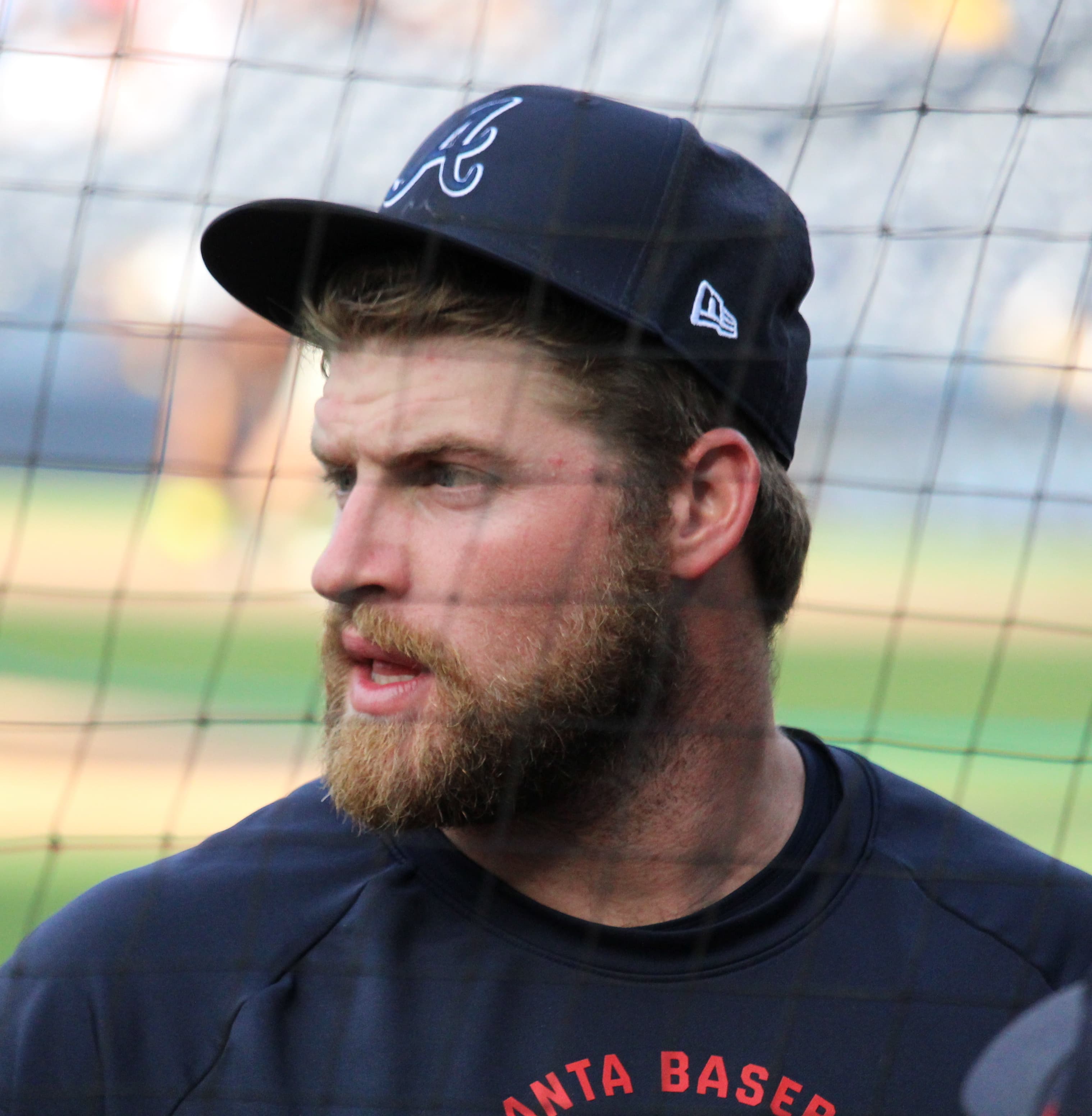
 Photo by TarheelBornBred, CC0, via Wikimedia Commons
The Numbers That Stopped Lying
Drake Baldwin's xwOBA and wOBA have converged to within a thousandth of a point. In a sport that rewards patience, the second-year catcher's production just ran out of caveats.
There is a number that separates hope from evidence, and Drake Baldwin found it sometime in early May.
His wOBA is .398. His expected wOBA, the Statcast-derived metric that strips away luck and fielding and the thousand small mercies a baseball can offer a hitter, is .397. The gap between what Baldwin has produced and what he deserves to have produced is one thousandth of a point. In a sport that spends entire winters arguing about sample size, that convergence is the closest thing to a closed case you will find in a 46-game window.
I asked the floor-or-ceiling question in April. Forty-six games later, the answer is neither. Baldwin has built a new room.
The Architecture of Contact
The exit velocity is 92.3 miles per hour. The hard-hit rate is 51.8 percent. The barrel rate is 17.5 percent. Each of these numbers, taken alone, would place Baldwin among the best-hitting catchers in baseball. Taken together, they describe something rarer: a hitter whose production is mechanically sound, not sequentially fortunate.
This distinction matters more at catcher than at any other position. The squat, the foul tips, the collisions at the plate — catching erodes offensive performance the way coastal weather erodes paint. Most catchers who hit well in April are borrowing against a body that will collect in August. Baldwin's Statcast profile says the lending rate is fair. The contact quality is real. The BABIP is not doing favors it will later rescind.
Through 46 games: .297/.383/.509, 13 home runs, 36 RBI, a 125 wRC+ that means he is producing 25 percent more offense than a league-average hitter. He leads Major League Baseball in hits on pitches outside the strike zone with 17 — a detail that sounds like a curiosity until you understand what it reveals. Baldwin is not simply recognizing pitches. He is recognizing pitches, deciding they are close enough, and driving them with authority. The discipline to take and the discipline to damage are usually different skills. Baldwin has married them.
He is slashing .889 against left-handed pitching. He has scored in 21 of the Braves' 31 wins. On Friday night against Boston, he opened the game with a 421-foot home run, went 2-for-3 with two RBI, and still watched the Braves lose 3-2 because one bat, no matter how good, cannot pitch a bullpen into silence.
The Ghost of Javy Lopez
Baseball has a long memory, and the last time a Braves catcher hit like this, the catcher was Javy Lopez and the year was 2003.
Lopez finished that season at .328/.378/.687 with 43 home runs — a number so dissonant for the position that it finished fifth in MVP voting and still felt like an outlier rather than a precedent. No Braves catcher has approached it since. The franchise record for home runs by a catcher has stood for twenty-three years, undisturbed, the way records stand when they describe something slightly unreasonable.
Baldwin is on pace for 46.
I will let that number sit for a moment, because it deserves the silence. Forty-six home runs from the catcher's box at Truist Park would not just break Lopez's record. It would rewrite the positional expectation for the franchise. Lopez himself, in a recent AJC interview, called Baldwin "a spark" — the kind of understatement that suggests the man who holds the record can see it leaving.
The comparison is imperfect, as all comparisons across decades must be. Lopez was 28 during his monster year, a veteran who had been catching in Atlanta for a decade. Baldwin is 23, in his second full season, still calibrating a relationship with a pitching staff that includes two arms returning from major injury. Lopez played in an era when catcher offense was measured against a lower baseline. Baldwin is producing in a landscape where the position has been permanently altered by the two-way expectations Buster Posey codified when he won NL MVP in 2012 — the last time a catcher took that award.
But the bones of the comparison hold. Elite bat. Franchise catcher. A team built to win now. And the quiet question of how long the body cooperates.
The Honest Paragraph
This is where I owe you the other number.
Baldwin's caught-stealing rate sits at the 19th percentile. His pitch framing grades at the 45th. The bat is elite. The glove is not. This is not a nitpick deployed to balance a flattering portrait — it is the central tension of Baldwin's value proposition, and an honest piece must sit with it rather than wave it away.
The 19th percentile means roughly four out of five catchers in baseball are better at controlling the running game. In a sport trending toward larger leads and more aggressive baserunning, that number has defensive consequences that compound across a 162-game season. The framing, at the 45th percentile, is league-average when you are generous and below-average when you are not. Neither number will prevent Baldwin from being an All-Star. Both numbers will surface in October, when the margins between advancing and going home are measured in single pitches and single bases.
The Braves, at 31-14 with the best record in baseball and a nine-game cushion in the NL East, can afford this trade-off in May. Whether they can afford it in a five-game series against a team that runs — that is a question for a different month and a more anxious notebook.
The Room He Built
When Dex made the extension case in April, the argument was financial. When I wrote about the roster depth that produced the 30th win, Baldwin was one name among many — the 11th home run folded into a depth thesis, not a star turn.
This piece is the star turn, and the evidence has earned it.
Matt Olson is slashing .296/.377/.654 with a 178 wRC+. He is the MVP frontrunner on this team and arguably in this league. Olson's presence is what makes Baldwin's production transformational rather than merely excellent — when the best hitter in your lineup is a first baseman producing at a historic rate, and your catcher is adding 125 wRC+ behind him, the multiplicative effect on run production is not addition. It is compounding interest.
Chipper Jones said this spring that Baldwin was "not far from becoming the best catcher in baseball." Forty-six games into the season, the expected stats agree with the legend. The exit velocity agrees. The barrel rate agrees. The only dissenters are behind the plate, not in front of it, and they are speaking in a language — caught-stealing percentage, framing runs — that the box score does not print.
Baldwin's bat has stopped needing caveats. His glove has not stopped earning them. The distance between those two facts is where the most interesting catcher in baseball lives right now — in a room the numbers say is real, furnished with a view the scouting reports say is incomplete.
Forty-six games. One thousandth of a point. The numbers stopped lying, and what they said was worth the wait.
The Tilt
Baldwin's bat has no caveats left. His glove still does.
— Ellis Magnolia
What's your take?
Keep Reading
October Has Two Off Days
I wrote yesterday that October asks a club who its best three starters are. The published 2026 calendar says the number is four, and Atlanta are carrying six arms with 17 games left to sort them.
Lopez Is Not Tonight's Problem
Everybody is about to tell you the Braves are gambling on an arm that has not pitched since July. The pitch count says otherwise, and it points at something worse.
_15.jpg&w=3840&q=75)
Somebody Has to Take the Turn
Atlanta went to a six-man rotation to keep five arms fresh for October. On the first night of nine straight games, the sixth man got ten outs, the staff gave up four home runs, and the bullpen covered the rest.