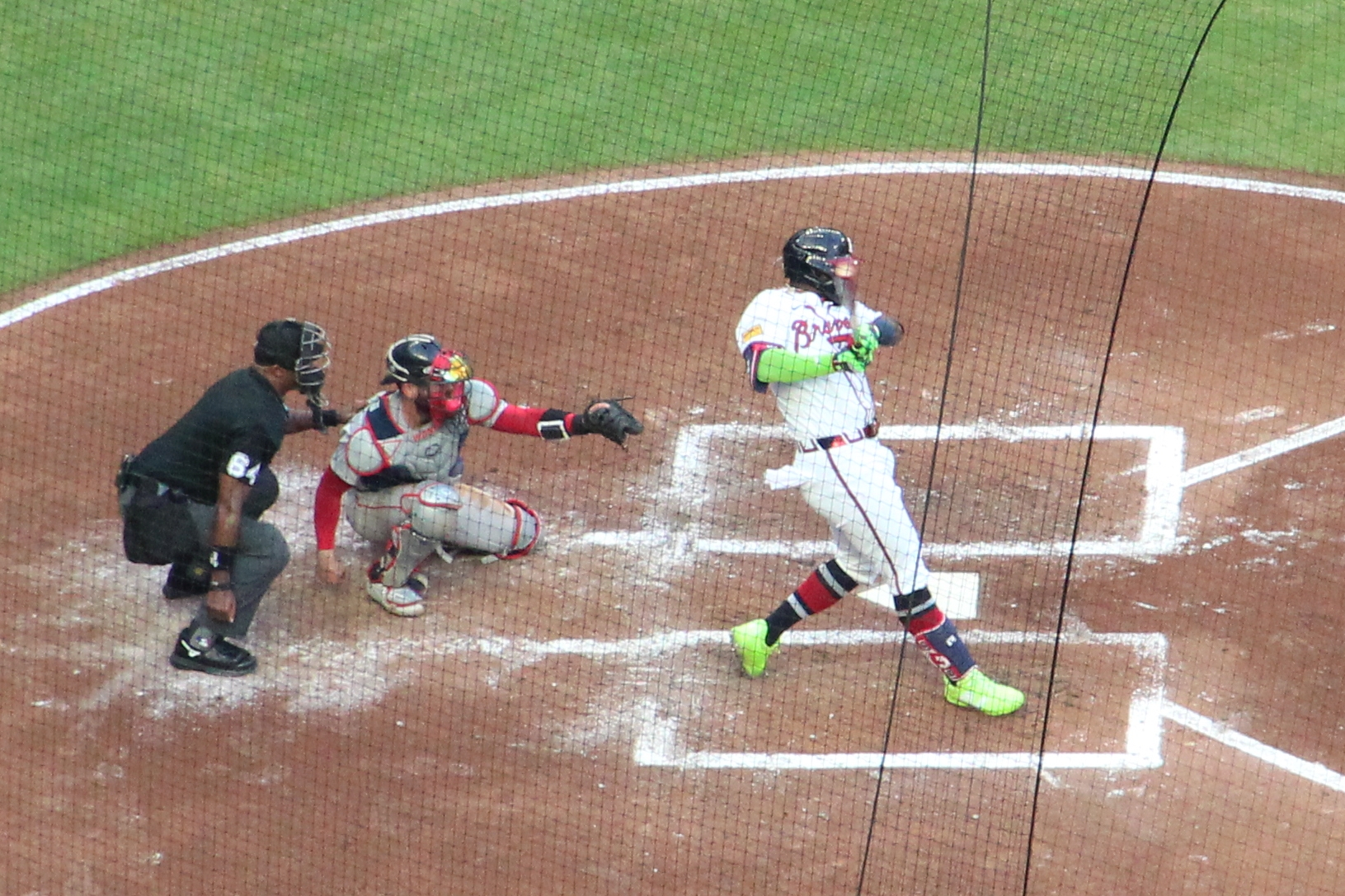
 Thomson200 / Wikimedia Commons
Thirty Wins and the Roster That Built Them
Thirty wins in 43 games is a .698 winning percentage. Extrapolated across 162, that is 113 victories, which would obliterate the franchise record of 106 set by the 1998 team that had Greg Maddux, Tom Glavine, and John Smoltz pitching in the same rotation and still lost the NLCS to San Diego.
Thirty wins in 43 games is a .698 winning percentage. Extrapolated across 162, that is 113 victories, which would obliterate the franchise record of 106 set by the 1998 team that had Greg Maddux, Tom Glavine, and John Smoltz pitching in the same rotation and still lost the NLCS to San Diego.
The number is seductive. It is also, at this stage of the calendar, a projection, not a prophecy. The 2026 Braves became the first team in baseball to reach 30 wins on Tuesday night, beating the Cubs 4-1 in a game where the winning margin was manufactured entirely by the back end of the roster. That detail matters more than the milestone.
The Infrastructure of the 30th Win
Drake Baldwin hit a solo home run in the fourth inning — his 11th of the season — to tie the game at 1. Baldwin is 25 years old, last year's NL Rookie of the Year, and now the everyday catcher for at least the next eight weeks while Sean Murphy recovers from a fractured left middle finger. His 2026 slash line reads .297/.383/.509, a sophomore statement that has quietly surpassed the numbers that won him the award.
Mike Yastrzemski delivered the tiebreaking run with a pinch-hit double in the eighth. Yastrzemski had been slashing .200/.264/.252 before the Cubs series — numbers that invited reasonable skepticism about his two-year deal. On May 12, he went 2-for-2 with three RBI. On May 13, he drove in the run that broke the game open. Two games do not erase a .200 batting average, but they do remind you why the front office valued the roster spot.
Mauricio Dubon sealed it with a two-run home run. Dubon filled in at shortstop for 28 games while Ha-Seong Kim recovered from offseason finger surgery, slashing .263/.321/.414 with 25 RBI. Kim was activated May 11. Dubon's insurance homer came from the bench, in a utility role, because the Braves had built a roster where the transition from starter to reserve still produces offense.
Three runs from three players occupying replacement-level roster spots. That is the architecture of the 30th win, and it is the architecture of the season.
The Thesis, Revisited
I wrote on April 25 that roster construction is the only baseball advantage that compounds across 162 games. That night, Michael Harris II was scratched with quad tightness, pinch-hit a 105 mph go-ahead double, and Jorge Mateo pinch-ran and stole third. The organism absorbed the disruption and produced a win anyway.
The pattern has repeated with escalating scale. The Braves went 24-8 over their last 32 games after a 6-5 start. They absorbed Ronald Acuna Jr.'s Grade 1 hamstring strain on May 2, Murphy's fracture on May 11, Spencer Strider's delayed return from an oblique, and Eli White's concussion — and the record improved. The roster does not depend on any single player being available on a given night. It depends on the organizational depth producing replacement-level contributions that, cumulatively, are anything but replacement-level.
Matt Olson is slashing .296/.377/.654 with 14 home runs, 15 doubles, and a 178 wRC+ that ties Aaron Judge for third-highest in baseball. He is only the second player in the Modern Era to record 14 home runs and 15 doubles through a team's first 41 games, joining Lance Berkman in 2008. Harris is carrying a career-best 139 wRC+ with a 95.1 mph average exit velocity and a 58.7% hard-hit rate. Chris Sale starts Thursday at 6-2 with a 2.20 ERA, 56 strikeouts in 49 innings, and a 0.90 WHIP. Ozzie Albies is hitting .333 with a 145 wRC+.
The lineup leads baseball in batting average (.272), runs per game (5.55), wRC+ (121), and slugging (.453). The run differential sits between 87 and 90, first in baseball by approximately 15 runs. The NL East lead is nine games.
These are not incremental advantages. They are structural ones.
The Honest Notebook
And yet. The honest notebook has entries that the milestone celebrations will not include.
The rotation carries an ERA of approximately 3.06, which is elite by any measure. The rotation's FIP is approximately 4.22 — a gap of more than a full run, which is the largest positive variance in baseball. I noted this yesterday after Grant Holmes's start, and the math has not changed overnight. A gap that size is built on a rotation BABIP of .244, which is 30-plus points below the league average. Balls in play are finding gloves at an unsustainable rate. When they stop — and they will — the ERA will rise to meet the FIP somewhere in the middle.
This is not a warning. It is arithmetic. The 1998 Braves went 106-56 and had the deepest rotation in modern history. They lost the NLCS. The franchise has won 14 consecutive division titles in its history, spanning 1991 to 2005, and converted that dominance into exactly one World Series ring, in 1995. Since expanded playoffs began in 2022, the best regular-season team has won the World Series only once — the 2024 Dodgers.
Pace does not predict October. It never has.
On May 4, I called the 25-10 start diagnostic, not predictive — a reading of the organizational blueprint, not a forecast of where it leads. That position holds at 30-13. What the record tells you is that the Braves have built something structurally sound: an offense that leads every meaningful category, a rotation that suppresses runs even if the peripherals suggest some of that suppression is borrowed, and a depth chart that absorbs injuries the way a well-built bridge absorbs traffic. What it does not tell you is whether that bridge holds in October, when the traffic is different.
What 30-13 Actually Means
The temptation with a milestone is to assign it more meaning than it carries. Thirty wins in 43 games is not a championship. It is not a guarantee that the rotation BABIP stays at .244 or that Olson sustains a 178 wRC+ through August. It is not proof that the 1998 record will fall.
But it is proof of something. The Braves reached 30 wins without their best player, without their starting catcher, with a rotation that reshuffled four times, and with a bench that has been asked to perform above its expected level every week since April. The 30th win was delivered by Baldwin, Yastrzemski, and Dubon — a sophomore catcher, a struggling veteran, and a utility infielder.
Roster construction compounds. That was the thesis in April, and it is what 30-13 confirms. The regression will come — it always does, and the ERA-FIP gap and the BABIP both promise it. The question is whether the infrastructure that built this record can absorb the regression the way it has absorbed everything else.
Thirty wins is a number. The depth that produced them is the story.
The Tilt
30-13 is the roster, not the stars. The depth IS the advantage.
— Ellis Magnolia
What's your take?
Keep Reading
October Has Two Off Days
I wrote yesterday that October asks a club who its best three starters are. The published 2026 calendar says the number is four, and Atlanta are carrying six arms with 17 games left to sort them.
Lopez Is Not Tonight's Problem
Everybody is about to tell you the Braves are gambling on an arm that has not pitched since July. The pitch count says otherwise, and it points at something worse.
_15.jpg&w=3840&q=75)
Somebody Has to Take the Turn
Atlanta went to a six-man rotation to keep five arms fresh for October. On the first night of nine straight games, the sixth man got ten outs, the staff gave up four home runs, and the bullpen covered the rest.