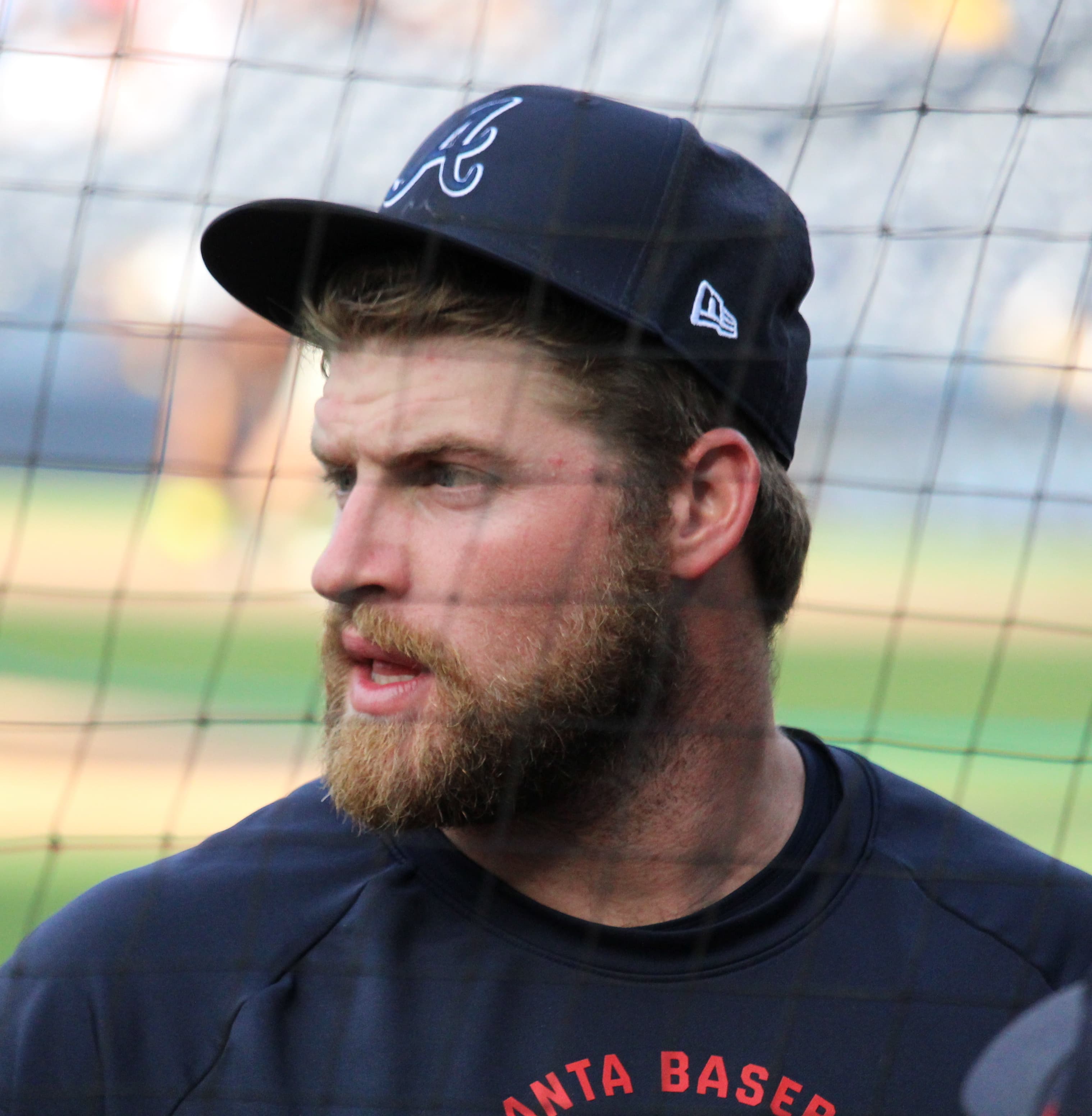
.jpg&w=3840&q=75) Photo by All-Pro Reels, CC BY-SA 2.0, via Wikimedia Commons
Photo by All-Pro Reels, CC BY-SA 2.0, via Wikimedia CommonsThe Column That Was Always Coming
The Braves went 11-7 while Austin Riley's bat was silent. Then the $212M man hit two home runs in Philadelphia, and the building that held without him got its load-bearing wall back.
Eighteen games.
That's how long Austin Riley went without a home run to open 2026. For a man who averaged 36 per season from 2021 to 2023, for a man whose signature on a $212 million extension was supposed to anchor this franchise through the decade, eighteen was an uncomfortable number. Not catastrophic. Not even, if you read the underlying data carefully, surprising. But uncomfortable.
Here's the part that matters more than the drought: the Braves went 11-7 during it.
They won series after series. They posted the National League's stingiest pitching numbers without Strider, without Schwellenbach, without Waldrep. They got 406-foot home runs from Dominic Smith and three-hit nights from Drake Baldwin and six-inning zeroes from a rotation held together with minor-league deals and organizational belief. The absence of Riley's power was, for the first three weeks of the season, something closer to an afterthought than an emergency.
That's not an accident. That's the whole point.
On April 15, Riley broke the drought against Miami — a solo shot off John King, 400 feet, 109.3 miles per hour off the bat. A crack in the silence. Two days later, on Thursday night in Philadelphia, he kicked the door the rest of the way open: a three-run homer in the second inning, a solo shot in the ninth, four RBI in a 9-0 shutout of the Phillies. His line for the night — 2-for-5, two home runs — read like a man who remembered something he'd temporarily misplaced.
I wrote yesterday that the Braves' depth wasn't a hot streak but something more durable. The thesis was structural: this roster was built to absorb exactly the kind of absences it has absorbed. Thursday night didn't change that argument. It extended it. The depth held the building upright while the most expensive column was being repaired. Now the column is bearing weight again, and the building hasn't lost a step.
The Savant data told this story before the homers did. Riley's expected weighted on-base average (.300) has exceeded his actual weighted on-base average (.286) all season — a gap that, in the grammar of Statcast, translates to a simple sentence: the quality of contact was there, and the results would follow. His average exit velocity sits at 88.3 mph. His barrel rate, at 6.3 percent, is below his career norms, but the hard-hit profile says the barrels are coming. What looked like a slump was closer to a calibration. A man who had core muscle surgery last August in Philadelphia — performed by Dr. William Meyers, the same city where he just launched two balls into the seats — was always going to need time to rediscover his timing.
Three home runs in two games. A season line of .240 with 13 RBI through twenty games. It is not what the $212 million version of Riley looks like at full capacity. It is, however, what the first draft of that version looks like, and the trend line matters more than the snapshot.
But Riley wasn't even the only story Thursday night. Michael Harris II went 3-for-4 with a homer of his own. Dominic Smith — the man on a minor-league deal who keeps showing up in meaningful moments — added a 406-foot shot. The Braves hit four home runs as a team. This was not a Riley solo act. It was the entire lineup functioning at volume, with Riley's name finally appearing on the setlist.
And then there was Martin Perez.
The 34-year-old left-hander was designated for assignment on April 12. Five days later, he was back on the active roster and pitching the game of his month: six innings, four hits, zero earned runs, four strikeouts, a 2.21 ERA that belongs to a man significantly more secure in his employment than Perez has been. He was literally released and re-signed in the span of a week. Then he went to Philadelphia and threw six shutout innings in a division game. If you wanted a single data point to illustrate how the Braves' depth functions, you couldn't design a cleaner one.
Jose Suarez recorded a three-inning save to close it. The Braves' fourth shutout of the season — tied for the major-league lead. They are 13-7, first in the NL East by four and a half games over a Phillies team sitting at 8-11 with a run differential of negative 34. Atlanta's run differential is plus 53. They haven't lost a series all year.
And here is where it becomes difficult to maintain the appropriate April restraint: the same night Riley was hitting home runs in Philadelphia, Spencer Strider was throwing three and a third scoreless innings for the Rome Emperors — his first rehab start. Three strikeouts. Fifty pitches. Zero earned runs. Walt Weiss says he doesn't expect Strider back this month, and there's no reason to rush it. But the signal arrived on the same evening as Riley's confirmation. What does this roster look like when Strider returns to a rotation already featuring Sale, Lopez, Elder, Holmes, and a Perez who can't stop pitching zeroes?
Twenty games is not a season. FanGraphs projects ninety wins and eighty-four percent playoff odds, and those projections account for the easy early schedule and the regression that April always promises. Ellis knows — I know — that the 102-win pace is a mathematical mirage at this sample size.
But the shape of this team is not a mirage. The depth held when the stars were silent. Now the stars are arriving, one by one, and the depth hasn't gone anywhere. That's not a streak. That's a blueprint reading exactly the way it was drawn.
The Tilt
The depth held without Riley. Now Riley's back and the depth hasn't gone anywhere.
— Ellis Magnolia
What's your take?
Keep Reading
October Has Two Off Days
I wrote yesterday that October asks a club who its best three starters are. The published 2026 calendar says the number is four, and Atlanta are carrying six arms with 17 games left to sort them.
Lopez Is Not Tonight's Problem
Everybody is about to tell you the Braves are gambling on an arm that has not pitched since July. The pitch count says otherwise, and it points at something worse.
_15.jpg&w=3840&q=75)
Somebody Has to Take the Turn
Atlanta went to a six-man rotation to keep five arms fresh for October. On the first night of nine straight games, the sixth man got ten outs, the staff gave up four home runs, and the bullpen covered the rest.