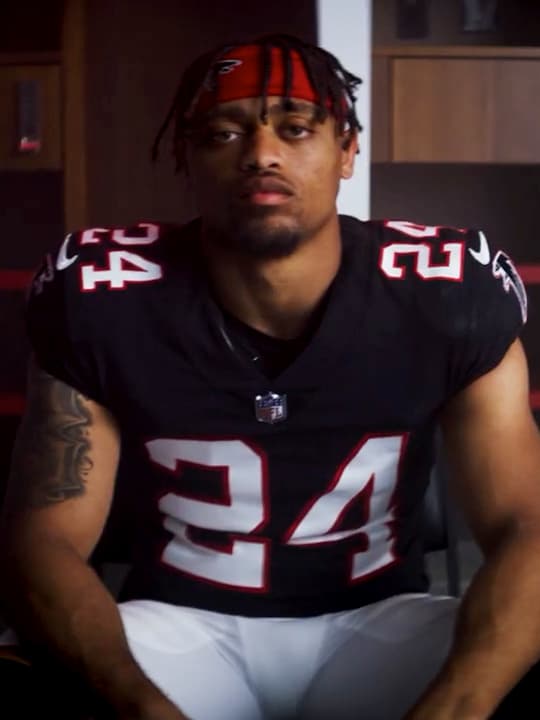
 Photo by Thomson200, CC BY 3.0, via Wikimedia Commons
Cunningham Didn't Build a Draft Class. He Built a Secondary.
I spent two weeks telling you the Falcons needed an interior defender at 48. The board cooperated. Three legitimate DTs sat there waiting. Cunningham walked past all of them and took a cornerback — and he might have been right.
I spent two weeks telling you the Falcons needed an interior defender at 48. Christen Miller was there. Lee Hunter was there. Kayden McDonald was there. The board cooperated in a way it almost never does for a team picking in the mid-second round, and I wrote exactly that in this space Friday morning. Cunningham walked past all three of them and took a cornerback.
He might have been right.
Avieon Terrell's 27 pass breakups since 2023 rank third in the FBS. His eight forced fumbles are a Clemson defensive back record. His four interceptions in 2025 came against quarterbacks who will be starting in the NFL this fall. And the moment his name was called at pick 48, the Falcons' secondary went from a question mark to something that looks, on paper, like the best in the NFC South — A.J. Terrell at CB1, Avieon at CB2, Jessie Bates III at free safety, and a defensive coordinator in Jim Ulbrich who ran man coverage at more than double the league average last season. That is not a secondary. That is a coverage structure designed to take away the intermediate passing game entirely, and in a division where the Saints just drafted Jordyn Tyson and the Buccaneers still have Mike Evans, the intermediate game is where NFC South offenses live.
But let me be precise about what happened over three days, because the national grades are telling two different stories and most people are reading only one of them.
Day 2 was an A+ class
CBS Sports gave the Falcons an A+ for their Day 2 selections, and I cannot argue with it. Terrell at 48 addressed a genuine vulnerability — the nickel position has been a problem since Dee Alford left for Buffalo and Clark Phillips III tore his Achilles — while simultaneously creating the first sibling cornerback tandem in franchise history. The Terrell brothers grew up running the same coverage techniques in the same backyard in Westside Atlanta, and that shared processing language is the kind of advantage that does not show up on a scouting report but reveals itself in Cover 2 rotations where a half-second of shared instinct is the difference between a pass breakup and a touchdown.
Zachariah Branch at 79 was the speed element this offense has lacked since Calvin Ridley left. His 4.35 forty is not the story — the story is 46 catches for 715 yards and five touchdowns at Georgia in 2025 after transferring from USC, where he put up 1,018 yards the year before. Branch's yards-after-catch rate is where the schematic value lives. Drake London wins at the catch point. Kyle Pitts wins over the middle in the seam. Neither of them makes defenders miss in the open field. Branch does. In Stefanski's Kubiak-tree system, which depends on play-action concepts that create space at the second level, a receiver who turns a seven-yard catch into a twenty-two-yard gain is the missing variable that makes the math work.
Yes, Branch had a marijuana-related arrest during draft week. The charges were dropped the same day. The Falcons knew before they drafted him — Cunningham confirmed as much in his Saturday press conference — and they made the pick anyway. That tells you how they graded the player.
Day 3 is where the argument starts
The overall CBS grade was a B+, not the A+ that circulated on social media Friday night. The distinction matters. Kendal Daniels at 134 — acquired by trading back from 122, picking up an extra sixth-rounder from Las Vegas in the process — drew a D from CBS and a glowing review from PFF, sometimes in the same paragraph of analysis. That kind of evaluator disagreement does not mean one side is wrong. It means the player is genuinely polarizing, and the polarization is the point.
Daniels is 6-foot-5, 220 pounds, with seven career sacks and seven career interceptions at Oklahoma. Those are not normal numbers for anyone at any position, and the reason evaluators cannot agree on him is that they cannot agree on what position he plays. He lined up at safety, at outside linebacker, at slot corner, and in the box as a run defender — sometimes within the same drive. CBS graded him as a safety who is too light. PFF graded him as a chess piece who gives Ulbrich something the defense does not currently have: a single player who can cover a tight end in man, blitz off the edge, and drop into a deep third on consecutive snaps without a substitution.
I think PFF is closer to right. Ulbrich's 32.5% man-coverage rate is the highest in the NFL, and man-heavy defenses live and die on matchup versatility. The traditional NFL model of eleven specialists who each do one thing is exactly what man coverage breaks. You need defenders who do three things adequately rather than one thing well, and Daniels's college tape shows a player whose range of adequate is wider than almost anyone in this class. The risk is that adequate at three things becomes below-average at all of them once the speed of the NFL compresses his processing time. That is a fair concern. But at pick 134, acquired for the cost of sliding back twelve spots, the math favors the upside.
The trade itself deserves a sentence. Cunningham moved from 122 to 134 and picked up 208 — a net gain of a sixth-round selection for twelve spots of draft position in the fourth round, where the talent gradient between picks is nearly flat. That is the kind of trade that does not make headlines but wins offseasons. It is the same impulse that defined the Sydney Brown acquisition: extract value from the margins, bet on evaluation over draft position.
The lottery tickets
Anterio Thompson at 208 is a 305-pound defensive tackle who ran a 4.75 forty and posted a 9.36 Relative Athletic Score. Those are numbers that belong to a different species. He came as part of the Las Vegas trade, and his role is straightforward — develop behind Maason Smith and Zach Harrison, earn snaps in sub-packages as a pass-rushing interior option, and give Ulbrich a rotation piece who can push the pocket with raw explosiveness rather than refined technique. He may never start. But he addresses the interior depth concern I spent two weeks writing about, just at a different price point than I expected.
Harold Perkins Jr. at 215 is the pick that will define this draft class in three years. Before tearing his ACL in the 2025 SEC Championship game, Perkins was a consensus first-round projection — 17 career sacks at LSU, 63 tackles in 2024, a player who PFF called "potentially the steal of this draft" even with the knee. The Falcons are betting that a torn ACL in December 2025, rehabbed through the spring and summer of 2026, produces a healthy player by midseason at the latest and a legitimate pass-rushing weapon by 2027. At round-six cost, the downside is a roster spot. The upside is a starting outside linebacker on a rookie contract. That is asymmetric risk, and Cunningham's entire philosophy is built on finding exactly these kinds of bets.
Ethan Onianwa at 231 — forty-five career starts at Ohio State, a redshirt senior with the technique refinement that comes from starting in a top-five offensive line room for four years — is developmental tackle depth after Kaleb McGary's retirement. He will not play in September. He might play in December. The pick is about 2027.
The scorecard
PFF ranked the Falcons 24th overall at C+, driven largely by Day 3 skepticism. Sports Illustrated gave a B. CBS landed at B+ with the Day 2 selections carrying the weight. The consensus splits cleanly: everyone agrees Terrell and Branch were excellent value, and everyone disagrees about whether Daniels, Thompson, and Perkins represent shrewd evaluation or reckless projection.
Here is what I think the grades miss. This was a six-pick draft executed by a first-year GM with no first-round selection, and it produced a coherent defensive vision — two cornerbacks (the Terrells), a hybrid coverage weapon (Daniels), a developmental interior presence (Thompson), a high-ceiling edge rusher on a medical redshirt (Perkins) — layered on top of an offensive addition (Branch) who completes the London-Pitts-Branch triangle that gives Stefanski three distinct receiving threats for the first time since he arrived.
I predicted DT at 48. I was wrong about the position and right about the philosophy. Cunningham is still a floor-first builder — Terrell's floor is a starting NFL cornerback, Branch's floor is a dynamic return man and slot receiver, Onianwa's floor is a competent swing tackle — but the Perkins and Daniels picks reveal something I underestimated. The floor-first builder is willing to buy lottery tickets when the price is right. He just refuses to buy them at retail.
Six picks. No first-rounder. A secondary that might be the best in the division. And a pair of Day 3 gambles that will take two years to grade.
I have been covering Falcons drafts for a long time. I cannot remember one that was this boring on the surface and this interesting underneath.
The Tilt
The national grades are split because the evaluators are grading different drafts — Day 2 was an A+ class, Day 3 was a lottery ticket portfolio, and the final grade depends entirely on whether Kendal Daniels and Harold Perkins Jr. become starters or footnotes.
— Miles Grady
What's your take?
Keep Reading
The Test Is Built to Say Yes
Kevin Stefanski said out loud on Monday what the orthopedic literature has been saying for years: the test that clears a knee was never designed to measure whether a quarterback can play. Here is what it actually measures, what it structurally cannot, and what Atlanta is really giving up by making the eighth pick of the 2024 draft inactive.
The Rescue Quarterback Is Already on the Roster
The loudest demand in Atlanta on Monday was for somebody to go get a quarterback. He is already on the roster, he cost the eighth pick in the draft, and he spent Monday saying out loud that he is not ready yet.
The Blind Side Doesn't Move
By the national count, Pittsburgh is the last team in the NFL that does not know which quarterback it will see on Sunday. It matters less than a week of coverage has implied, because Michael Penix Jr. and Tua Tagovailoa throw with the same hand.