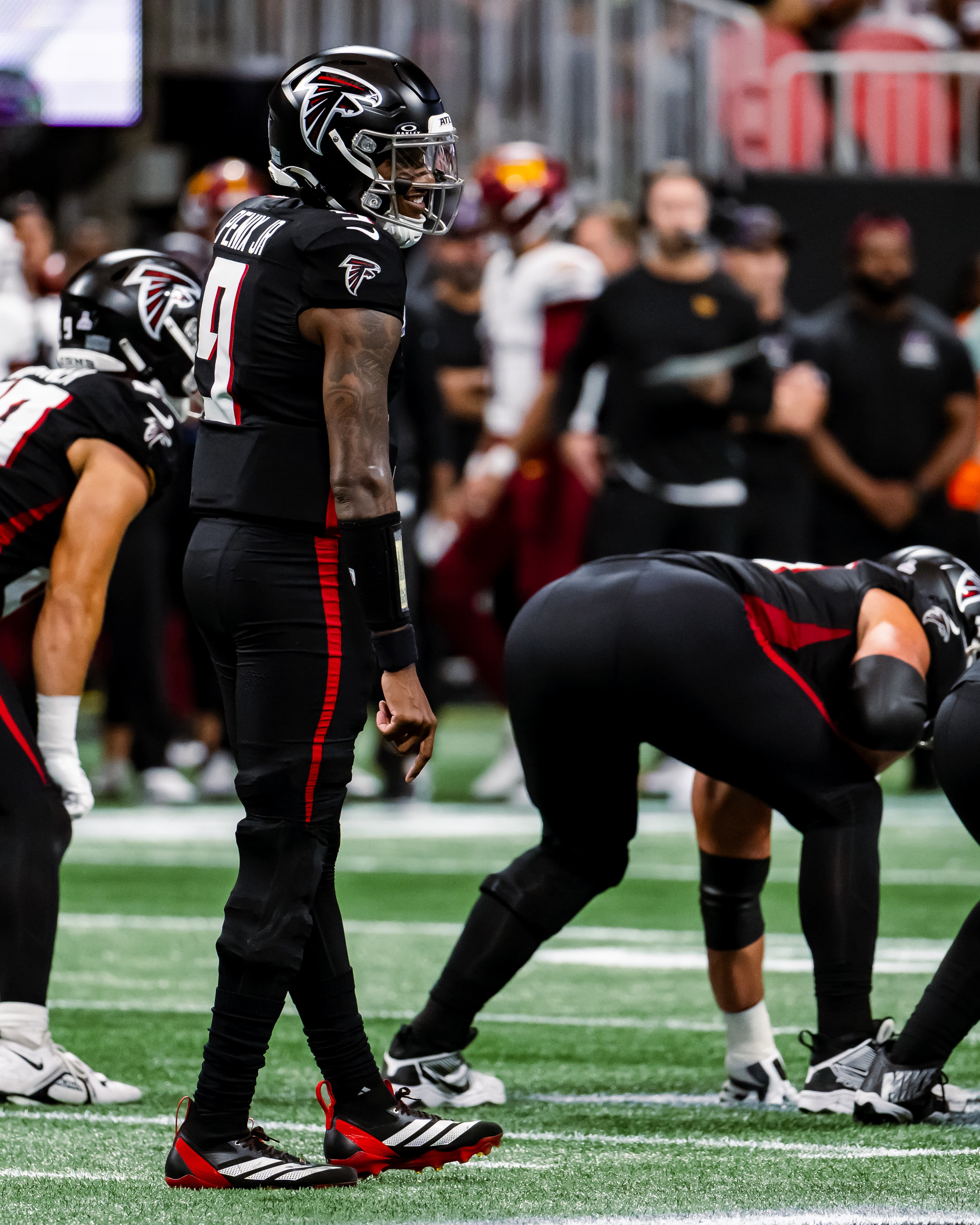
 Photo by Joe Glorioso/All-Pro Reels, CC BY-SA 4.0, via Wikimedia Commons
The Falcons Finally Have a Coach Who Can Say 'I Don't Know'
In three years, the Falcons have cycled through Desmond Ridder, a $180 million Kirk Cousins deal, an 8th-overall pick behind that deal, Cousins benched for the pick, the pick's third ACL tear, Cousins returning, Cousins released at $35 million in dead money, and a quarterback signed for $1.2 million who was benched by his last team. Kevin Stefanski looked at all of that and said the three most revolutionary words in recent Falcons history: 'I don't know.'
In three years, the Falcons have cycled through Desmond Ridder, a $180 million Kirk Cousins deal, an 8th-overall pick behind that deal, Cousins benched for the pick, the pick's third ACL tear, Cousins returning, Cousins released at $35 million in dead money, and a quarterback signed for $1.2 million who was benched by his last team. Kevin Stefanski looked at all of that and said the three most revolutionary words in recent Falcons history.
"I don't know."
Asked about Michael Penix Jr.'s recovery timeline during Phase I of the offseason program this week, Stefanski declined to commit: "I don't think it's fair to say. I don't know. There's obviously timelines when it comes to injuries, but we're all different. We want to see how he looks in a week, how he looks in a month." Then, on the broader quarterback competition: "It will be a competition but I can't tell you exactly what it will look like until Michael gets healthy."
That sounds like coachspeak. It is not. It is a structural departure from how the Falcons have handled the most important position on the field since Matt Ryan left. Every decision since then has been defined by urgency — the need to have an answer right now, the refusal to sit with uncertainty. Stefanski is the first person in the building to frame not knowing as a legitimate operational posture.
The franchise should listen carefully. It has spent $35 million learning what impatience costs.
The financial archaeology
The numbers tell the story more honestly than any press conference. Kirk Cousins's release created a $22.5 million dead-cap charge in 2026 and another $12.5 million in 2027 — $35 million total for a quarterback who no longer plays in Atlanta. Tua Tagovailoa signed for $1.215 million, the league minimum. Miami owes him $54 million in guaranteed money minus his Falcons salary, having absorbed an NFL-record $99.2 million total dead-cap hit. Penix's rookie-deal cap hit runs approximately $5.7 million.
Do the math: the Falcons are spending more on a quarterback who doesn't play for them than on both quarterbacks who do — combined. When you have already paid $35 million for the wrong answer, rushing to the next one is not diligence. It is compulsion.
The structural advantage nobody is naming
Phase I is classroom and weight room — no on-field work, no helmets. Stefanski described it as "building foundational knowledge." This is the one stage where Penix's knee is not a competitive disadvantage. He can absorb Tommy Rees's play-calling language at the same speed as Tagovailoa.
That changes when they walk onto the field. Penix tore his left ACL — partially — in Week 11 against Carolina. Surgery was November 25. Nine-month recovery puts earliest clearance in late August. He has not been cleared for full contact.
That means Tagovailoa gets every meaningful on-field rep through Phase II, Phase III, and potentially training camp — four to five months of system installation with Drake London, Kyle Pitts, and the first-team skill players that Penix cannot replicate from the rehab room. The competition is open in name. The calendar favors the healthy quarterback.
Tagovailoa seems to understand this. "I embrace the competition. I'm excited to work alongside Mike." And: "I knew I needed to play better, but I think this is a great opportunity to come here and get a good reset."
The two résumés
The benching in Miami was not ambiguous: career-high 15 interceptions in 14 games, interception rate ballooning from 1.8% to 3.9%, completion percentage dropping from 72.9% to 67.7%. The Dolphins replaced him with Quinn Ewers at Week 16.
But the 2025 collapse exists on the same résumé as the 2023 peak — 4,624 passing yards (league-leading), 29 touchdowns, all 18 games. At his best, Tagovailoa is an intermediate-accuracy machine who processes coverage shells quickly enough to weaponize timing routes — precisely the quarterback profile I outlined in March that Stefanski's Kubiak-tree system rewards. He passed the Falcons' medical evaluation. The medicals are the floor. The 15 interceptions are the ceiling risk.
Penix's nine starts told a quieter story: 60.1% completion, 1,982 yards, nine touchdowns, three interceptions, 88.5 passer rating, 3-6. But one number stands apart. His 1.1% interception rate was the lowest in the NFL among quarterbacks with at least 14 attempts per game. He does not throw into coverage he has not solved. In a Kubiak-tree system that leans on play-action to create favorable down-and-distance, a quarterback who protects the football has a higher floor than one who gambles.
Penix says recovery from his third ACL surgery is "a little bit" ahead of schedule. He tore the same knee twice at Indiana and came back to become a Heisman finalist at Washington. The resilience is documented. It is also incomplete until his doctor clears him for contact.
The coaching staff as mechanism
Stefanski did not build a quarterback room. He built a development infrastructure. Alex Van Pelt, the new quarterbacks coach, was Stefanski's offensive coordinator in Cleveland from 2020 through 2023 and coached Aaron Rodgers to MVP honors with the Packers in 2014. Rees will call plays, the same arrangement from Cleveland's Week 10 onward. "That's a setup that I'm very, very comfortable with," Stefanski said. Van Pelt teaches the reads, Rees translates to game-day calls. They are not building a quarterback competition from scratch. They are importing one.
Stefanski was fired after going 5-12 in 2025 despite two Coach of the Year awards. "There's something to be said when you're fired," he said. "You want to prove people wrong." He sees the same chip in Tagovailoa. Shared motivation is not a scheme fit. But it is the precondition for one.
What Cunningham's draft tells you
The front office is not waiting for the quarterback question to resolve. GM Ian Cunningham's first draft invested four of six picks on defense — Avieon Terrell, Kendal Daniels, Anterio Thompson, Harold Perkins Jr. — plus sixteen UDFAs. The strategy is legible: compete through Jeff Ulbrich's defense while the quarterback situation sorts itself out. This is not a "win with the quarterback" roster. It is a "win despite quarterback uncertainty" roster.
Stefanski's patience is not an abstraction. It is being built into the roster architecture.
Where this actually goes
The honest answer is that nobody knows, and for the first time in three years, the Falcons have a head coach willing to say so. Tagovailoa has the reps, the health, and a coaching staff that sees its own story in his. Penix has the draft capital, the ball security, and a history of returning from the exact injury that sidelines him. When Phase II begins, the asymmetry will become visible.
"It's about being where your feet are," Stefanski said, "and making sure you're not getting too far ahead of yourself." In most coaching contexts, that is a platitude. In a franchise that spent $180 million on a quarterback, drafted his replacement eight picks into the same draft, benched the first for the second, lost the second to a knee, cut the first for $35 million in dead money, and signed a third for $1.2 million off another team's bench — in that franchise, telling people to slow down is the most radical thing the head coach could say.
The Falcons don't need another answer at quarterback. They have had plenty. What they need is the willingness to sit with the question.
The Tilt
Stefanski saying 'I don't know' is the most radical thing a Falcon has done at QB in three years.
— Miles Grady
What's your take?
Keep Reading
The Test Is Built to Say Yes
Kevin Stefanski said out loud on Monday what the orthopedic literature has been saying for years: the test that clears a knee was never designed to measure whether a quarterback can play. Here is what it actually measures, what it structurally cannot, and what Atlanta is really giving up by making the eighth pick of the 2024 draft inactive.
The Rescue Quarterback Is Already on the Roster
The loudest demand in Atlanta on Monday was for somebody to go get a quarterback. He is already on the roster, he cost the eighth pick in the draft, and he spent Monday saying out loud that he is not ready yet.

The Blind Side Doesn't Move
By the national count, Pittsburgh is the last team in the NFL that does not know which quarterback it will see on Sunday. It matters less than a week of coverage has implied, because Michael Penix Jr. and Tua Tagovailoa throw with the same hand.