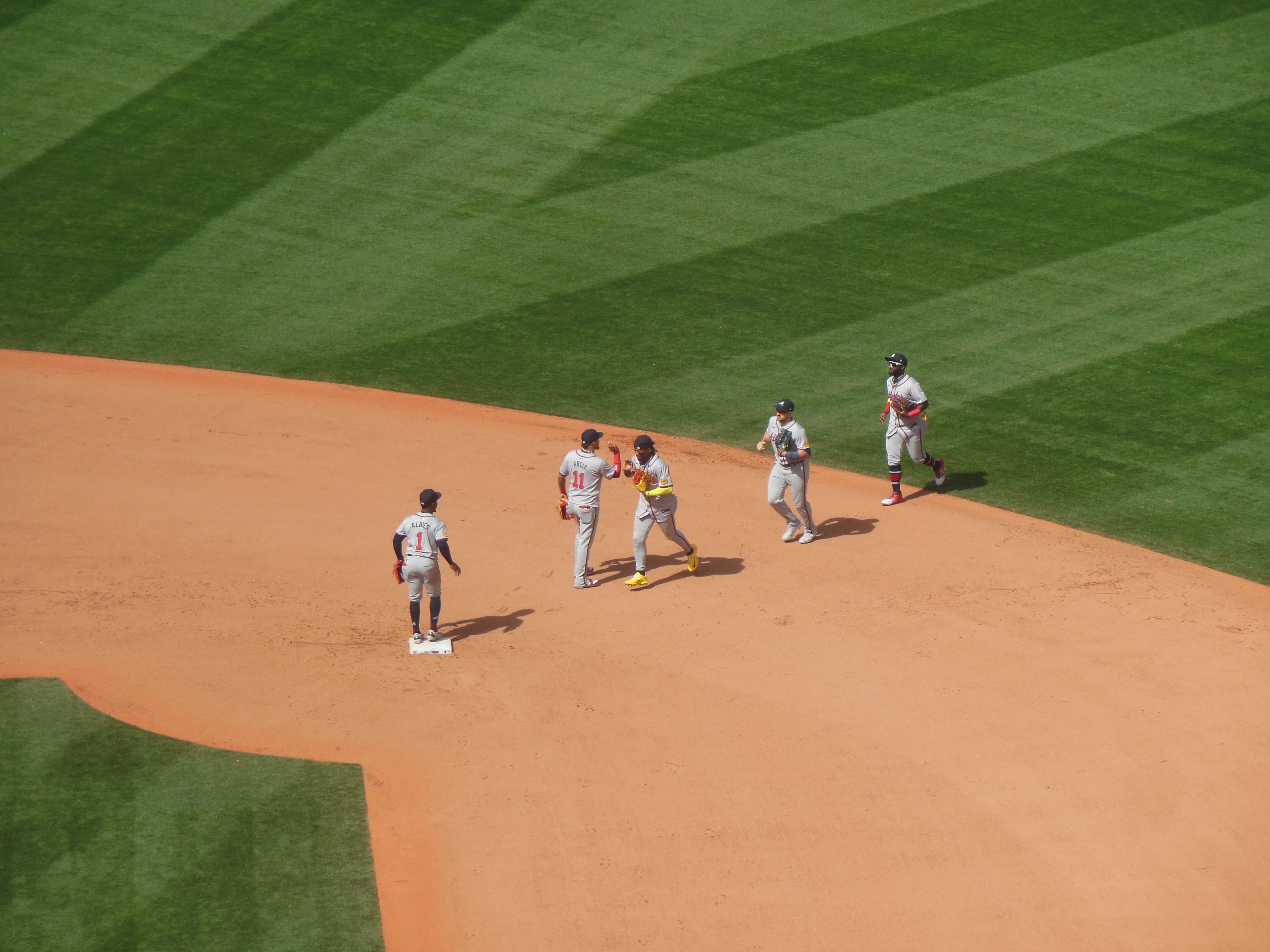
 Photo by Jsayre64, CC BY-SA 4.0, via Wikimedia Commons
The Man Who Wasn't in the Lineup
Michael Harris II was scratched from the starting lineup with left quad tightness. He came off the bench in the sixth inning and hit the go-ahead double at 105 mph. The Braves are 19-8 and playing like a team that has answers in places most rosters don't bother to look.
Thirty-nine thousand, six hundred and twenty-seven people came to Truist Park on Thursday night to watch the Braves play the Phillies. Michael Harris II was not in the starting lineup.
He had been scratched with left quad tightness — the same quad that pulled him from Wednesday's game in Washington during the seventh inning, the same quad the team called precautionary, the same quad attached to a player hitting .447 with a 1.383 OPS over his previous eleven games. He was, by every measurable standard, the hottest hitter on the best team in baseball, and he was sitting on the bench watching Grant Holmes throw first pitches.
In the bottom of the sixth inning, with the Braves trailing 3-2 and two men on base, Harris walked to the plate as a pinch-hitter. He saw a pitch from Andrew Painter. He hit it 105 miles per hour to center field. Mauricio Dubon scored. Dominic Smith scored. The Braves led 4-3, and they would not trail again.
The box score will record a pinch-hit, two-run double. What it will not record is the specific texture of the moment — a player whose body had disqualified him from starting, whose bat had not received the memo.
The game began as a conversation between home runs. Trea Turner hit a two-run shot in the top of the third, 375 feet, and the Phillies led 2-0. Ronald Acuna Jr. answered in the bottom of the same inning with a two-run home run to left, 410 feet, the kind of swing that reminds you what Acuna looks like when the timing is right and the body cooperates. The game was tied at two. Bryce Harper restored the Phillies' lead with a solo home run in the fifth, 389 feet, and for a few innings the night belonged to the names printed largest on the marquee.
Then the sixth inning happened, and the names changed.
Dubon reached base. Smith reached base. Harris, who was not supposed to be available for anything more strenuous than stretching, pinch-hit and drove the ball to center field with an exit velocity of 105 mph. Two runs scored. The Braves led. And then the game did what April 2026 Braves games have done with startling regularity — it found another way to add a run nobody expected. Jorge Mateo, inserted as a pinch-runner for Harris, stole third base. Andrew Painter, perhaps still processing the double, threw a wild pitch. Mateo scored. The lead was 5-3.
Three runs in the sixth. None of them from the starting lineup as originally constructed.
Grant Holmes earned the win. His line — 6.0 innings, 7 hits, 3 earned runs, 4 strikeouts, 3 walks — is not the kind of start that generates superlatives. It is the kind of start that gets filed under "enough." Holmes walked three batters and survived all three. He allowed a two-run homer to Turner and a solo shot to Harper and did not allow either moment to metastasize into an inning. He threw strikes when the count demanded strikes and trusted the defense behind him when the contact came.
His ERA sits at 3.42 through six starts. The walk rate remains his honest broker — 3.8 per nine entering the game, roughly half a walk above league average. Holmes is not dominating anyone. He is persisting, and persistence is an undervalued quality in a starting pitcher during a month when three of the team's projected arms started the season on the injured list.
Robert Suarez closed the game in the ninth: 1.0 inning, 1 hit, 0 runs, 1 strikeout, 1 walk, his third save of the season. He was pitching in place of Raisel Iglesias, who is injured. This is a detail worth pausing on. The Braves' closer was unavailable. Their replacement closer recorded the save. Their starting center fielder was unavailable. Their replacement center fielder — who was the original center fielder, pinch-hitting for himself in a different role — delivered the go-ahead hit. The depth is not incidental to this team. It is the team.
Andrew Painter took the loss for Philadelphia. His line — 5.2 innings, 9 hits, 5 earned runs, 1 strikeout, 2 walks — is the line of a young pitcher learning what it costs to leave pitches over the middle of the plate at this level. He struck out one batter in nearly six innings. One. Against a lineup missing its best hitter. The Phillies are now 8-18. They have lost ten consecutive games, their longest losing streak since 1997 — the first 10-game skid of the 21st century for a franchise that has won back-to-back National League pennants. They sit 10.5 games behind the Braves in the NL East standings.
Those numbers are real, and they are not the subject of this piece. The Phillies will have Zack Wheeler on the mound tonight against Bryce Elder in a 7:15 start, and whatever is wrong with Philadelphia will still be wrong tomorrow, and the week after, and possibly through May. But the collapse of a defending pennant winner, while historically notable, is a mirror that reflects more about one franchise's misfortune than another franchise's construction. The Braves did not beat the Phillies because the Phillies are collapsing. They beat them because a man who was not in the lineup walked to the plate and hit a baseball 105 miles per hour.
Nineteen wins in twenty-seven games. Best record in baseball. Nine of the last ten. The best start in the franchise's Atlanta era — better than the 1969 team that won the first division title after the move from Milwaukee, better than the '91 team that began the dynasty, better than any of the Maddux-and-Glavine Aprils that blur together in the memory of anyone old enough to have watched them on TBS.
And the thing that distinguishes this April from all those Aprils is not the record, which is a number, or the run differential, which is another number, or even the pitching, which has been legitimately excellent even after you adjust for the regression the FIP projects. What distinguishes it is the way the wins arrive. They arrive from the bench. They arrive from the eighth spot in the order. They arrive from a pinch-runner stealing third and scoring on a wild pitch. They arrive, in other words, from the places on the roster that most teams treat as afterthoughts.
Harris's quad will be re-evaluated. He may start tonight. He may not. The specifics matter less than the principle the last two games have illustrated: this roster does not require its best version of itself to win. It has enough depth, enough versatility, enough players who can hurt you from positions you did not expect, that a diminished lineup is still a dangerous lineup.
That is not an April phenomenon. That is roster construction, and roster construction is the only kind of baseball advantage that compounds across 162 games.
Wheeler and Elder tonight at 7:15. The Phillies will send their best arm. The Braves will send whoever is healthy enough to play. Lately, that has been more than sufficient.
The Tilt
Scratch your hottest hitter. Win anyway. That's not luck — that's roster construction.
— Ellis Magnolia
What's your take?
Keep Reading
October Has Two Off Days
I wrote yesterday that October asks a club who its best three starters are. The published 2026 calendar says the number is four, and Atlanta are carrying six arms with 17 games left to sort them.
Lopez Is Not Tonight's Problem
Everybody is about to tell you the Braves are gambling on an arm that has not pitched since July. The pitch count says otherwise, and it points at something worse.
_15.jpg&w=3840&q=75)
Somebody Has to Take the Turn
Atlanta went to a six-man rotation to keep five arms fresh for October. On the first night of nine straight games, the sixth man got ten outs, the staff gave up four home runs, and the bullpen covered the rest.