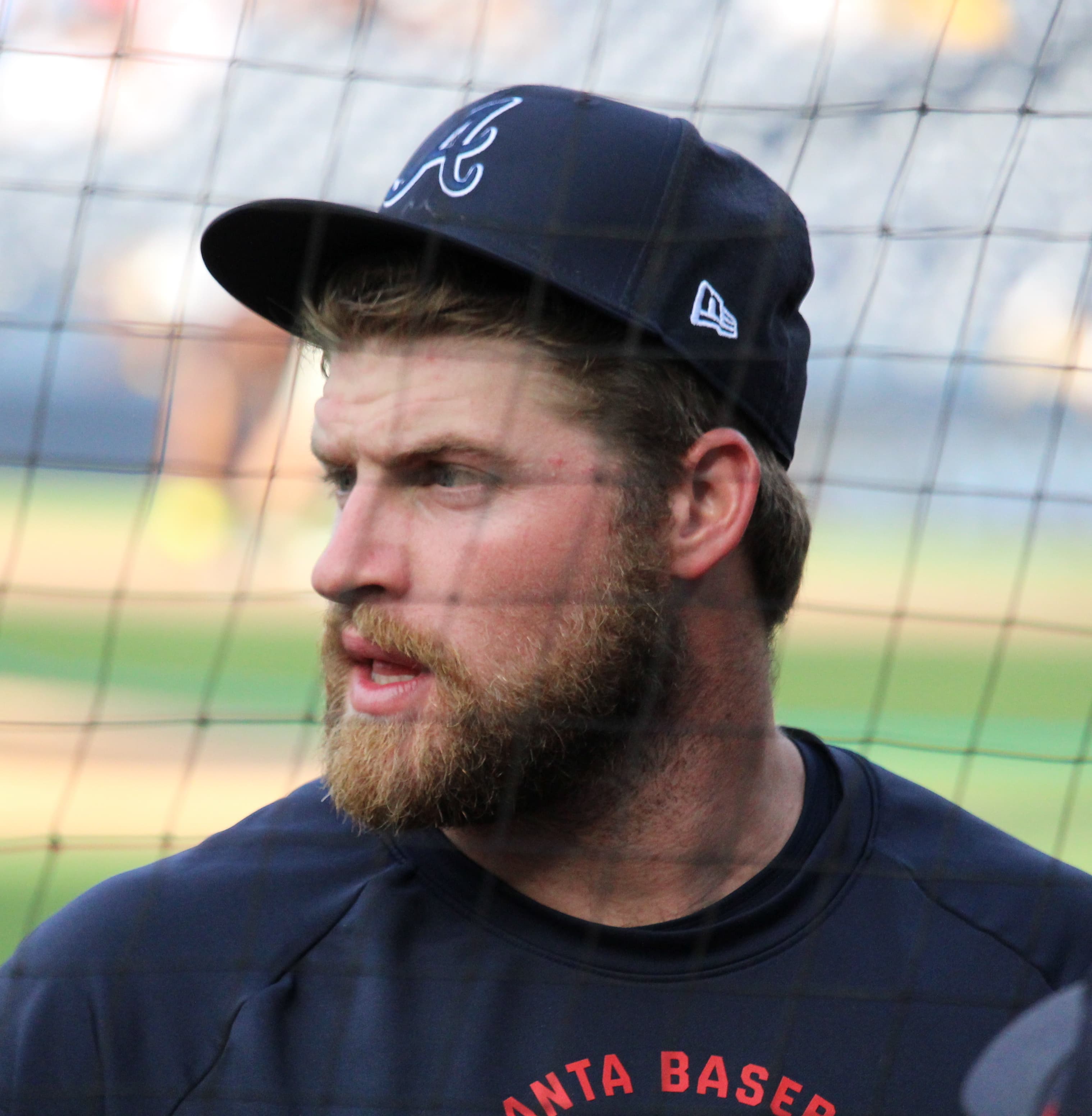
 Photo by Thechased via Wikimedia Commons, CC BY 4.0
Ellis Magnolia: One Game, Eleven Hits, and the Temptation of Belief
The Braves' Opening Day shutout offered everything a fan could want and almost nothing a statistician can use. Almost.
Six innings. Three hits. Zero runs. Six strikeouts.
Those are Chris Sale's numbers from tonight, and they are, by any reasonable standard, excellent. They are also one start. I mention this not to diminish what Sale did against the Royals — a 6-0 shutout on Opening Day at Truist Park, in front of 39,697 people who came ready to believe — but because baseball's particular cruelty is that it makes you wait 161 more games before it tells you what one game meant.
I wrote this morning about the prediction gap. Keith Law has the Braves at 83-79. ESPN's projection model says 90-72. Eleven wins apart, built on identical information, which tells you less about the projections than it does about how much uncertainty still lives in this roster. Tonight was the first data point. It was a good one. Let's be careful about what we do with it.
The Sale We Expected
Sale entered 2026 as the reigning NL Cy Young winner, which is a sentence that still feels mildly surreal if you watched the 2019-2022 version of his career. But the 2024 resurrection was real — 177.2 innings, 2.38 ERA, a 2.72 FIP that confirmed the ERA wasn't lying — and tonight's start read like a continuation rather than a statement.
His pitch mix looked familiar: the slider generated four of his six strikeouts, and the fastball sat comfortably in its usual range. He walked three, which is slightly elevated for Sale's 2024 standard (1.9 BB/9 over the full season), but Opening Day adrenaline and a strike zone still finding its spring shape can account for that without much hand-wringing. The Royals went 0-for-4 with runners in scoring position, which is partly Sale being Sale and partly a Kansas City lineup that finished 2025 ranked 22nd in wRC+ against left-handed pitching.
What Sale's start confirmed is narrower than what the crowd wanted it to mean. It confirmed that the arm is healthy, the mechanics are sound, and the competitive fury that defined his Cy Young campaign didn't winter somewhere else. It did not confirm that the 2026 rotation can survive what's sitting on the injured list.
The Names Not on the Field
Here is where the numbers start telling a different story than the scoreboard. Spencer Strider is on the IL with an oblique injury. Spencer Schwellenbach is done until at least midseason following elbow surgery. Sean Murphy is nursing a hip. Ha-Seong Kim has a finger tendon issue. AJ Smith-Shawver is out for the year after Tommy John. Reynaldo Lopez, the veteran right-hander who posted a 1.99 ERA over 29 starts in 2024, now anchors a rotation spot that was supposed to belong to Strider.
I have been tracking what I've called the Health Bet — the premise that the Braves' 2026 outcome is almost entirely a function of whether their core stays on the field simultaneously. Tonight, Sale held up his end. Ronald Acuna Jr. returned to an Opening Day lineup for the first time since 2024 and looked like a man who remembered where everything was. Ozzie Albies launched a solo homer in the first inning with the easy violence of someone who considers this routine.
But one healthy night does not make a healthy season, and the five names on the IL are a constant, quiet counterweight to every good thing that happens on the field.
Baldwin's Announcement
Now, for the part of the evening that warranted genuine attention.
Drake Baldwin hit a solo home run in the third inning. His first career Opening Day plate appearance ended with a ball in the Truist Park seats, which is exactly the kind of biographical detail that baseball manufactures on a nightly basis and which almost never means anything predictive.
Except.
Baldwin's spring was not an accident. He slashed .308 with an .885 OPS across Grapefruit League play, and the underlying contact metrics — particularly his strikeout rate, which hovered near the bottom of the team — suggested a hitter whose plate discipline had matured past his NL Rookie of the Year campaign. Last season's .274/19 HR/80 RBI line was a strong debut. The question I've been sitting with since February is whether that was the floor or the ceiling.
Tonight's home run doesn't answer that question. One swing in one game is a data point, not a thesis. But it's worth noting the type of swing: Baldwin sat on an elevated fastball from Cody Ragans and drove it with the kind of barrel control that separates hitters who sustain from hitters who regress. His approach at the plate tonight — patient through two balls, then decisive on the pitch he wanted — mirrored the spring training version of himself rather than the occasionally chase-happy hitter from last August.
There's a version of this season where Baldwin takes the next step and posts a .290/.370/.510 line that makes the Braves' prediction gap look like a failure of imagination. There's also a version where the league adjusts and he settles back toward .260. The spring and tonight suggest the former is at least plausible. I'm watching the strikeout rate. That's where the answer lives.
Michael Harris II and the Middle of the Order
Harris's two-run homer in the fourth inning turned a 2-0 lead into 4-0 and effectively ended the competitive portion of the evening. Ragans lasted four innings and allowed six hits against four walks, which is the pitching line of a man who was never comfortable. By the time Mauricio Dubon doubled home two more in the seventh, the game had become an exercise in confirming what was already obvious.
The Braves finished with eleven hits and zero errors. The game lasted two hours and twenty-eight minutes, which is practically a haiku by modern baseball standards. It was clean, professional, and — if you are in the business of extracting signal from noise — frustratingly tidy. Blowouts are satisfying to watch and almost useless to analyze. When everything goes right, you can't see the seams.
What One Game Tells You
Baseball has a long memory, but a short attention span. Tomorrow night, Reynaldo Lopez takes the mound, and we'll learn more about the 2026 Braves from that start than we learned from tonight's. Lopez was magnificent in 2024 — 1.99 ERA, an All-Star nod — but his 2025 was cut short by injury, and the question of whether he can sustain that level over a full season is, in miniature, the question facing this entire roster. Sale is why someone can look at this team and see 90 wins. The IL is why someone else can look at the same team and see 83.
Tonight was the version of the Braves that exists when the healthy players are healthy, the young hitters are confident, and the opposing starter can't locate his fastball. That version is legitimately good. The question, as always, is how often that version shows up over the next 161 games.
I'll be watching the strikeout rates, the velocity readings, the innings counts. I'll be tracking Lopez's velocity and noting when the bullpen arms start showing fatigue. I'll be checking the IL updates with the grim regularity of a man who has learned that Atlanta sports and sustained health have a complicated relationship.
But tonight? Tonight was a good data point. The temptation is to make it more than that. The discipline is knowing it's enough.
The Tilt
Chris Sale's six-inning, six-strikeout Opening Day start was the most predictive single performance in the Braves' lineup tonight — and the one least in need of proving anything.
— Ellis Magnolia
What's your take?
Keep Reading
October Has Two Off Days
I wrote yesterday that October asks a club who its best three starters are. The published 2026 calendar says the number is four, and Atlanta are carrying six arms with 17 games left to sort them.
Lopez Is Not Tonight's Problem
Everybody is about to tell you the Braves are gambling on an arm that has not pitched since July. The pitch count says otherwise, and it points at something worse.
_15.jpg&w=3840&q=75)
Somebody Has to Take the Turn
Atlanta went to a six-man rotation to keep five arms fresh for October. On the first night of nine straight games, the sixth man got ten outs, the staff gave up four home runs, and the bullpen covered the rest.