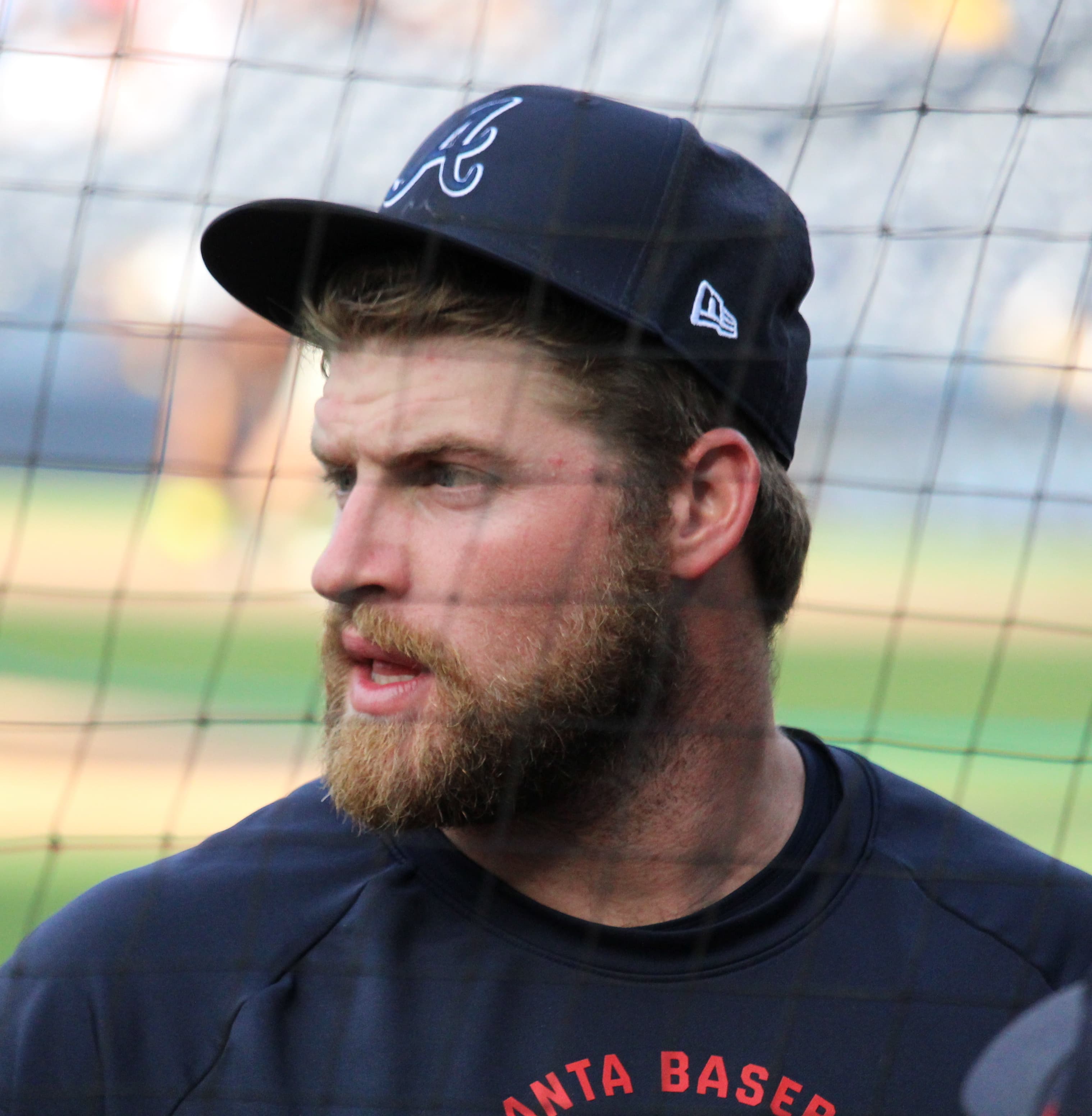
_13_Chris_Sale.jpg&w=3840&q=75) Photo via Wikimedia Commons, CC BY-SA 4.0
Photo via Wikimedia Commons, CC BY-SA 4.0One Hit Through Six and the Way a Series Ends
Chris Sale held the Phillies to a single hit through six innings, struck out nine, and turned a rubber match into something closer to a lecture.
One hit.
Through six innings on a Sunday afternoon at Truist Park, Chris Sale allowed one hit to a Philadelphia Phillies lineup that arrived having scored eight runs less than twenty-four hours earlier. Kyle Schwarber would add a home run off a reliever in the eighth, but by then the argument was over. It had been over since the second inning.
The Braves scored three in the first. Three more in the second. By the time Sale needed to record his first out of the third, he was working with a six-run cushion and a lineup that had already provided the only evidence the afternoon required. Matt Olson's home run — a three-run shot in the first — was the kind of swing that lands in a box score and tells you the entire story of the game without reading another line. Eli White added a two-run homer in the second. Ronald Acuña Jr. contributed two hits, two runs, and a stolen base, which is the sentence you write about Acuña when he's healthy and engaged and reminding you that the tools are still all there.
Sale's final line: 6.0 innings, 1 hit, 0 earned runs, 9 strikeouts, 2 walks. His record moves to 5-1. His ERA moves to 2.31.
The game deserves the full line because the line is the story. Nine strikeouts against a lineup that features Schwarber, Bryce Harper, and Trea Turner is not the product of a favorable matchup. It is the product of a 37-year-old left-hander whose command is sharper at this point in the season than it was during his Cy Young campaign in 2024.
The interesting number is not the nine strikeouts. It is the one hit.
Sale has always been a strikeout pitcher — his 11.82 K/9 led the National League last season, and the arm angle that makes left-handed hitters miserable has been his calling card since Chicago. Strikeouts are the expected output. What Sunday demonstrated was something quieter: suppression. The Phillies did not foul pitches off. They did not work deep counts. They did not manufacture baserunners through attrition. They got one hit. One.
Aaron Nola stood on the other mound, and the contrast tells you something about what happens when aces share an afternoon and only one of them shows up. Nola lasted 4.2 innings, surrendering seven hits and six earned runs. His ERA sits at a number that will not accompany the word 'ace' in many more sentences if the trend continues. Sale's slider located inside to right-handed batters all afternoon. Nola's changeup found barrels.
The Braves are 20-9. That is a .690 winning percentage. They hold the best record in Major League Baseball, a six-game lead in the NL East, and a +62 run differential — the largest in either league. The run differential, more than the record, is the number I keep circling back to. Twenty-nine games is a meaningful sample. A 62-run gap between what you score and what you allow is not a streak. It is a structure.
Sale turned 37 on March 30. He spent 2025 limited to twenty starts by a fractured rib. There was a version of this spring where the question surrounding Sale was whether the Braves could get 28 starts out of him, not whether those starts would be this dominant. The answer through six starts is that the question was wrong. The starts are not merely occurring. They are accumulating force.
His six-start arc this season reads: 6 IP/0 ER, 6 IP/1 ER, 4 IP/6 ER, 6 IP/1 ER, 7 IP/1 ER, 6 IP/0 ER. One bad afternoon in Anaheim against the Angels — four innings, six earned runs, a game that inflated his ERA from sub-1.00 to nearly 4.00 in a single start. He has responded with three consecutive starts of 1 earned run or fewer, covering nineteen innings. The Angels start looks less like a regression and more like an interruption that never recurred.
Sunday's nine strikeouts were his most of the season. His slider was the best pitch on the field. Drake Baldwin, who caught every inning, set up on the inside corner against right-handed batters and Sale hit the glove often enough that by the fourth inning the Phillies were swinging at pitches they knew were coming and missing them anyway.
Yesterday, the Phillies won 8-5 in ten innings. Zack Wheeler made his 2026 debut throwing 95 mph and looking every bit like the pitcher Philadelphia paid $130 million to watch. Harper drove in four runs. The ten-game losing streak — the longest of the 21st-century Phillies — ended at Truist Park, and for a few hours the series felt like it might be the first real test of the Braves' April.
It was not. Sunday's rubber match was decided before it began. The Braves scored six runs in the first two innings, Sale held the Phillies to one hit through six, and the test was graded before the third period. The series ends 2-1 Atlanta. Two weeks ago, the Braves swept the Phillies three games to none at Citizens Bank Park. The season record against Philadelphia is now five wins in six games.
I wrote this morning about the $10.5 million Alex Anthopoulos spent on four players nobody else wanted. That piece was about the roster's edges — the fill-in shortstop, the castaway DH, the quiet catcher. Tonight was about the center. Chris Sale is the center. When the ace pitches like this, the edges are luxuries. When the edges perform like they have, the ace becomes something else entirely: a multiplier applied to a system that was already producing.
The Braves have twenty wins before May. Sale has five of them. The numbers will regress — they always do, and the run differential will narrow, and the winning percentage will settle somewhere closer to earth. But twenty-nine games is no longer an early return. It is a quarter of a season's data, and the data says this team is built the way the best teams are built: from the middle out.
One hit through six. The rest was arithmetic.
The Tilt
Sale's one-hitter through six wasn't a great start — it was the kind of start that makes you reconsider how good 'great' has to be to keep up with him at 37.
— Ellis Magnolia
What's your take?
Keep Reading
October Has Two Off Days
I wrote yesterday that October asks a club who its best three starters are. The published 2026 calendar says the number is four, and Atlanta are carrying six arms with 17 games left to sort them.
Lopez Is Not Tonight's Problem
Everybody is about to tell you the Braves are gambling on an arm that has not pitched since July. The pitch count says otherwise, and it points at something worse.
_15.jpg&w=3840&q=75)
Somebody Has to Take the Turn
Atlanta went to a six-man rotation to keep five arms fresh for October. On the first night of nine straight games, the sixth man got ten outs, the staff gave up four home runs, and the bullpen covered the rest.