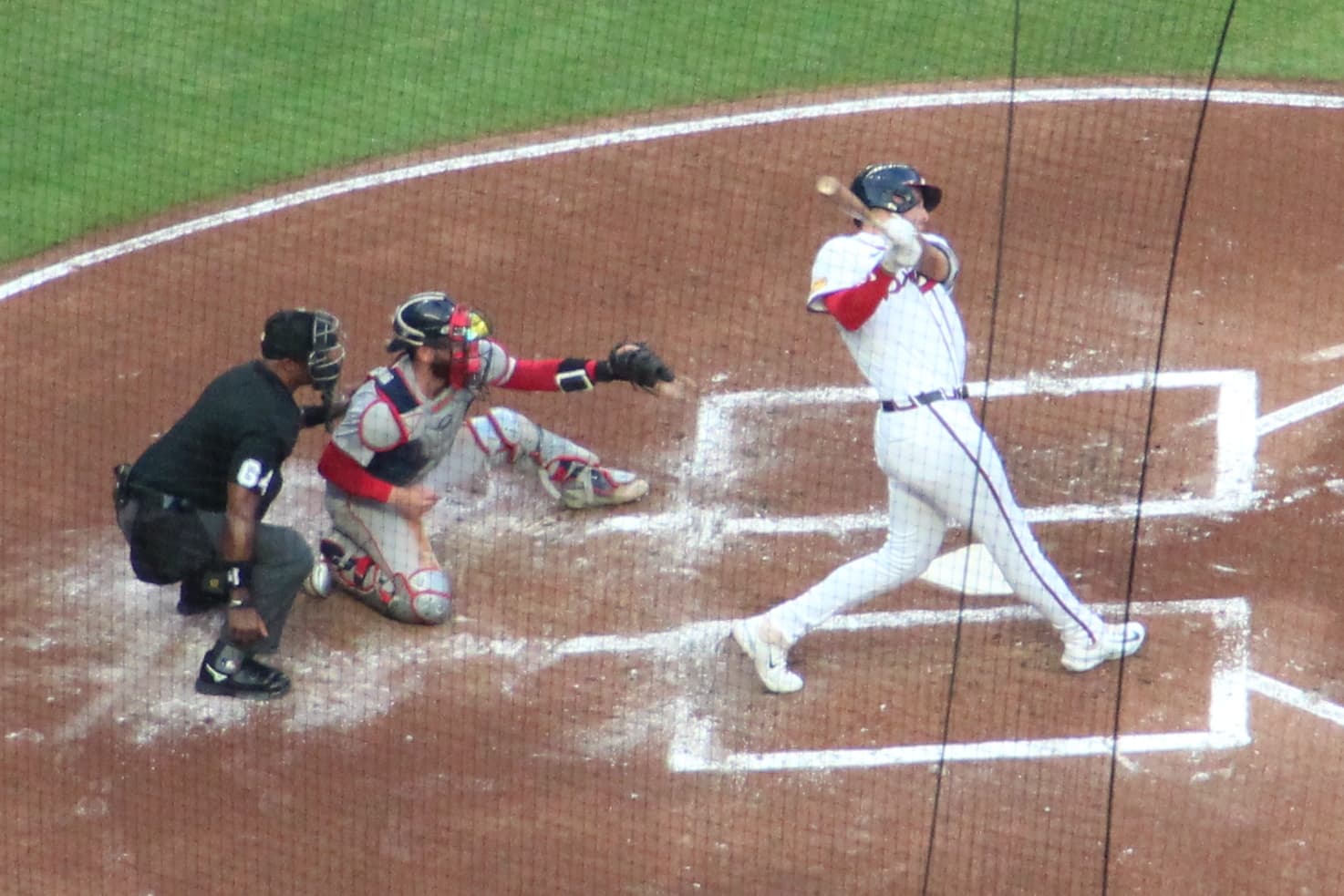
 Photo via Wikimedia Commons, CC BY-SA 4.0
Ellis Magnolia: Seven Innings, Zero Walks, and a No-Decision
Tarik Skubal threw seven innings of two-run ball with zero walks and seven strikeouts against the best team in baseball. His name does not appear in the result.
Seven innings, zero walks, seven strikeouts.
Tarik Skubal's pitching line against the Atlanta Braves on Tuesday night at Truist Park was the kind of performance that, in a sport governed by the arithmetic of outcomes, should produce a victory. Two earned runs across seven innings. A strikeout-to-walk ratio that does not lose baseball games — seven strikeouts divided by zero walks is not a number. It is an abstraction. And the result was equally abstract: a no-decision. Not a win, not a loss — an erasure.
The final score reads Braves 4, Tigers 3. The winning pitcher is Reynaldo López, who threw two innings. The losing pitcher is Kenley Jansen, who recorded zero outs. Skubal, who threw seven innings of the best pitching seen at Truist Park this season, is a statistical bystander in a game he dominated.
The ninth inning lasted seven pitches.
Jansen walked Ozzie Albies on four of them. Matt Olson saw three more, the last of which was a cutter that neglected to cut. It left the bat at an angle and velocity that admitted no ambiguity. Left field. Ninth homer of the season. Walk-off.
Skubal's seven innings required twenty-one outs. The walk-off required two at-bats. The disproportion is not an aberration — it is the sport's foundational cruelty. A starter's masterpiece is, by the architecture of modern bullpen usage, dependent on the ninth-inning performance of a pitcher who was not part of the masterpiece. Skubal did not make the mistake. Jansen did. Skubal's name does not appear in the result. Jansen's does.
This is not a complaint. It is a description.
Olson finished the night 2-for-4 with two RBIs. He is batting .306 with nine home runs through 31 games. He has played in 782 consecutive games — a number that is easy to overlook because it does not generate its own drama. Olson does not miss games. He does not miss at-bats. He occupies the four-hole of a lineup that includes a former MVP in Ronald Acuña Jr. and a Rookie of the Year in Drake Baldwin, and on a night when Acuña struck out three times and Baldwin singled twice without driving in a run, Olson was the one standing in the batter's box when the outcome was available.
The contract is eight years, $168 million. Year four. In 2023, the number that validated the signing was 54 — home runs hit in a season that answered every question about whether Olson could replace Freddie Freeman. The two seasons since have been productive without being spectacular: good at-bats, durable presence, a batting average that hovers near .260. The .306 through April suggests something more. Whether it sustains or regresses is a May question. Tonight, the only question was whether he could hit a cutter from Kenley Jansen, and the answer traveled 380 feet.
J.R. Ritchie made his Truist Park debut. Seven days ago, in Washington, he threw seven innings of one-run ball without issuing a walk — an MLB debut that rewrote franchise records for pitching efficiency. Tuesday's start was a different education. Five and a third innings, five hits, two earned runs, and four walks. The walks are the number that separates the two performances: zero in Washington, four at Truist Park.
The difference is not mechanical. Ritchie's fastball still touched 97. His slider still produced swings that missed by margins measured in inches — four strikeouts from a pitch that vanishes at the plate. But the command wandered, and the walks came in pairs: two in the second inning that contributed to Detroit's first rally, two more in the middle innings that extended at-bats and inflated pitch counts. A road debut before a modest Wednesday crowd in Washington imposes different internal pressure than a home debut before a Truist Park audience that has been told this arm is the future.
Ritchie will be fine. The arm talent is obvious. The command will settle. This is what second starts are for — to prove that the first one was not an accident and that the gaps between them are navigable.
The bullpen navigated those gaps. Dylan Lee struck out four batters in one and two-thirds innings of scoreless relief — a performance of quiet violence, each strikeout swinging. López, who moved to the bullpen earlier this month to work through a delivery adjustment, threw two scoreless innings and earned the win. Ten days ago he was the No. 2 starter. Tonight he was the bridge to a walk-off. The versatility required to make that transition without decline is not accidental — it is organizational.
Between Lee's four strikeouts and López's two scoreless innings, the bullpen threw three and two-thirds innings of zero-run, zero-hit baseball. Ritchie's five and a third innings became sufficient because the infrastructure behind him absorbed what remained. When the ninth inning arrived, the score was still 3-2. Skubal's masterpiece was still intact. And then the bullpen on the other side could not match.
The Braves are 22-9. They have won games this month by every method available: offensive explosions, pitching duels, and now walk-offs against two-time Cy Young winners. The variety of the victories is more revealing than any single result. A team that can only win one way will eventually face a night when that way is unavailable. A team that can win by walking off in the ninth against elite pitching, after its rookie starter struggled, after its bullpen threw three and two-thirds scoreless — that is a team with structural depth.
The walk-off is the highlight. The pitching lines are the story.
Braves 4, Tigers 3. Skubal's line: 7 IP, 5 H, 2 ER, 0 BB, 7 K. Result: nothing.
Baseball's cruelest arithmetic.
The Tilt
The walk-off home run is the best moment in baseball and the cruelest sentence in a pitcher's season. Skubal deserved better. Olson did not care.
— Ellis Magnolia
What's your take?
Keep Reading
October Has Two Off Days
I wrote yesterday that October asks a club who its best three starters are. The published 2026 calendar says the number is four, and Atlanta are carrying six arms with 17 games left to sort them.
Lopez Is Not Tonight's Problem
Everybody is about to tell you the Braves are gambling on an arm that has not pitched since July. The pitch count says otherwise, and it points at something worse.
_15.jpg&w=3840&q=75)
Somebody Has to Take the Turn
Atlanta went to a six-man rotation to keep five arms fresh for October. On the first night of nine straight games, the sixth man got ten outs, the staff gave up four home runs, and the bullpen covered the rest.