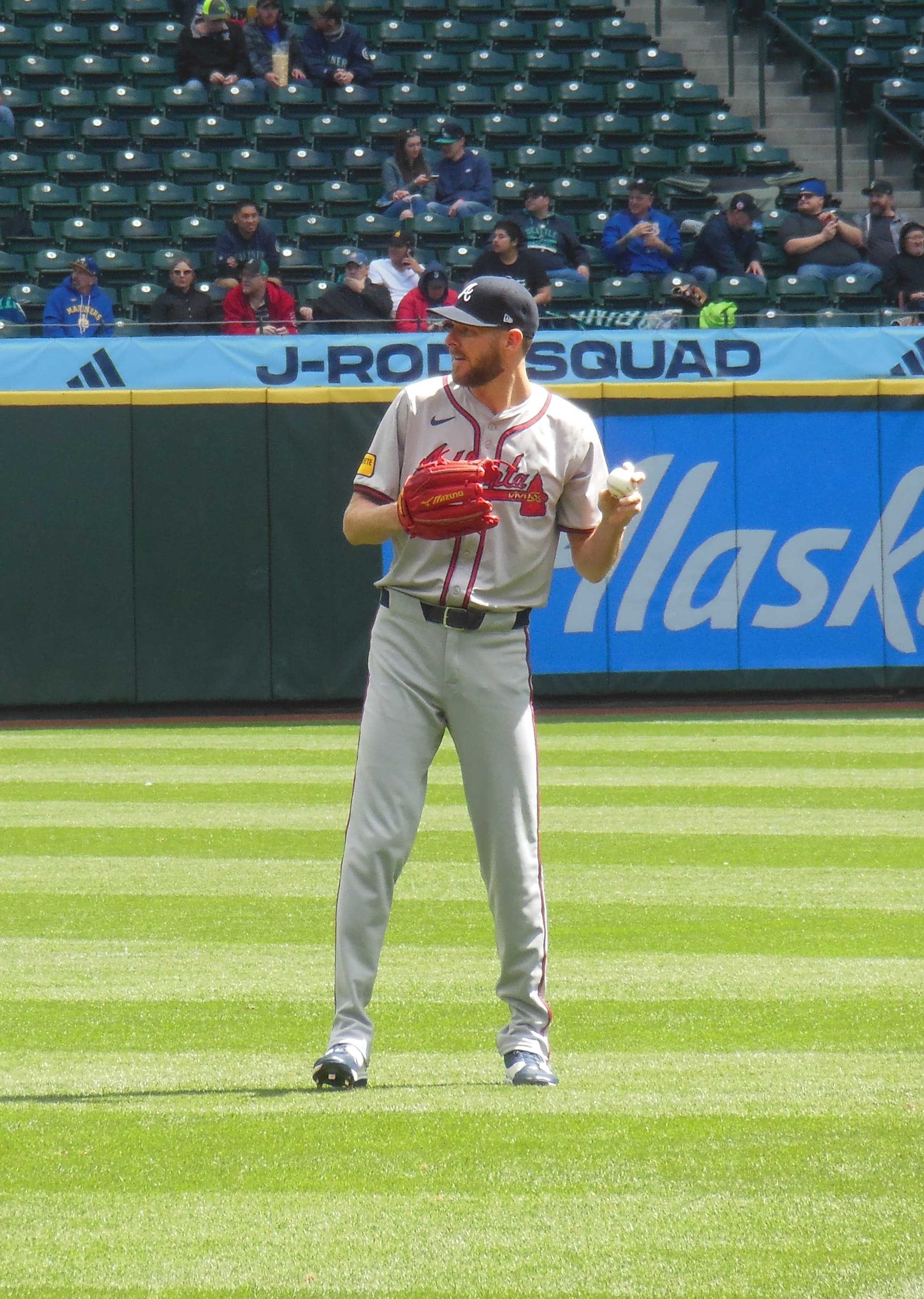
 Photo by Jsayre64, CC BY-SA 4.0, via Wikimedia Commons
Ten Million Dollars and the Best Record in Baseball
Ha-Seong Kim broke his hand before spring training. The Braves replaced him, and three other holes, for less than what most teams spend on a single reliever. At 19-9, nobody in baseball has a better record.
Ten-point-five million dollars.
That is the combined 2026 salary of Mauricio Dubón, Dominic Smith, Jonah Heim, and Jorge Mateo. Four players. Four separate transactions between November and March, none of which generated a single headline outside of Atlanta's local beat. The Braves signed them the way you buy light bulbs — because you need them, not because they excite you.
The Braves are 19-9, the best record in baseball. Their +62 run differential is the largest in either league. FanGraphs projects 91 wins and a 91.1% probability of reaching the postseason — up from 84% before the season, when the projection models could see Alex Anthopoulos's roster and the injury report but couldn't see what he apparently could.
A year ago, this franchise went 76-86 and missed the postseason for the first time since 2017. The rebuild was supposed to take longer than 28 games.
Start with the transaction that mattered most.
Ha-Seong Kim signed a two-year deal worth $28 million to play shortstop. Then he fractured his hand before spring training, and a signing that was supposed to solidify the infield became a line item on the injured list. In most organizations, losing your new shortstop before Opening Day qualifies as a crisis. In Anthopoulos's front office, it qualified as a phone call.
Mauricio Dubón cost $3.5 million. He is hitting .274 through 28 games, which is approximately what you'd want from a shortstop you didn't plan on starting. He isn't dazzling. He isn't struggling. He is, in the most useful sense of the word, sufficient — and sufficiency at shortstop, purchased for the price of a mid-tier apartment in Buckhead, is the kind of value that doesn't announce itself but shows up in the standings every morning.
Dubón was hitting .299 a week ago. The regression has arrived, as regression always does. But here is what the batting average misses: his defense has been steady, his at-bats have been professional, and the Braves have not spent a single morning wondering whether shortstop was a problem. When your emergency option eliminates a position from the worry list, the emergency was never really an emergency. It was a test of organizational depth, and the organization passed.
Dominic Smith's story is the one you already know, even if you've forgotten the details.
The Red Sox released him in spring training. He had played for six organizations. His mother, Yvette LaFleur, died on March 15, thirteen days before his Braves debut. The Braves signed him to a $1.25 million minor-league deal — the kind of contract that includes an opt-out nobody expects to be exercised because nobody expects the player to be on the roster long enough to matter.
Smith has mattered. Through 21 games: .349/.396/.587, four home runs, seventeen RBI. His walk-off grand slam on debut day was the first in MLB history by a player appearing in his first game with a new team, according to Elias Sports Bureau. That is the kind of statistical oddity that makes you check the sourcing twice, and it holds up.
Will he sustain a .349 average? He will not. The underlying contact quality and BABIP suggest a correction is coming, probably soon. But the correction will bring him back to earth, not erase what he has already contributed. Seventeen RBI in 21 games from a roster spot that cost $1.25 million is not a projection — it is a deposit that has already cleared.
Jonah Heim is the quietest acquisition in the group, which is saying something for a group that collectively generated less coverage than a single Phillies bullpen trade.
The Rangers non-tendered him in November. The Braves signed him for $4 million. In 7 starts behind the plate, the Braves are 6-1. He has caught three shutouts. Opposing teams are averaging 1.6 runs per game when Heim calls the pitches.
Catching is the position where the stat sheet lies to you most aggressively. A catcher's batting average tells you about his bat. It tells you nothing about the pitcher who located a slider two inches lower because the target was in the right place, or the runner who didn't attempt a steal because the exchange time was 1.85 instead of 1.95. Heim's value lives in the negative space — the runs that weren't scored, the innings that didn't unravel.
Jorge Mateo rounds out the four. Baltimore declined his $5.5 million option. The Braves signed him for $1.75 million, which means Anthopoulos acquired him for 32 cents on the dollar of what the Orioles decided he wasn't worth.
Mateo is hitting .292. He was hitting .368 a week ago, so the regression is underway here too — faster and steeper, as regression tends to be for players who start furthest from their true talent level. But like Dubón, the batting average is the least interesting part. Mateo's speed on the bases has changed games. Friday night, he pinch-ran for Michael Harris II, stole third base, and scored on a wild pitch. That sequence — bench player enters, advances two bases without a hit, scores without a swing — is the distilled philosophy of how Anthopoulos builds a roster.
Four players. $10.5 million total. Less than what the Phillies are paying Kyle Schwarber this season.
Last night, the Phillies beat the Braves 8-5 in ten innings. Zack Wheeler returned from the injured list throwing 95-plus, struck out six, and looked every bit the pitcher Philadelphia paid $130 million to watch. The Phillies' 10-game losing streak — the first that long for the franchise in the 21st century — is over.
The Braves will lose more games. The .679 winning percentage will come down, because winning percentages always come down, and the regression nibbling at Dubón's average and Mateo's line will eventually visit the record too.
But here is what Anthopoulos understood that the rest of the market apparently did not: you cannot buy depth in July. You can buy a starter. You can buy a closer. But the utility man who steals third in a one-run game, the shortstop who makes the team forget about the $28 million player he replaced, the catcher who turns a rotation's ERA into something it had no statistical right to be — those players have to be in the building before anyone knows they're needed.
I wrote on Friday that roster construction is the only advantage that compounds. Twenty-eight games in, the interest is showing. Four players nobody else wanted, for a combined salary that wouldn't cover a single mid-tier free agent, have turned a 76-86 team into the best record in baseball.
The numbers will regress. The philosophy won't.
The Tilt
Anthopoulos didn't outsmart the market this winter — he built a roster where the market's leftovers could become someone else's starters.
— Ellis Magnolia
What's your take?
Keep Reading
October Has Two Off Days
I wrote yesterday that October asks a club who its best three starters are. The published 2026 calendar says the number is four, and Atlanta are carrying six arms with 17 games left to sort them.
Lopez Is Not Tonight's Problem
Everybody is about to tell you the Braves are gambling on an arm that has not pitched since July. The pitch count says otherwise, and it points at something worse.
_15.jpg&w=3840&q=75)
Somebody Has to Take the Turn
Atlanta went to a six-man rotation to keep five arms fresh for October. On the first night of nine straight games, the sixth man got ten outs, the staff gave up four home runs, and the bullpen covered the rest.