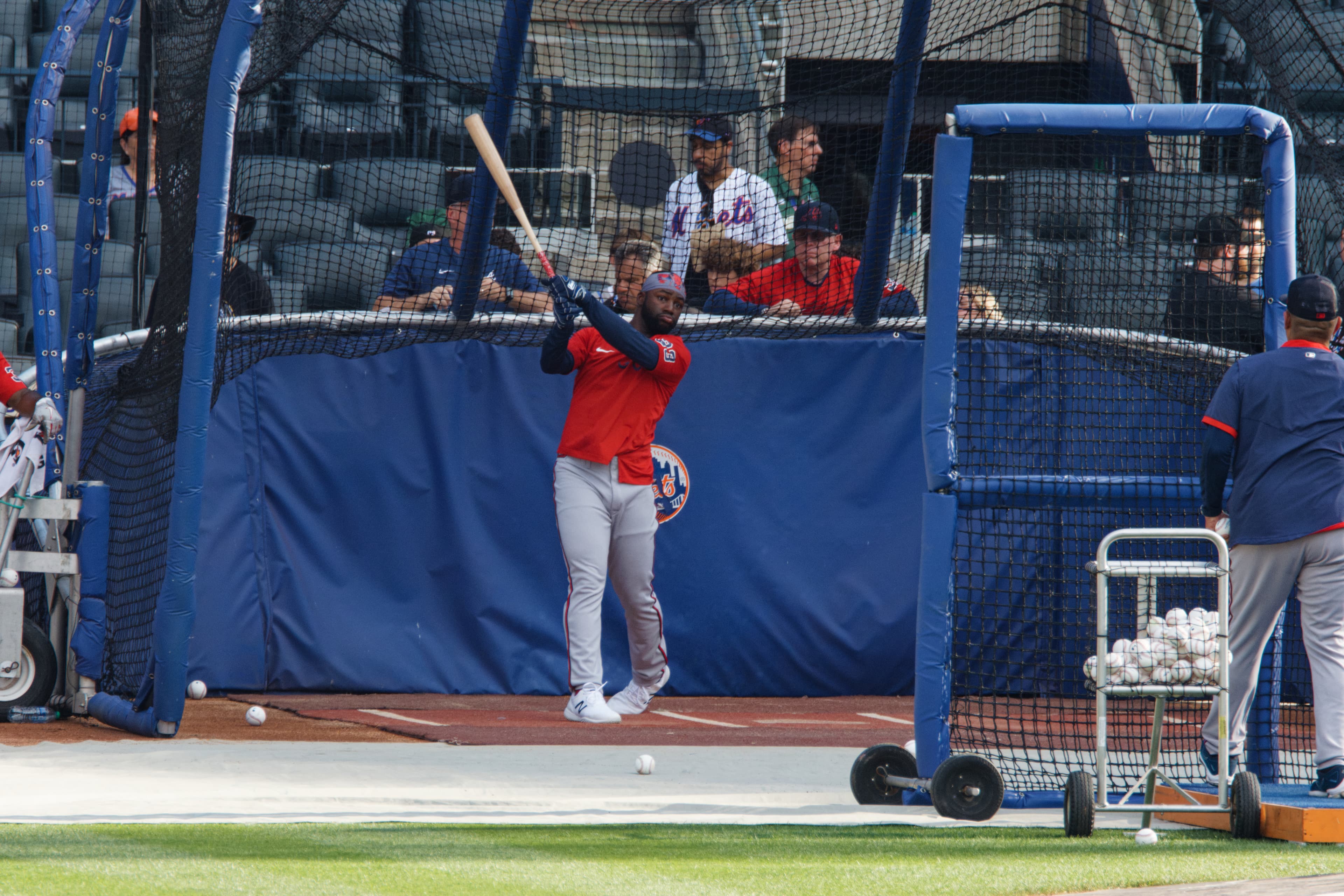
 Photo by D. Benjamin Miller, CC0, via Wikimedia Commons
Six Runs Down, Nine Digits on the Linescore, and a Debut Win for the Kid
The linescore read 000 100 142. Not an explosion. Not a single swing that rewrote the evening. It was an escalation — six different hitters, across three innings, each one widening a crack that Colorado's bullpen could not seal.
The linescore is a sentence. Most people read only the final score — the period at the end — and move on. But linescores have grammar. They have rhythm. They have a narrative structure that box scores, for all their utility, cannot replicate.
Here is the sentence the Braves wrote at Coors Field on Thursday night:
ATL: 0-0-0-1-0-0-1-4-2.
COL: 5-1-0-0-0-0-0-0-0.
Nine digits on each side. Colorado's story ends after the second inning and never resumes. Atlanta's does not begin until the fourth, and does not become interesting until the seventh. The final score was 8-6. The Braves' 12th comeback victory of 2026 — and the largest deficit they have erased this season — was not a single dramatic moment. It was an escalation.
Grant Holmes gave up five runs in the first inning. Mickey Moniak added a solo home run in the second to make it 6-0. In most accounts of this game, Holmes's night will be summarized in a parenthetical: Holmes struggled early. This is accurate and insufficient.
Holmes's final line: 5.0 innings, 7 hits, 6 runs, 5 earned, 3 walks, 4 strikeouts. It is an ugly line. It is also, in a way nobody will celebrate, the line that made the comeback possible.
Consider the alternative. Holmes exits after three innings, having absorbed his damage. The bullpen inherits a 6-0 deficit in the fourth inning and needs to cover six innings. Anthony Molina, Didier Fuentes, and Robert Suarez — the three arms who ultimately held Colorado scoreless over the final four frames — would have needed to stretch across six. Fresh arms become tired arms. Available relievers become unavailable ones. The margin for the offense to rally disappears because the bullpen has no margin left to hold.
Instead, Holmes stayed. He threw three scoreless innings after the disaster — third through fifth, seven batters faced, two hits, no runs. Nobody will build a monument to those innings. They were, statistically speaking, unremarkable. But they were the structural prerequisite for everything that followed. A pitcher who accepts a terrible first inning and still gives his team five total innings has done something that does not appear in any highlight package: he has preserved the bullpen's capacity to finish the game.
Matt Olson's solo home run in the fourth — his tenth of the season — cut the deficit to 6-1. In the mathematics of a six-run deficit, a solo shot is almost meaningless. It changes the probability of winning by a fraction of a percentage point. But baseball is played by humans who do not think in probability distributions, and the difference between 6-0 and 6-1 is the difference between silence and a signal. Someone has scored. The shutout is gone. The conversation has shifted from whether to when.
A run in the seventh. Nobody will remember who scored or how. The deficit was 6-2. Still theoretical.
Then the eighth inning.
The Rockies handed the game to Zach Agnos in the seventh with a 6-1 lead and a fresh bullpen. By the time the eighth inning was over, three Colorado relievers had combined to allow seven runs across three innings, and José Quintana's six innings of one-run baseball had been erased from the result.
The structural turning point was not Michael Harris II's home run. It was Mauricio Dubón's bases-loaded triple into the right-field corner in the eighth inning — three runs scoring, the deficit collapsing from 6-2 to 6-5 in the time it takes a ball to reach the wall. A sacrifice fly later in the inning scored Dubón himself. Six-all.
Dubón's season line will not make anyone's All-Star ballot. He is hitting in the .339-to-.351 range depending on when you check, with a modest 87.2 miles per hour average exit velocity and a 7 percent barrel rate. The advanced metrics — a .329 wOBA against a .301 expected wOBA — suggest the batting average will come down. The contact quality is modest even as the results have been excellent. I have been noting Dubón as a quiet engine since March 30, when he went 3-for-4 with 3 RBI against Oakland. Thursday night was not quiet. A bases-loaded triple at Coors Field is the loudest thing a quiet engine can produce.
But the honest read on Dubón remains what it was in March: the moments are real, and the underlying numbers say the moments will become less frequent. That is not a criticism. It is context, and context is what separates observation from argument.
The ninth inning. Juan Mejia, Colorado's reliever, walked Jonah Heim to start the frame. One batter later, Michael Harris II — pinch-hitting, not in the original starting lineup — drove a two-run home run to right field. His seventh of the season. Final score: 8-6.
Harris entered the game hitting .324 with a .926 OPS through 31 games. His Statcast profile — 94.9 miles per hour average exit velocity, 56.5 percent hard-hit rate, 18.8 percent barrel rate, .401 wOBA — confirms what the traditional numbers suggest: this is elite-level hitting, and the sample is now approaching a quarter of a season. I took the position on April 23 that Harris's power surge was arrival, not streak. Thirty-one games later, there is no evidence to contradict that.
The pinch-hit context deserves acknowledgment without overstatement. Harris pinch-hit a go-ahead double against Philadelphia on April 25 — a game I covered at length. That he has now delivered twice as a pinch-hitter in high-leverage spots is notable. That I should not build a thesis around two data points is also notable. The pattern is interesting. The sample is a sample.
I wrote yesterday that the Braves' bullpen was the team's first genuine vulnerability — that the 0.86 collective ERA masked fragility in the middle innings, that Iglesias's shoulder and López's broken slider had exposed a tier of relievers who had not yet proven themselves. I stand by the structural argument. The bullpen is unfinished.
But last night, the unfinished bullpen held Colorado scoreless for the final four innings while the offense completed the largest rally of the season. Molina threw two innings without allowing a hit. Fuentes — twenty years old, the Braves' number-three prospect, making his case one appearance at a time — threw a clean inning to earn his first career MLB win. Robert Suarez, thirty-five years old, filling in for Iglesias, worked a scoreless ninth for save number four, lowering his season ERA to 1.04.
The counternarrative I raised yesterday survived exactly twenty-four hours before the evidence complicated it. That is not a rebuttal. The middle-inning questions remain. But the specifics of Thursday night — Molina's zeroes, Fuentes's composure, Suarez's efficiency — are data points that the honest notebook must record alongside the concerns.
A fifteen-year age gap between the winning pitcher and the closer. Fuentes at twenty. Suarez at thirty-five. The same job, separated by a generation. There is something in that gap that resembles a blueprint, though I am wary of calling it one until the sample grows.
The Braves are 23-10. Seven games clear of Miami in the NL East. Best record in baseball. The linescore at Coors Field — those nine digits on each side — told a story that the final score compresses into irrelevance. Colorado's story was a first-inning burst that peaked immediately and decayed to nothing. Atlanta's was a slow accumulation: a solo shot that meant almost nothing, a run nobody will recall, a triple that changed the math, and a home run from a man who was not supposed to play.
The comeback was not a single act of heroism. It was a sequence — each contribution insufficient on its own, each one necessary for the next. Holmes absorbed the damage. Olson kept the scoreboard moving. Dubón broke the game open. Harris finished it. The bullpen held.
That is not a miracle. That is a roster.
The Tilt
The Braves' 12th comeback victory of 2026 was not a miracle. It was arithmetic — and the hidden variable was a starter who absorbed a disaster and gave his bullpen four fresh innings to close the deal.
— Ellis Magnolia
What's your take?
Keep Reading
October Has Two Off Days
I wrote yesterday that October asks a club who its best three starters are. The published 2026 calendar says the number is four, and Atlanta are carrying six arms with 17 games left to sort them.
Lopez Is Not Tonight's Problem
Everybody is about to tell you the Braves are gambling on an arm that has not pitched since July. The pitch count says otherwise, and it points at something worse.
_15.jpg&w=3840&q=75)
Somebody Has to Take the Turn
Atlanta went to a six-man rotation to keep five arms fresh for October. On the first night of nine straight games, the sixth man got ten outs, the staff gave up four home runs, and the bullpen covered the rest.