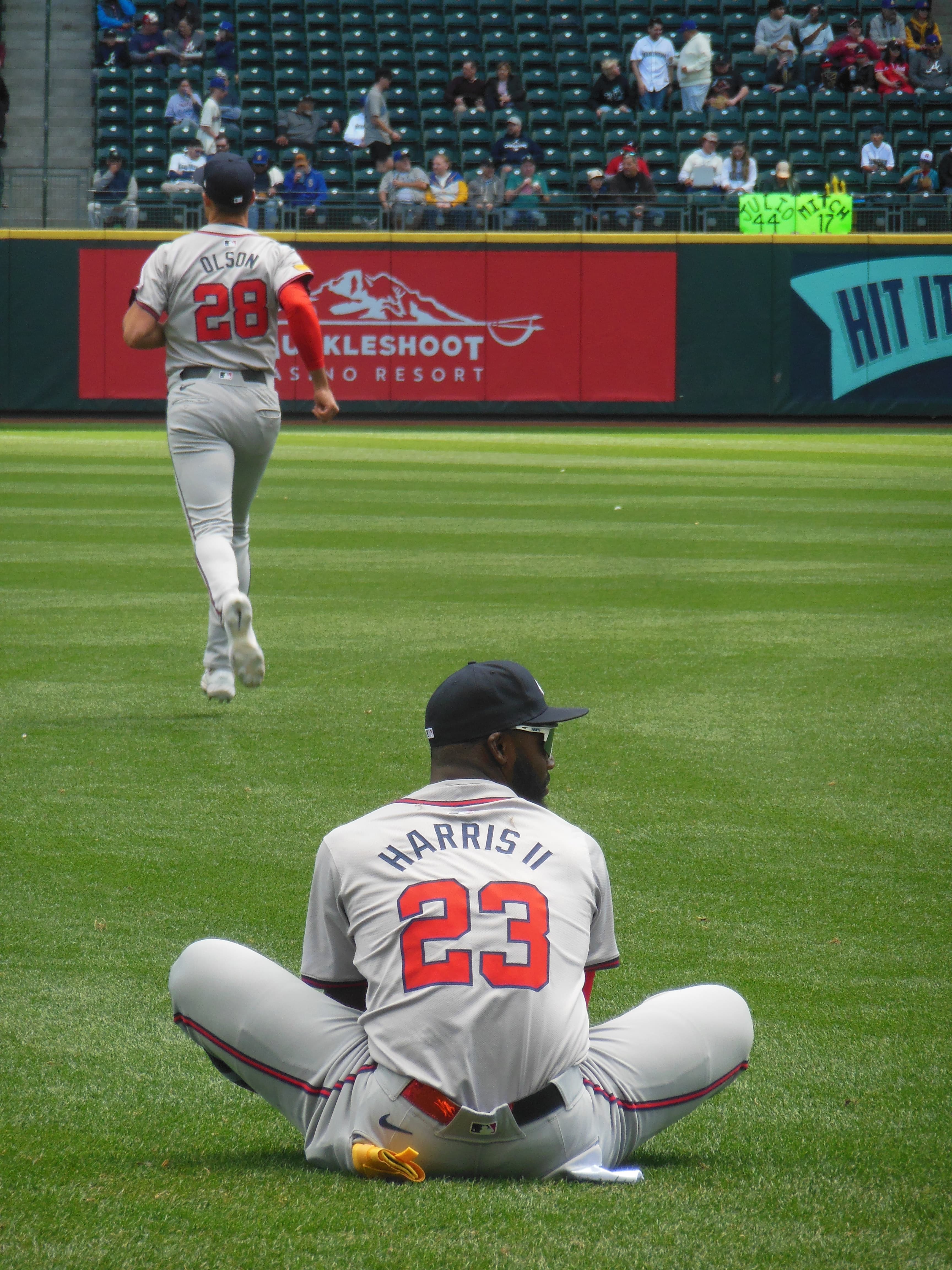
 Photo by Jsayre64, CC BY-SA 4.0, via Wikimedia Commons
Sixteen Runs in Three Days and the Series Record That Won't Break
The last time the Atlanta Braves swept a three-game series at Citizens Bank Park was September 2016. A decade is a long time to wait for something that, when it arrived, felt less like an event than a confirmation.
The last time the Atlanta Braves swept a three-game series at Citizens Bank Park was September 2016. A decade is a long time to wait for something that, when it arrived, felt less like an event than a confirmation.
Sixteen runs scored. Three allowed. A 9-0 shutout, a 3-1 pitching clinic, a 4-2 comeback on Sunday Night Baseball. The Braves left Philadelphia with a sweep, a 15-7 record, a five-game winning streak, and a series ledger that now reads 6-0-1 — the only team in Major League Baseball that has not lost a series this season. That last number is the one worth holding onto. Individual games are noisy. Series outcomes are signal.
The final game was the hardest, which is how sweeps tend to work. Kyle Schwarber hit a two-run home run off Grant Holmes in the first inning, and for a moment Citizens Bank Park remembered what optimism felt like. The Phillies led 2-0. The crowd had volume. Then the Braves did what they have done all month: they absorbed the early damage and found a different way through.
Michael Harris II started the correction. His solo home run off Andrew Painter in the third inning — a pulled shot that left the bat with authority and the deficit with a crack — cut the lead to 2-1. Harris went 3-for-3 with a walk on Sunday. He reached base in all four plate appearances. He did not make an out. His season line through 20 games now reads .290/.338/.478 with four home runs and nine RBI, and the numbers are converging on a sentence the Braves have been reluctant to say out loud: Harris is becoming the lineup's most reliable hitter.
The decisive inning was the fifth. Painter was still on the mound, and the Braves loaded the order against him like a calm, methodical argument. Matt Olson grounded out to score a run — the sort of productive out that never trends on social media and always shows up in the win column. Austin Riley followed with an infield single that brought home another. Then Ozzie Albies doubled off the left-field wall to make it 4-2, and Tim Mayza inherited a game that had already been decided by an inning that generated three runs on small, sequential pressure.
Painter took the loss, his line reading 4 innings, 5 hits, 3 earned runs, a 4.42 ERA. He was the third different Phillies starter the Braves faced in three days, and none of them lasted beyond the sixth inning. Taijuan Walker managed zero runs allowed to him by the Braves' nine-run barrage in Game 1. Cristopher Sanchez threw six innings of zero earned runs in Game 2 and still lost to Sale's precision. Painter never found his footing in Game 3. Three starters, three mechanisms of defeat.
What followed Holmes's exit in the fifth told the deeper story. Five Braves relievers — Aaron Bummer, Tyler Kinley, Dylan Lee, Robert Suarez, and Raisel Iglesias — combined for 4.1 innings without allowing a run. That is not one arm carrying the burden. That is a chain, each link holding its weight. Kinley earned the win, improving to 3-0 with a 1.00 ERA. Iglesias earned his fifth save while maintaining a 0.00 ERA — a number that is both unsustainable and, at this point, irrelevant to question. He will give up a run eventually. He has not given up a run yet.
The ninth inning had theater. Iglesias allowed a double and a walk, putting the tying run at second base with Trea Turner at the plate. He struck Turner out. Then Schwarber lined a ball into right field that looked, for half a breath, like redemption. Ronald Acuna Jr. tracked it down. Schwarber slammed his helmet. The sweep was complete.
The Phillies are 8-13. Their 21-game start is tied for the franchise's worst since 2000. They carry the fifth-highest payroll in baseball at $317 million and the worst run differential at minus-38. Alec Bohm is hitting .139. Their closer, Jhoan Duran, went on the 15-day injured list with an oblique strain on April 15. J.T. Realmuto sat out Sunday with lower back tightness after jamming his back reaching for a throw in Game 1. These are not April inconveniences. These are structural fractures appearing under load.
And across the field, the team that beat them is doing this with Spencer Strider, Spencer Schwellenbach, and Hurston Waldrep on the injured list. Three-fifths of the projected rotation, unavailable, and the Braves are 15-7 and five games clear of everyone in the division.
I wrote on April 15 that the rotation depth was no longer a survival story — it was a structural advantage. The Phillies sweep is the strongest evidence yet. Holmes pitched 4.2 innings and handed off to a bullpen that finished without allowing a baserunner to score. Martin Perez shut them out in Game 1. Sale dominated Game 2. Three different starting pitchers, none of them named Strider, all of them sufficient. The bridge is not just holding. It is taking traffic.
Strider himself threw 3.1 innings in a rehab start for Rome on April 17 — 50 pitches, 3 strikeouts, 1 hit allowed. His own assessment: "Outcomes are irrelevant. It's really just try to throw strikes, get deep in the game and build up the stamina." An early-May return is no longer projection. It is calendar. And when he arrives, he joins a rotation that does not need saving.
That is the sentence the NL East should be reading twice.
The Braves open a series in Washington tonight at 6:45. Bryce Elder — whose 0.77 ERA ranks second in Major League Baseball — faces Jake Irvin and his 6.16 ERA. Last year's team started 0-7 and spent the entire summer trying to recover the ground it lost in the first week. This year's team is 15-7, has won nine of its last eleven, and has not lost a series through the first three weeks of the season.
April is still a small sample. But the sample keeps saying the same thing, in different voices, on different nights, with different arms on the mound. At some point you stop qualifying the evidence and start listening to it.
The Braves swept Philadelphia for the first time in a decade. The interesting part is that it barely felt surprising.
The Tilt
6-0-1 in series with three-fifths of the rotation injured is not a streak. It's structural.
— Ellis Magnolia
What's your take?
Keep Reading

October Has Two Off Days
I wrote yesterday that October asks a club who its best three starters are. The published 2026 calendar says the number is four, and Atlanta are carrying six arms with 17 games left to sort them.
Lopez Is Not Tonight's Problem
Everybody is about to tell you the Braves are gambling on an arm that has not pitched since July. The pitch count says otherwise, and it points at something worse.
_15.jpg&w=3840&q=75)
Somebody Has to Take the Turn
Atlanta went to a six-man rotation to keep five arms fresh for October. On the first night of nine straight games, the sixth man got ten outs, the staff gave up four home runs, and the bullpen covered the rest.