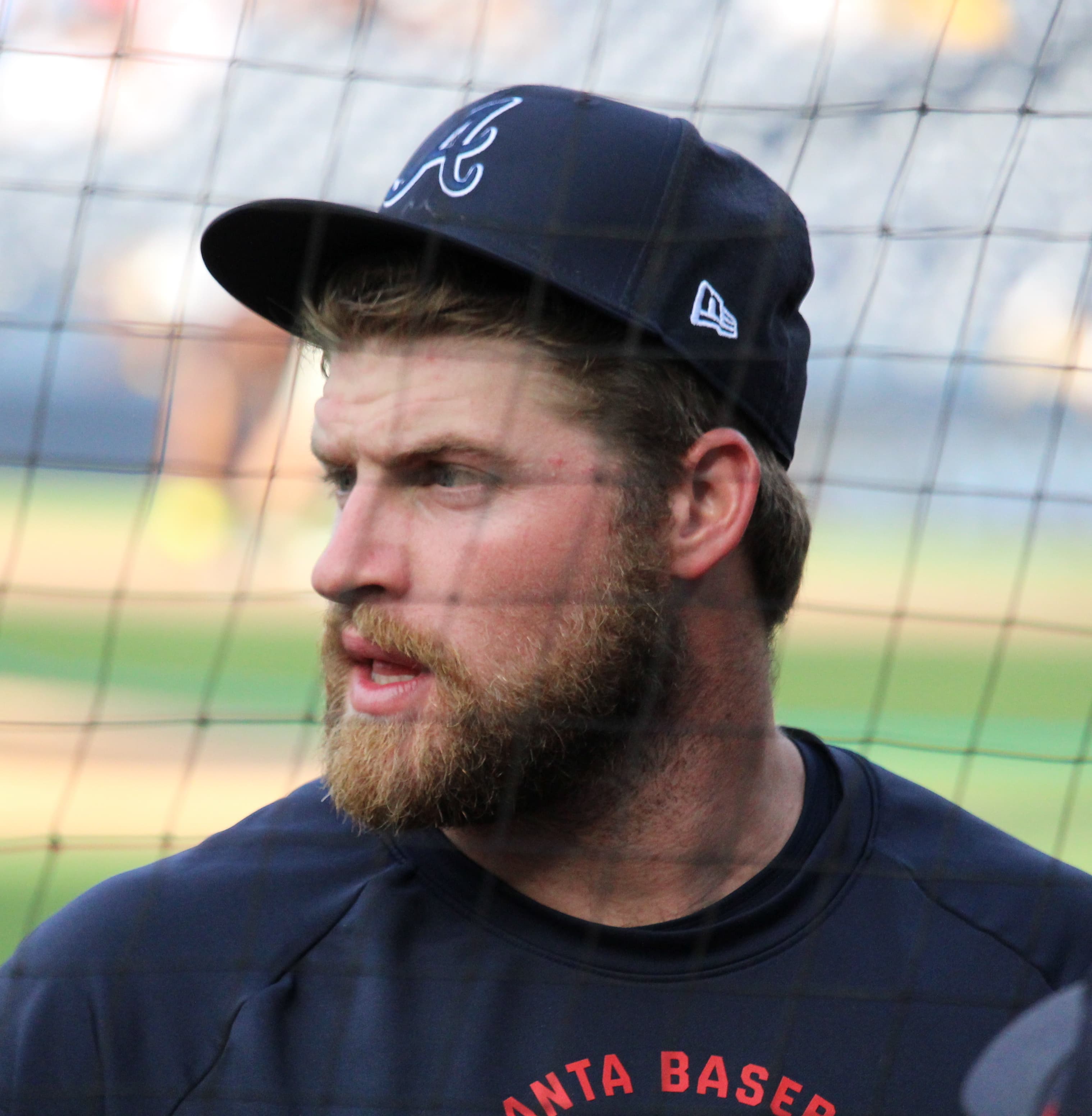
 Photo by Jsayre64, CC BY-SA 4.0, via Wikimedia Commons
Strikeout 2,608 and the Inheritance Sale Never Asked For
Chris Sale struck out Felix Reyes in the seventh inning Saturday at Citizens Bank Park and passed Tom Glavine on the all-time strikeout list. He did not know it at the time. That is the most Chris Sale detail of the 2026 season.
Chris Sale struck out Felix Reyes in the seventh inning Saturday at Citizens Bank Park and passed Tom Glavine on the all-time strikeout list. He did not know it at the time. That is the most Chris Sale detail of the 2026 season.
Strikeout number 2,608 — one past Glavine's 2,607, good for 29th all-time, eighth among left-handers — arrived on the same evening that Reyes, a 23-year-old in his first major-league game, had hit a solo home run off Sale in the second inning. A 348-foot opposite-field shot on a 94 mph fastball. The sixth Phillie in franchise history to homer in his first career at-bat. Sale gave up a memory, then spent the next five innings erasing everything else. He retired 13 of his final 14 batters. His line — seven innings, five hits, one earned run, seven strikeouts — was not the kind of performance that generates headlines. It was the kind that generates wins. The Braves beat the Phillies 3-1, and if you only saw the score, you knew enough. If you saw the pitching lines, you knew more than enough.
Because on the other mound, Cristopher Sanchez threw six innings of zero earned runs and lost.
Eight strikeouts. One walk. A 1.59 ERA that dropped no further because the earned-run column remained at zero and the loss column did not. Sanchez — the 2024 NL Cy Young runner-up, the best young left-hander in a city that has produced a few — was functionally better than Sale on Saturday night. The numbers say so. FIP would agree. And none of it mattered, because in the bottom of the third inning, Edmundo Sosa fielded an Ozzie Albies grounder at second base and threw it into a parallel universe.
The error loaded the bases with two outs. What followed was the kind of rally that makes sabermetricians twitch: Drake Baldwin singled to start it, which was earned. Everything after that was architecture built on sand. Matt Olson walked. Austin Riley hit a dribbler in front of the mound that Sanchez slipped trying to field — Baldwin scored, tie game. Then Mauricio Dubon dropped a bloop into center field, two runs crossed, and the Braves had a 3-1 lead on three runs, none of them earned, two of the hits registering exit velocities under 70 miles per hour.
Seventy miles per hour. That is the speed at which you drive past Citizens Bank Park on I-95, not the speed at which you beat one of baseball's best pitchers.
Sale made it hold. He went back out for the fourth and the fifth and the sixth and the seventh. He struck out Bryce Harper twice, including an 11-pitch at-bat in the third that ended with Harper swinging through a 96.2 mph fastball — the kind of sequence that does not appear in box scores and defines entire starts. After the Reyes homer in the second, Sale's final five innings looked like a man who had remembered something about himself and saw no reason to share it with the opposing lineup.
Then Dylan Lee threw a 1-2-3 eighth. Albies made a diving play. Robert Suarez — the closer the Braves signed to a three-year, $45 million deal in December, the one whose 1.04 ERA through seven appearances suggests the investment is paying interest already — struck out two in a 1-2-3 ninth. Three pitchers, nine innings, one earned run. The game lasted two hours and 43 minutes. Brevity as a statement.
I wrote two days ago that the Braves' rotation depth was not a hot streak but something structural, and that Thursday night's series opener in Philadelphia would be the test. The test came: a 9-0 shutout, Riley's power breakout, Perez's shutout innings. Now Saturday has added a second answer in a different register. Thursday was volume. Saturday was precision. The same opponent, the same ballpark, two completely different mechanisms of dominance.
The Braves are 14-7 and 5-0-1 in completed series — the only team in Major League Baseball that has not lost a series this season. The Phillies are 8-12, 5.5 games back, losers of seven of their last nine, with closer Jhoan Duran now on the injured list and J.T. Realmuto leaving Saturday's game with lower back tightness. There is a version of April where a 5.5-game lead is a suggestion. This does not feel like that version.
And the part that should unsettle the rest of the division is not what the Braves have. It is what they are about to get back. On Thursday — the same night Riley was hitting home runs in this ballpark — Spencer Strider threw 3.1 scoreless innings for Rome in his first rehab start. Three strikeouts. Fifty pitches. The early-May return that Walt Weiss has been hedging toward is no longer a projection. It is a timeline.
Sale's 2.79 ERA through five starts is elite. But the question that should keep the Phillies and the Mets and the rest of the NL East awake is not what Sale is doing. It is what happens when Sale is doing this and Strider slides back into a rotation that already features Lopez at 2.18, Elder at 0.77, and Holmes at 3.32. Four of those five starters would be the best pitcher on most National League teams. The Braves might end up with all five.
That is not a hot streak. Hot streaks cool. This is a rotation being assembled one returning arm at a time, behind a 37-year-old left-hander who just passed a Braves legend on a list he did not know he was climbing.
Glavine won 305 games in this sport and struck out 2,607 men doing it. Sale now has 2,608 and a franchise that is handing him something Glavine never quite had in Atlanta: a supporting cast so deep that even a night where the offense scores on dribblers and bloops and an error, the pitching makes it enough.
Tonight Holmes faces Andrew Painter at 7:20 on Peacock. A sweep is on the table. The Braves have not lost a series in 2026. At some point, that sentence will stop being a novelty and start being a thesis.
The evidence suggests that point is now.
The Tilt
Sale is not having a great start to the season. He is having the kind of season that looks inevitable in retrospect, and the Braves are building something behind him that makes the retrospect terrifying for the rest of the NL East.
— Ellis Magnolia
What's your take?
Keep Reading
October Has Two Off Days
I wrote yesterday that October asks a club who its best three starters are. The published 2026 calendar says the number is four, and Atlanta are carrying six arms with 17 games left to sort them.
Lopez Is Not Tonight's Problem
Everybody is about to tell you the Braves are gambling on an arm that has not pitched since July. The pitch count says otherwise, and it points at something worse.
_15.jpg&w=3840&q=75)
Somebody Has to Take the Turn
Atlanta went to a six-man rotation to keep five arms fresh for October. On the first night of nine straight games, the sixth man got ten outs, the staff gave up four home runs, and the bullpen covered the rest.