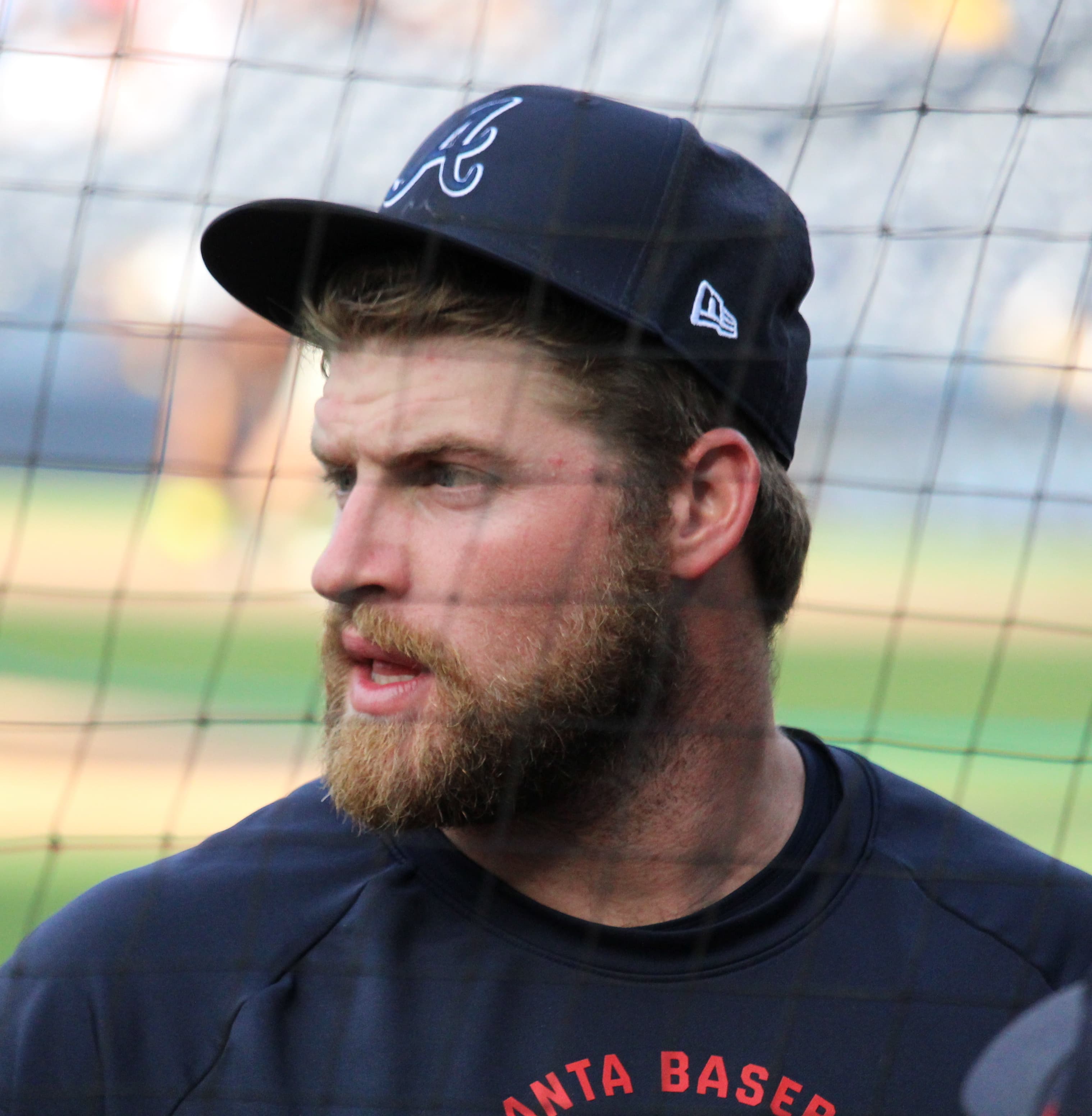
 Photo by D. Benjamin Miller, CC0, via Wikimedia Commons
Two Linescores, Two Fingerprints, One Catcher Who Outproduced Everyone
A linescore is a fingerprint. Thursday's read 0-0-0-1-0-0-1-4-2 — a comeback built through patient accumulation. Saturday's read 2-1-0-3-2-0-0 — a declaration that ended the argument before the fourth inning. Same city, same opponent, same final run total: eight. The rhythm was inverted. The catcher was the difference nobody expected.
A linescore is a fingerprint. No two are identical, and each one contains a story that the final score flattens into irrelevance.
Here are the fingerprints from two nights in Denver:
Thursday: ATL 0-0-0-1-0-0-1-4-2. COL 5-1-0-0-0-0-0-0-0. Saturday: ATL 2-1-0-3-2-0-0. COL 0-0-1-0-0-0-0.
Same opponent. Same ballpark. Same final total for the Braves: eight runs. But the rhythm is inverted. Thursday's line began in silence and ended in a crescendo — a six-run deficit erased through patient accumulation across three late innings. Saturday's line announced itself in the first chapter and never retreated. Thursday was resilience. Saturday was inevitability.
The difference was Chris Sale.
Sale's six innings at Coors Field produced two hits, one earned run, three walks, and eight strikeouts. His ERA settled at 2.20. The pitch count — eighty-six pitches, fifty-eight for strikes — was efficient enough that Brian Snitker could have sent him back for the seventh, but there was no structural reason to test a seven-run lead against a thirty-seven-year-old arm. The decision to pull Sale after six was not caution. It was arithmetic: the equation was solved.
What separates this start from a routine quality outing is altitude. Coors Field is where earned run averages go to die. The thin air inflates fly balls, stretches doubles into triples, and turns mistakes into souvenirs. A pitcher who holds a lineup to two hits and one earned run at five thousand feet above sea level has done something that the same line in Atlanta would not convey. Sale's eight strikeouts — against a Colorado lineup that entered the night hitting .248 as a team — were not the product of overwhelming velocity. They were sequencing. Changeups on the outer third after fastballs inside. Sliders that started in the zone and finished outside it. The craft of a pitcher who has thrown more than two thousand career innings and has decided that 2026 is the year the arm cooperates fully.
This is Sale's seventh start. Forty-plus innings. A 2.20 ERA. The velocity concerns from his early April starts — residue from an offseason illness that suppressed his fastball below baseline — have been overwritten by seven consecutive appearances of evidence. The narrative around the Braves' rotation has been structural depth: Ritchie's debut, Elder's 1.95 ERA, López's transition from rotation to bullpen. Sale's name gets lost in the depth conversation because he has been so consistently excellent that his performance has become background noise. That is a compliment, not a criticism.
Drake Baldwin went three-for-three with a home run and four RBIs.
That sentence deserves its own paragraph because the catcher position in modern baseball is not supposed to produce four-RBI games. The catcher is the workhorse, the defensive anchor, the man who squats for nine innings and whose offensive contribution is graded on a curve. A catcher who goes three-for-three is an anomaly. A catcher who goes three-for-three while catching Chris Sale's dominant start is doing two jobs simultaneously and excelling at both.
Baldwin's home run came in the first inning — a two-run shot that gave Sale a lead before he had thrown his fifteenth pitch. He added an RBI single in the fourth. By the time the fifth inning ended, Baldwin had driven in four runs from the bottom third of the order, more than any other Brave in the lineup.
I wrote about Baldwin on April 2, when his early numbers suggested a player with elite contact skills operating at a position that rarely produces elite offense. His Rookie of the Year campaign in 2025 — .274 with nineteen home runs — established the baseline. Tonight was not a new revelation. It was confirmation at a higher volume: the catcher can carry the offense on a night when the lineup's biggest contracts do not need to.
Baldwin is now hitting .283 with eight home runs. The number that matters more is the one that does not appear in the box score: he caught a pitcher who struck out eight and allowed two hits. The dual contribution — bat and glove in the same game, both excellent — is the kind of performance that sabermetricians have been trying to quantify for years. Catcher WAR attempts it. The box score does not.
Austin Riley hit a home run in the fifth inning that traveled four hundred and thirty-eight feet.
Four-three-eight. At Coors Field, where the air is thin and balls carry, the distance is less remarkable than it would be at sea level. But Riley missed the first month of 2025 after core muscle surgery. The idea that a player recovering from that procedure could generate the exit velocity required to hit a baseball four hundred and thirty-eight feet is reassurance that arrives in the form of a Statcast measurement rather than a press conference. The body is fine. The bat speed is present. The core — the literal core, the muscles that were surgically repaired — is producing.
Riley finished one-for-two with two RBIs and a walk. His season line continues its quiet recovery: the April slump that produced a .236 average through the first three weeks has given way to a stretch of productive at-bats. The 438-foot home run is the data point that will appear in the highlight package. The walk — taking a ball four with the count full, trusting the zone — is the data point that suggests the approach is sound.
The Braves scored eight runs on Thursday and eight runs on Saturday. The linescores tell completely different stories about the same conclusion: this is a team that produces runs in multiple modes. Thursday required patience, a starter who absorbed damage, a mid-game rally that escalated through six different hitters across three innings. Saturday required none of that. Sale set the tone. Baldwin provided the early offense. Riley added the exclamation in the fifth. The bullpen inherited a seven-run lead and had the simplest assignment of the season.
Two fingerprints. Two rhythms. Same verdict.
The Braves are 24-10. Best record in baseball. Seven-plus games clear in the NL East. The two nights at Coors revealed what the standings already suggest: this team does not have one way to win. It has several. Thursday's version needed resilience. Saturday's version needed only competence.
Saturday's version got excellence.
The Tilt
Drake Baldwin's three-for-three night behind the plate catching Chris Sale was the most quietly dominant performance of the Braves' season.
— Ellis Magnolia
What's your take?
Keep Reading
October Has Two Off Days
I wrote yesterday that October asks a club who its best three starters are. The published 2026 calendar says the number is four, and Atlanta are carrying six arms with 17 games left to sort them.
Lopez Is Not Tonight's Problem
Everybody is about to tell you the Braves are gambling on an arm that has not pitched since July. The pitch count says otherwise, and it points at something worse.
_15.jpg&w=3840&q=75)
Somebody Has to Take the Turn
Atlanta went to a six-man rotation to keep five arms fresh for October. On the first night of nine straight games, the sixth man got ten outs, the staff gave up four home runs, and the bullpen covered the rest.