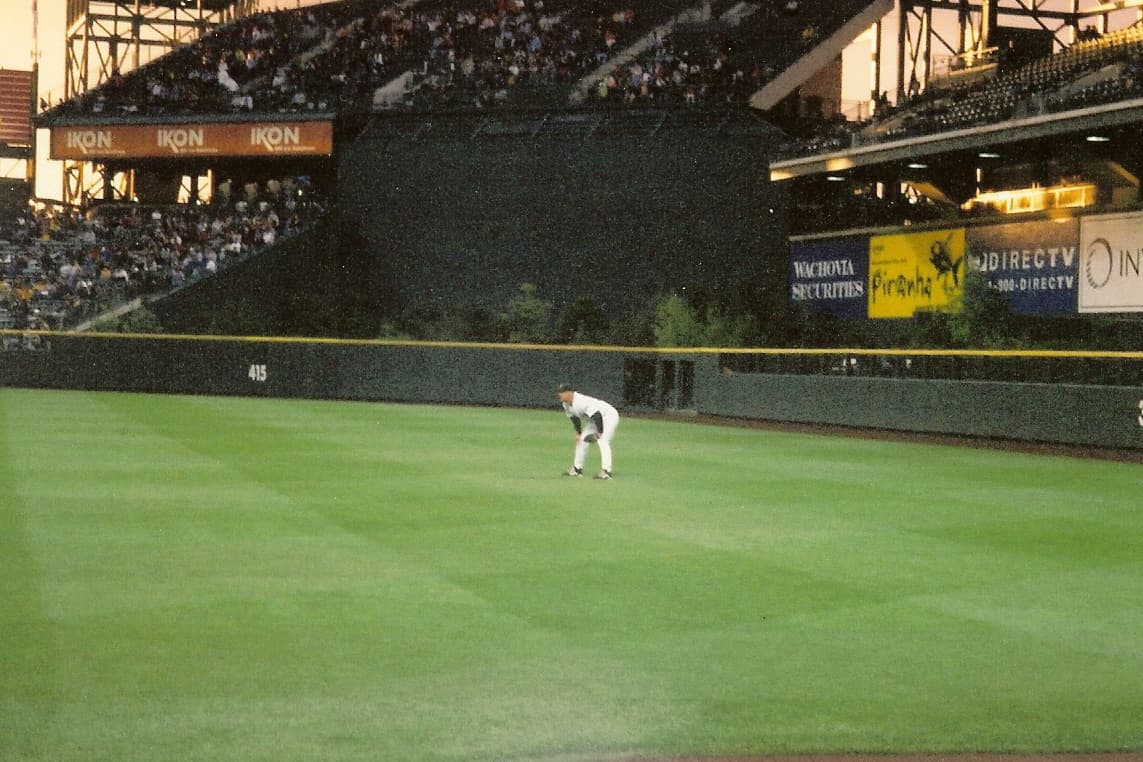
 Photo by Ken Lund, CC BY-SA 2.0, via Wikimedia Commons
Seventeen Inches of Vertical Break and a Rotation That Didn't Need Him
In 2023, Spencer Strider's fastball generated 18.4 inches of induced vertical break — one of the highest marks in baseball, the invisible architecture behind 281 strikeouts and a franchise record. In his final rehab start six days ago at Triple-A Gwinnett, the number was 17. The gap is 1.4 inches. The implication is considerably larger.
In 2023, Spencer Strider's fastball generated 18.4 inches of induced vertical break — one of the highest marks in baseball, the invisible architecture behind 281 strikeouts and a franchise record that had belonged to John Smoltz. In his final rehab start six days ago at Triple-A Gwinnett, the number was 17. The gap is 1.4 inches. The implication is considerably larger.
Strider makes his 2026 season debut today at Coors Field. The activation from the 15-day injured list ends a journey that began on March 17 with a left oblique strain during a Minor League spring training game and wound through three rehab starts — High-A Rome, then two at Gwinnett — across seventeen days of what amounted to an audition for a team that had already decided to win without him.
That is the detail worth sitting with. The 24-10 Braves — best record in baseball, seven and a half games clear of Miami in the NL East, first in runs scored, first in batting average, first in slugging — did not wait. They did not limp along and count the days. They played the first thirty-four games of 2026 as if their most talented arm was a theoretical concept, and they compiled the best record in the sport.
The rotation is the mechanism.
Chris Sale enters May at 6-1 with a 2.20 ERA — his seven-inning, eleven-strikeout performance Saturday night was the kind of outing that makes you reconsider what a thirty-seven-year-old arm is supposed to be capable of at altitude. Bryce Elder is 3-1 with a 1.95 ERA, his slider development under pitching coach Jeremy Hefner producing a weapon that did not exist twelve months ago. Grant Holmes has been a quiet structural contributor. The top four starters have combined for a 2.36 ERA.
I wrote on March 21 that the Braves would go exactly as far as Strider's arm takes them. The Health Bet thesis — the idea that this franchise's entire 2026 projection hinged on whether its most volatile physical asset could stay intact — was premised on a rotation that needed Strider to be competitive. That premise was wrong. The rotation did not need Strider to be competitive. It needed him to be extraordinary.
On April 29, I called the rotation a self-correcting system. Every time a door closed — Schwellenbach to the IL with elbow surgery, Waldrep the same, Reynaldo López demoted after his slider wOBA ballooned from .220 to .440 — someone opened another. Elder stepped up. Ritchie debuted with seven innings on eighty-nine pitches. Pérez threw scoreless frames on a minor-league contract. The system kept producing functional arms.
Strider is not a functional arm. Strider is the variable that changes the conversation from "best record in baseball" to something the rest of the National League would prefer not to think about.
Three rehab starts. High-A Rome on April 16: 3.1 innings, one hit, no earned runs, three strikeouts. A reintroduction. Then Gwinnett on April 21: 4.1 innings, no earned runs, eight strikeouts, fastball touching 98.1 mph with a 95.9 average. That was the start that changed the conversation from "when" to "how soon." The final start, six days ago: five innings, eighty-two pitches, seven strikeouts. Fastball maxing at 96.9, averaging 95.2.
The velocity is not the headline. The induced vertical break is.
IVB measures how much a fastball rises relative to a spinless pitch — the ride that makes hitters swing under four-seam fastballs, cutting through air two inches below the baseball. In 2022, Strider's IVB was 17.7 inches. In his All-Star 2023 season, 18.4. During the 2025 comeback — 7-14, a 4.45 ERA, the inconsistency of an arm finding its way back from internal brace surgery — the IVB fell, the ride flattened, and major league hitters adjusted downward.
At Gwinnett, the IVB was 17 inches. Not 2023. But closer to 2023 than anything the 2025 season produced. The oblique — a muscle injury, not an arm injury — may have been the reset that surgery could not provide.
Fifteen strikeouts in his final two rehab starts. Against minor league lineups, which invites the proper caveat. But the swing-and-miss rate, the ride, and the command of the full arsenal were structural indicators pointing in one direction.
The problem — and it is an honest one — is that Strider's season debut is happening at the worst possible address.
Coors Field sits at 5,280 feet above sea level. The thin air reduces pitch movement by approximately twenty percent. A fastball's vertical break — the very quality that defines Strider's arsenal — loses deception at altitude. The park factor is 1.38. Fly balls carry nine to ten percent farther. The seams grip less air. For a pitcher whose primary weapon is vertical fastball ride, the physics of altitude work against the very thing his rehab suggested was returning to form.
Walt Weiss acknowledged as much without saying it directly. "It's been a nice path back for him," the first-year manager offered this week. "Things can change as we've seen the first few weeks here, but that's the plan." The understatement is the message. No public expectations. No pitch count announced. Eighty-two pitches in his final rehab start suggests a relatively standard workload, but the leash will be shorter than the line score reveals.
If the IVB holds at altitude — if the fastball still rides through thin air and produces empty swings — then the rehabilitation is validated and the ceiling has not been reached. If the movement flattens and Colorado hitters make hard contact, the data point needs context, not alarm. One start at the most pitcher-hostile park in baseball is a stress test, not a verdict.
Here is the inventory of what will eventually return to this roster: Strider, today. Spencer Schwellenbach, recovering from bone spur removal, projected for a summer return. Hurston Waldrep, recovering from loose body removal, on a similar timeline. Sean Murphy, working his way back. Ha-Seong Kim, incoming.
The Braves built the best record in baseball without any of them.
That sentence should unsettle the rest of the league more than any individual comeback. A team whose rotation has a 2.36 ERA from its top four is about to start adding pieces. Not in July. Not through a waiver acquisition in August. Now.
On March 21, I predicted that if Strider sustained 95-plus velocity through his first month, his ERA would be under 3.50 by May 1. The oblique strain delayed the clock. The prediction remains open. But the rehab velocity — 95.2 average, 96.9 max, the 98.1 he touched on April 21 — says the arm remembers what it was. The 17 inches of vertical break says the ride is approaching what made hitters miss 281 times in a single season.
Baseball has a long memory, and this franchise's memory is longer than most. Strider has lived through an All-Star season, an internal brace procedure, a 7-14 comeback year, and an oblique strain that delayed his 2026 by six weeks. The Braves have lived through fourteen consecutive division titles and one ring, a 76-86 collapse in 2025, and now the best start in a generation.
Strider is not here to save this team. He is here to show them how high the ceiling goes.
The number was 17. In 2023, it was 18.4. The gap is closing. The season is not.
The Tilt
Spencer Strider returns today to a Braves rotation that posted a 2.36 combined ERA without him — he's not the rescue, he's the ceiling nobody has seen yet.
— Ellis Magnolia
What's your take?
Keep Reading
October Has Two Off Days
I wrote yesterday that October asks a club who its best three starters are. The published 2026 calendar says the number is four, and Atlanta are carrying six arms with 17 games left to sort them.
Lopez Is Not Tonight's Problem
Everybody is about to tell you the Braves are gambling on an arm that has not pitched since July. The pitch count says otherwise, and it points at something worse.
_15.jpg&w=3840&q=75)
Somebody Has to Take the Turn
Atlanta went to a six-man rotation to keep five arms fresh for October. On the first night of nine straight games, the sixth man got ten outs, the staff gave up four home runs, and the bullpen covered the rest.